




Are Markets Too Euphoric? Hardly
Crypto markets have had no shortage of massive sell-offs and bear markets, which in turn means we’ve also had no shortage of recoveries. Typically, a bounce from the lows happens quickly and catches many sidelined investors. Naturally, this raises questions about whether this is sustainable or just a bear market rally.
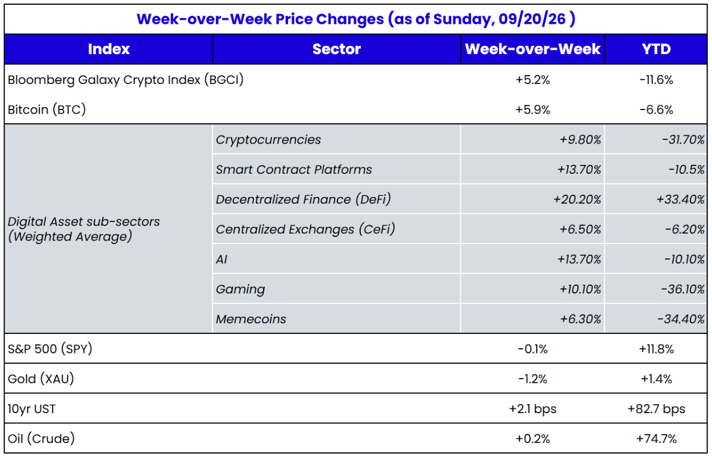
This past week we saw CLARITY fail in the Senate cloture vote, and the FOMC raised rates for the first time since July 2023. Even though both were expected outcomes (based on futures and Polymarket odds), it was still an uphill battle for digital assets to rally. But the SEC Innovation Exemption came out shortly thereafter (another expected outcome), and that was enough to stave off any negativity earlier in the week. So digital assets rallied again and continued their impressive relative performance throughout the 3rd quarter. This rally is especially interesting given equities have stalled, rates have climbed, and oil has breached $100. As a result, many are starting to call for a top to this crypto rally.
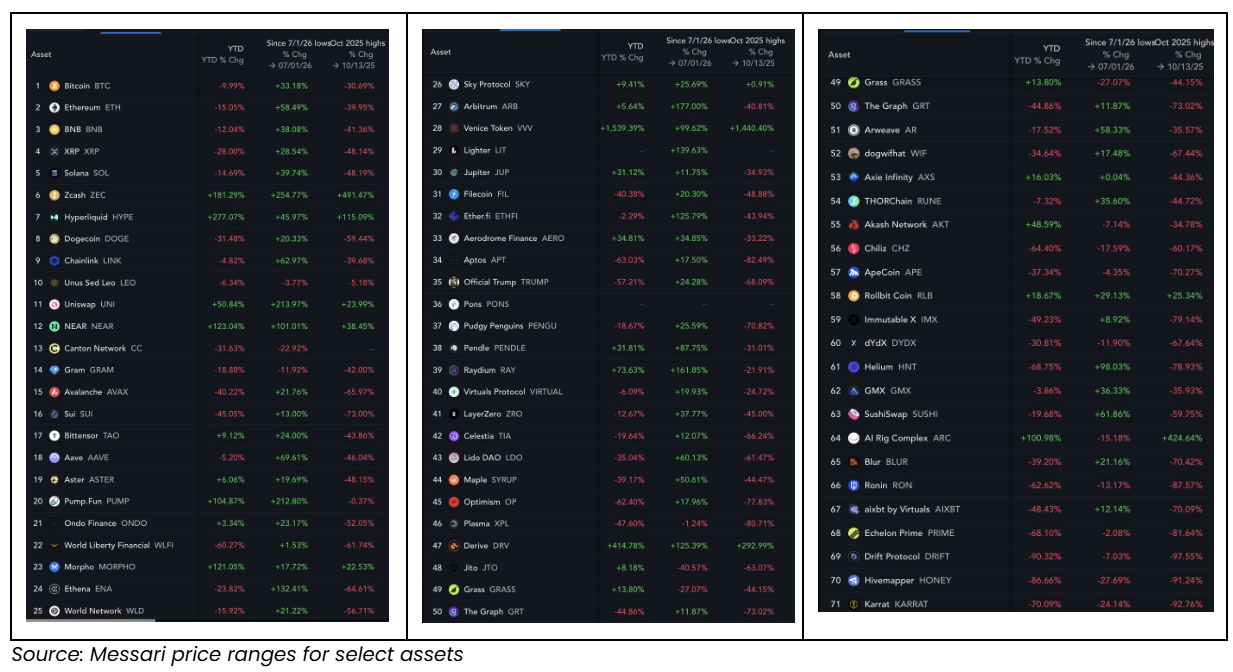
Here’s the problem with that. This was barely even a rally. Only a handful of crypto assets are meaningfully higher YTD (1st column), and they are the highest revenue-generating assets with the best tokenomics. The reality is that most assets are only up a modest amount since the stone-cold July 1st lows (2nd column). Looking further back to the Oct 2025 highs (3rd column), you can see that almost all assets are still down 30-70%. Crypto stocks look similar.
I’d hardly call this euphoric. Sure, the rally could pause and even reverse. But not because prices have gotten out of hand.
CLARITY's Post Mortem: We Were Answering the Wrong Questions
Guest Edition — Written by David Nage, Managing Director, Portfolio Manager
We've reached the end of years of work on CLARITY, and the job isn't done.
Three times this summer, I wrote about the bill in this space. In June, I told you we were 85% of the way to a law. In July, I told you to ignore the fake signed bills and count the Democrats. By late July, I noted that Arca estimated the odds closer to 10%, whereas the broader market was pricing them near 38%.
On Tuesday, the Senate settled it. The motion to proceed failed 49 to 50, falling short of the 60-vote threshold. Since then, my feed has been a blame game. Every camp has a villain, and each of them has a piece of the story. None of them has the whole thing.
My view is that CLARITY died of several causes at once, and one of them sits on our side of the table. As an industry, we spent a year answering questions the swing votes weren't asking. Before I make that case, I need to clear some rubble and grade our own homework.
First, What the Blame Game Gets Wrong
If you've been on Crypto Twitter since Tuesday, you've seen these takes.
"Warren killed it." She was a no from day one. The problem is who joined her. Every Democrat who spent months at the negotiating table voted no: Gillibrand, Warner, Booker, Warnock, Gallego, Alsobrooks, and Cortez Masto. When your own negotiators voted against the motion, the coalition never formed.
"It was close." No. Zero voting Democrats supported the motion, and four Republicans opposed it, which left the coalition 11 votes short of cloture. Eleven votes is a wide miss.
"It's dead forever." Also no. Tillis switched his vote to no so he could file a motion to reconsider, which lets leadership bring the question back without starting from zero. And GENIUS came back from a failed cloture vote within two weeks. A procedural path still needs votes, though, and I'll come back to that.
Grading Our Own Homework
June 15, "The CLARITY Act's Last Fight Isn't About Crypto." I said ethics was the wall. That was right. I said yield was noise, and that was wrong. Collins and Moran opposed the bill, with community-bank pressure on stablecoin yield among the sticking points. I predicted the bill would clear the Senate in the low-to-mid 60s and become law before Labor Day. It got 49.
July 13, "CLARITY's Home Stretch." This one aged best. We said the real ask was closer to nine Democrats and that zero were committed. The final count was zero. We flagged federal preemption as unsettled, and 18 attorneys general turned it into a letter. We warned that SEC rulemaking gave fence-sitters a reason to skip the ethics fight. One miss: we treated agency staffing as a nominations dispute, and Slotkin cited CFTC capacity when she voted no.
July 27, "More Clarity on CLARITY." We said the fight had moved from the ethics rules to the enforcer. That was right as far as it went. The final text added a role for state AGs, and Democrats still rejected the ethics section because it did not apply effectively to the president and the First Family. Our Republican count was off, too. We named Hawley and Paul as likely no votes, and the Republicans who voted no on the merits were Collins, Hawley, and Moran.
The biggest miss runs through all three pieces. Each one said the policy was basically finished and what remained was politics. In July, I described community banks, law enforcement, gaming interests, and Senate Democrats as four constituencies each pricing a veto. That framing treated their objections as leverage to buy off, when they were concerns we needed to answer. I'm putting that on the record before I say anything about anyone else.
Why It Died: More Than One Cause
The Part We Need to Own
Take the no votes at their word and write down what they said they needed. Cortez Masto cited illicit finance, presidential ethics, and prediction markets. Slotkin added CFTC staffing. The attorneys general wanted state police powers preserved. The community banks wanted their deposits protected.
Now write down what we, as an industry, asked for: yield for exchanges, developer protections, CFTC jurisdiction, and the argument that America will lose the next decade to Dubai and Zug. The two lists barely overlap.
I want to be fair to the trade associations. They got this industry into rooms it had never been in. They helped deliver GENIUS. They built relationships on the Hill that didn't exist a few years ago, and many of the people doing that work are friends. But associations carry their members' agenda, and the members, Arca included for years, handed them our list. We asked them to fight for yield, developer protections, and jurisdiction. We never asked them to lead on ethics, fraud, or state enforcement, because those weren't our problems. They were the voters' problems, and that turned out to be the only list that mattered.
The one concern that got a direct answer proves the point. Law enforcement resisted the developer protections for months. The unified text answered with a new Title IX of grants and training, and the Fraternal Order of Police, with more than 380,000 members, reversed its opposition and endorsed the bill. Answer the concern, and the vote moves. Nobody tried the same approach on ethics or preemption.
We've Been Here Before: Regulators First, Congress Later
Here's the good news, and it's why I don't think the story ends here. Financial markets have been in this position before. The regulators built the framework first, and Congress codified it into law afterward.
The pattern is consistent. The agencies go first, the market proves the model, and Congress codifies what works. It takes longer than any of us would like, which is why the job isn't done. It's also a path this industry has walked before.
Meanwhile, the SEC and CFTC Didn't Wait
Eight Years
Eight or so years ago, it was hard to picture senators, presidents, presidential candidates, mayors, regulators, and the CEOs of the largest asset managers in the world talking about digital assets. Here we are. We can't forget that.
What we have forgotten, as an industry, is how this technology helps everyday people. How does crypto help the farmer in Missouri? The school teacher in Minnesota? The medium-sized business that wants to take off and hire hundreds more? We need to answer those questions every day. When we do, policymakers can connect the dots to their own constituents.
It's worth noticing who represents those people. Missouri's Josh Hawley voted no. Both of Minnesota's senators are Democrats, and every Democrat voted no. These were the votes we needed, and these are the questions their voters would ask.
The agencies have given us some of the answers.
The farmer in Missouri. A farmer hedges price risk in the futures market, and hedging means posting margin. The CFTC's September 17 staff letter lets software, including a self-custodial wallet, connect users directly to registered brokers and exchanges without registering as a broker itself. That's the plumbing for a farm-management app to offer a regulated corn hedge. Since September 2025, the CFTC has also been working to let derivatives traders post stablecoins as collateral, which means margin could move in minutes rather than waiting for a bank wire. Both are early. Both point to a real problem a Missouri senator's constituents have.
The teacher in Minnesota. Her retirement account almost certainly holds ETFs, an industry the SEC built on exemptive orders for 27 years before writing a rule. The Innovation Exemption uses the same approach for tokenized stocks, with protections written for someone like her: shareholder rights equal to those of the underlying stock, volume caps, and smart contracts that anyone can audit. The promise to her is a cheaper, faster version of what she already owns, with the same rights.
The business that wants to hire. Regulation Crypto Assets proposes a startup exemption of up to $5 million over four years and a fundraising exemption of up to $75 million every 12 months. For a growing company, that's a defined, legal way to raise capital to pay for new hires. It's still a proposal, and the comment window closes October 20. If you want this to work for businesses like that one, write a comment.
None of this replaces a statute. The next commission can undo an exemption, a staff letter, or a prerule, and Atkins himself said in August that legislation matters for rules that last. But these are the stories the next bill has to be built on.
What a Second Attempt Needs
Kennedy suggested any new attempt may wait for the lame duck. Lummis says the bill won't return. Whenever it comes back, it passes if we start from the voters' list instead of ours:
My Read
I was wrong in June about the timeline and about yield. I was right about ethics and, in July, about the Democratic count. And, like most of this industry, I spent the summer calling the bill's opponents holdouts, when they were telling us what they needed.
The regulators have taken the first step, as they did for stock index futures, swaps, and ETFs. Congress codified those frameworks after the markets proved them. The last step is ours: take the no votes seriously, answer their concerns, and tell the story of the people this technology serves. Do that, and the next vote count looks different.
And That’s Our Two Satoshis!