




Guest Edition - Written by Joey Reinberg, Analyst, Research
Robinhood Chain: Where Stocks Meet Memecoins
Robinhood Chain launched on July 1, and for its first two months, it was basically just another Layer-2 (L2) built on Ethereum. That changed in late August, as DeFi experimentation with Robinhood’s tokenized stocks drove a sharp increase in trading activity and new financial primitives.
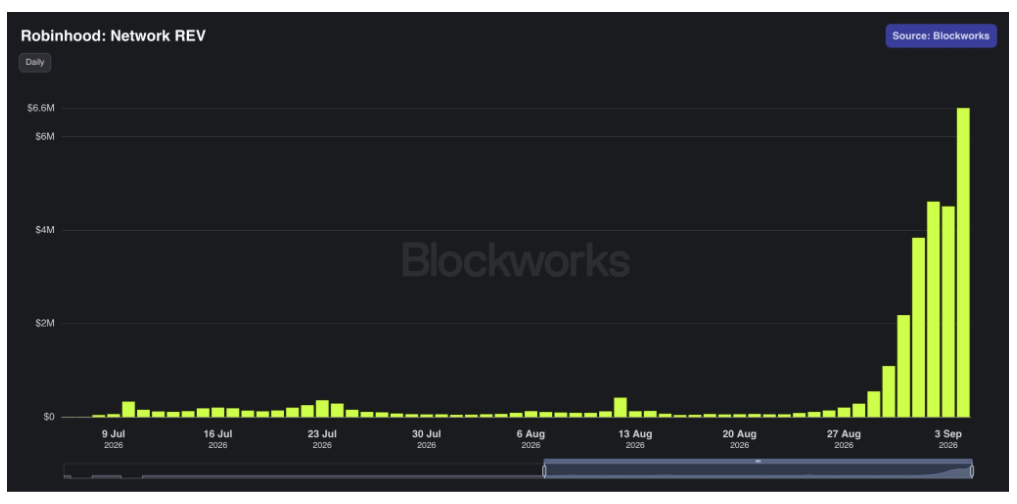 Source: Blockworks
Robinhood Chain Is Becoming a Real Business Line
If this revenue persists, Robinhood Chain could also become a meaningful business line for Robinhood itself.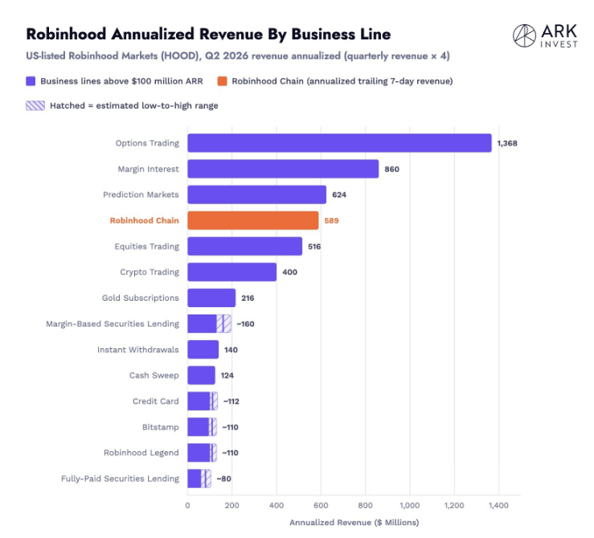
Source: ARK Invest
Based on the current trailing 7-day run rate, Robinhood Chain is already tracking as a meaningful business line relative to some of Robinhood’s existing products. Obviously, annualizing one week of highly speculative activity can be misleading, but it shows how quickly the economics can become material. If even a portion of this activity proves durable, Robinhood Chain could go from an experimental L2 to a real contributor to Robinhood’s overall business.
What really drove the takeoff was the ability to launch memecoins paired against wrapped versions of tokenized stocks. Before getting into that, it is worth distinguishing between wrapped stocks and issuer-sponsored tokenized stocks, as they are very different products.
How Wrapped Stocks Work
A wrapped stock is essentially a token that gives you economic exposure to an underlying public equity. A third party typically holds, custodies, or otherwise references the real shares and issues an onchain token representing that exposure. The company itself is not involved, and the token generally does not sit directly on the issuer’s cap table. You are relying on the wrapper, custodian, and redemption structure to maintain the link between the token and the underlying stock. Robinhood’s tokenized stocks fall into this bucket. They are onchain representations of the underlying equity created by Robinhood, not shares that were natively issued onchain by the company itself.
An issuer-sponsored tokenized stock is much closer to the actual security being issued natively onchain. The issuer, transfer agent, or another authorized party recognizes the blockchain-based position as the official record of ownership. That means shareholder rights, transfers, dividends, and corporate actions can be tied directly to the token rather than being recreated by a third-party wrapper. This is how Securitize is tokenizing equity.
The simplest distinction is:
Wrapped tokenized stock = onchain representation of a stock.
Issuer-sponsored tokenized stock = the stock itself represented onchain.
Memes Paired Against Stocks?
What really drove demand for Robinhood stock tokens onchain was the launch of memecoins with liquidity pools paired against them. If a memecoin were paired against something like a tokenized Robinhood stock, users would effectively need to buy the onchain stock first to trade into the memecoin. That created a completely new source of demand for the stock token that had very little to do with someone actually wanting equity exposure.
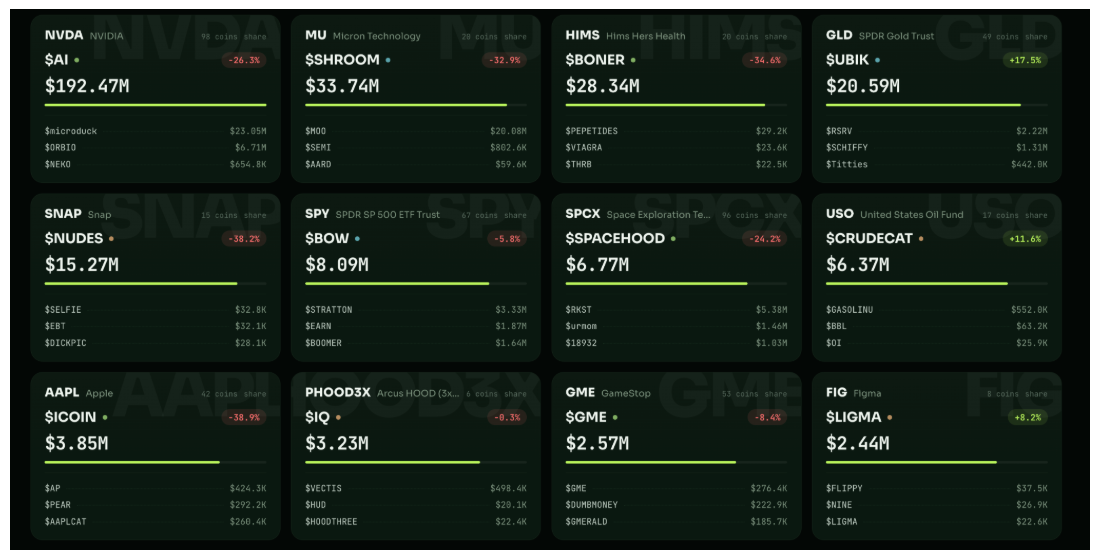 Source: Stonks Onchain
You can see above some of the stocks, with their top memecoin pairs listed below them, and how much money is already moving onchain as users rapidly experiment with these new markets.
Ironically, memecoins may end up being one of the first real liquidity-bootstrapping mechanisms for tokenized equities. Speculators are not necessarily coming onchain to own NVDA or AMC. They are coming because they want access to another asset paired against it. But the end result is still more stock supply moving onchain, deeper liquidity, and more infrastructure being built around these assets.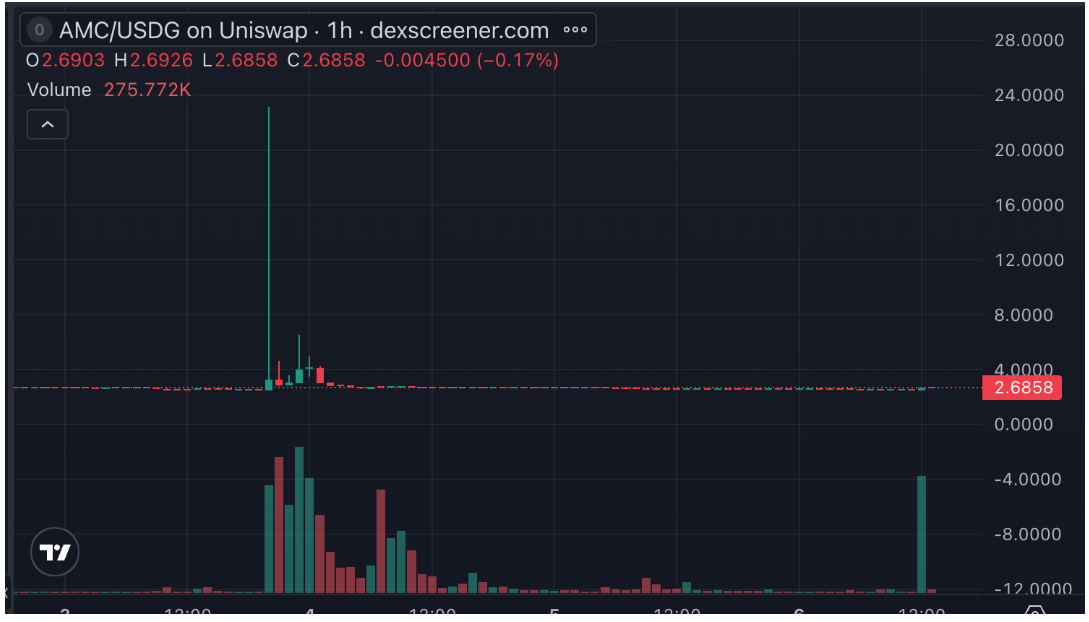 Source: Dexscreener
One of the clearest examples of what happens when that liquidity is still too thin was AMC. As you can see in the chart above, the onchain version briefly wicked up to around $24, while actual AMC shares were trading around $2.60. Demand for the CINEMA memecoin forced speculators to first buy the relatively illiquid tokenized AMC shares, creating a squeeze on the limited onchain supply and sending the price far above the underlying stock price.
The AMC situation received so much attention that CEO Adam Aron publicly went after Robinhood. He emphasized that AMC had no involvement with or endorsement of the tokenized shares, called the practice “contemptible, outrageous, disgusting, detestable, inexcusable, vile,” questioned how it could be legal, and said AMC would have outside securities counsel investigate and potentially raise the issue with the SEC.
This is really the core issue with the current structure. Robinhood Chain trades 24/7, but the underlying equities and the process for creating additional stock tokens do not trade 24/7. If a memecoin suddenly absorbs most of the available onchain float over a weekend, there may simply not be enough supply or arbitrage capacity to keep the wrapped stock near the real equity price. Once additional tokens can be created, that gap can collapse quickly.
Where the Revenue Actually Accrues
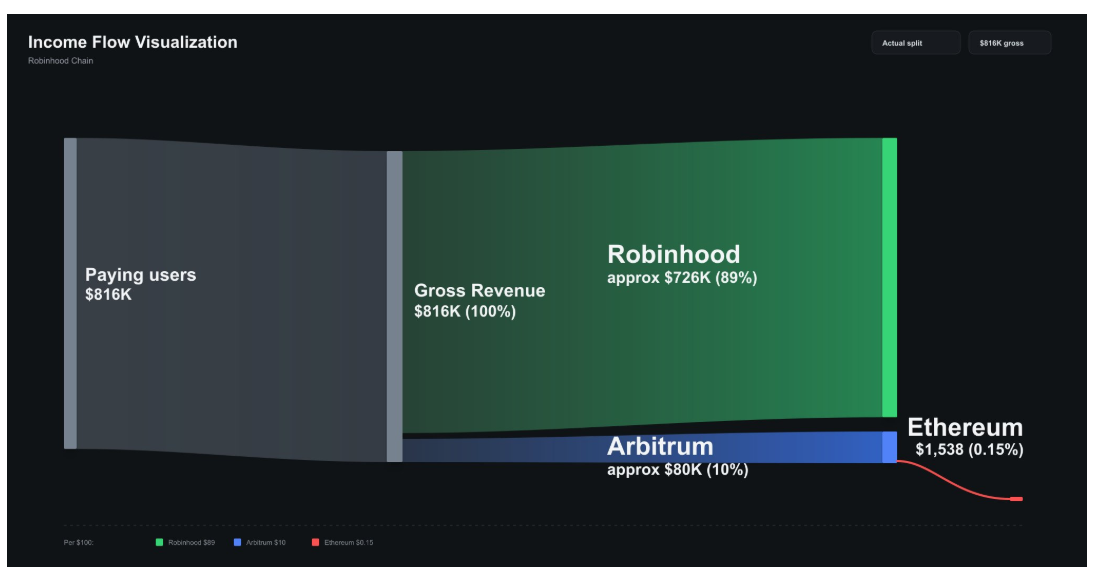
The revenue split is also interesting because it shows how little ultimately reaches the base layer. Roughly 90% of revenue goes to Robinhood, 10% to Arbitrum, and just 0.15% to Ethereum. Even though the activity ultimately settles back on Ethereum, very little of the economics makes it all the way down to ETH.
More importantly, much of the real value capture is happening one layer up the chain, at the application level. Robinhood owns the distribution and infrastructure, but the launchpads, DEXs, and other apps where users actually transact can charge fees directly on top of that activity.
A Pump.fun Competitor Emerges?
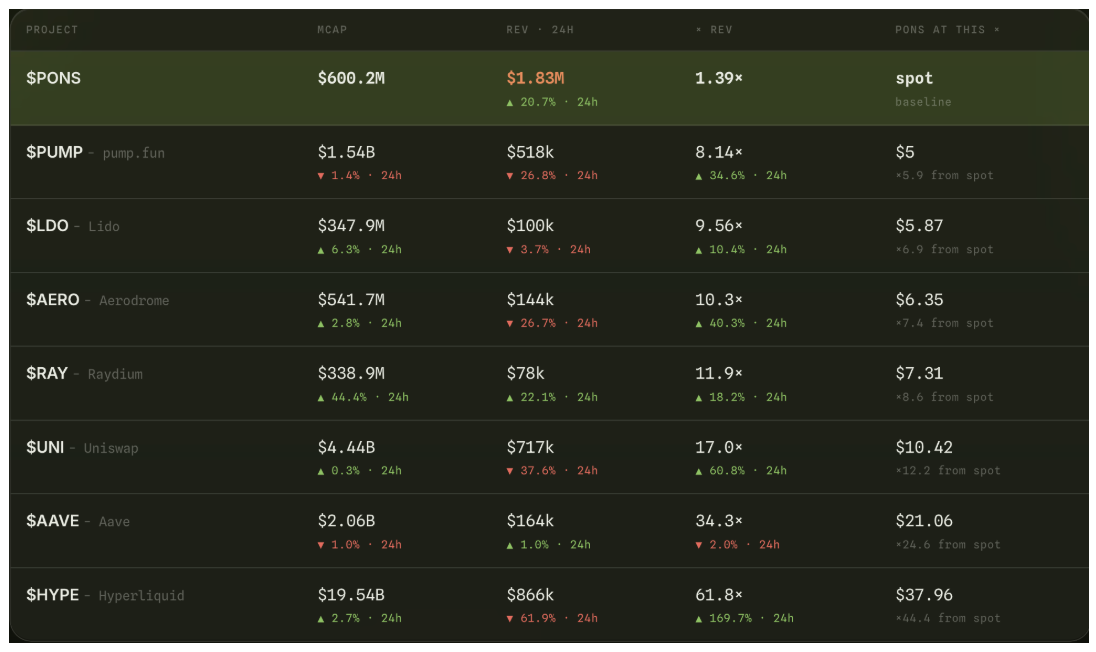
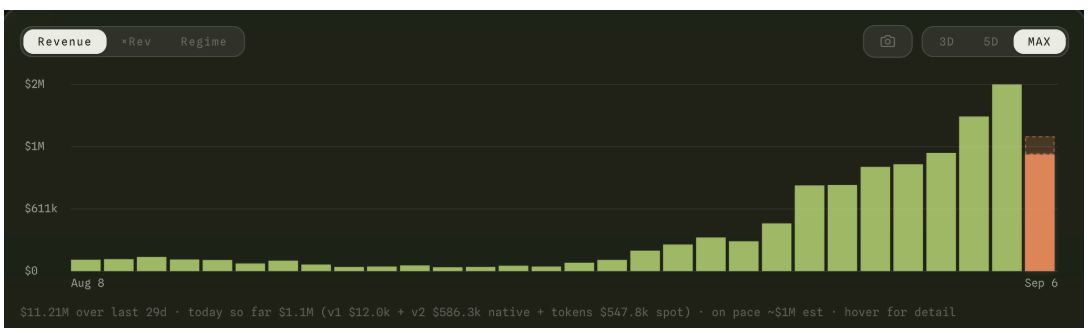
These tokens are being launched across a variety of launchpads on Robinhood Chain, but one with a liquid token has seen a massive price run-up over the last week: PONS. PONS allows users to create memecoins paired directly against wrapped tokenized stocks, making it one of the clearest ways to participate in this new activity on Robinhood Chain. As volumes exploded, the protocol also started generating real revenue, and as of today, it’s producing more 24-hour revenue than both Pump.fun and Hyperliquid, which is pretty remarkable for a launchpad that was barely on anyone’s radar a few weeks ago.
 Source: PON$ Terminal
Whether this trend continues remains to be seen, but what makes fundamental investors like us interested is the token setup behind PONS. PONS was fair launched, has no VC overhang or major unlock schedule, and uses 80% of protocol revenue to buy back and burn the token. So far, nearly 30% of the total supply has already been bought back and burned.
 Source: PON$ Terminal
There has not been a cleaner token setup in crypto in quite some time. You have a fair launch, no VC supply waiting to hit the market, real revenue, and the majority of that revenue being used to permanently reduce token supply. The question from here is simply whether the underlying activity and revenue are sustainable.
Composability Is the Real Unlock
The bigger takeaway here is not that people are trading memecoins against tokenized stocks; it is that once equities are brought onchain, they become composable assets that can be used in ways that are virtually impossible in traditional markets.
Today, that means pairing a memecoin against NVDA or AMC. Tomorrow it could mean using tokenized stocks as collateral, borrowing against them, trading prediction markets around them, creating structured products, or building entirely new markets that settle against equities. That is what makes this more interesting than just “stocks trading onchain.” The stock becomes a building block for what DeFi unlocks. This is what ultimately excites us at Arca, and we are excited to see where these onchain experiments go.
Disclosure: The Arca Digital Assets Fund holds a long position in HOOD.
And That’s Our Two Satoshis!