




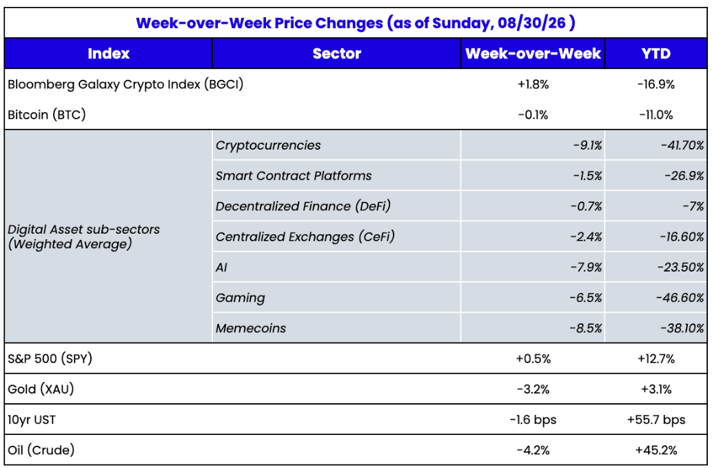
Last week we wrote about how, for most of 2026, the setup in digital assets had quietly been improving, with attractive valuations, improving fundamentals, and regulatory progress beneath the surface, but the catalysts to go higher didn’t arrive until two weeks ago.
Bitcoin went from roughly $60,000 to more than $80,000 in a matter of days. Ethereum and Solana rallied even more. HYPE and a host of smaller digital assets exploded higher. It was a pretty good demonstration of the point we were trying to make: crypto spends an extraordinary amount of time making investors regret owning it, and remarkably little time giving them an opportunity to buy it once everyone wants it again.
But this week also gave us an important reminder. Crypto assets may finally have plenty of their own unique reasons to go up, but tethering the entire asset class to Bitcoin still gives it plenty of macro reasons to go down.
Friday’s hawkish comments from Federal Reserve Chair Kevin Warsh were enough to quickly interrupt the rally. Bitcoin pulled back from its highs, Ethereum sold off, and suddenly the same assets that had been repriced sharply higher were repricing lower again. It makes sense that Bitcoin fell. Bitcoin remains a high-duration, liquidity-sensitive investment driven more by interest rates and the dollar than by most other digital assets. But many other assets within crypto should not have responded at all to the Fed, and fortunately, they didn’t.
Three weeks ago, we argued that crypto investors were finally getting better at distinguishing between headlines and fundamentals. The delay of the CLARITY Act, another disappointing Coinbase earnings report, forced selling from a highly levered AI hedge fund, and a hawkish Federal Reserve meeting would once have been enough to destroy the entire market. Instead, most of the crypto market largely shrugged.
And two weeks ago, we argued that digital assets are finally becoming fundamentally analyzable. Protocols have customers, generate revenues, and produce profits. Their operators have to make capital allocation decisions. And increasingly, those revenues are being connected directly to tokenholders through buybacks, burns, staking economics, and other value-accrual mechanisms.
Put those ideas together, and the next phase becomes pretty interesting. If HYPE, PUMP, AERO, ENA and other digital assets increasingly represent economic exposure to real, growing businesses, then eventually a macro-driven selloff shouldn’t simply result in investors saying, “crypto is down.” It should instead result in investors saying, “Great. At this price, this asset trades at X times revenue, generates Y dollars in earnings, is growing Z%, and uses a portion of those earnings to buy its token. Is it cheap?” Saying “crypto is down” is going to soon sound just as silly as saying “ETFs are down”... the ETF is just a wrapper, and what’s inside the wrapper matters more than the casing.
That’s what happens in every other mature asset class. The maturation of crypto does not mean volatility disappears. It means investors eventually know which assets to own and which not to own when volatility arises.
Crypto Adoption Got Boring, and That’s a Good Thing
There’s another strange thing happening in digital assets right now. Nobody seems particularly impressed by crypto adoption anymore.
For most of the past decade, the industry was desperate for validation from traditional finance. Every announcement that JPMorgan was experimenting with blockchain, every rumor that a large asset manager might launch a crypto product, every bank that dipped a toe into tokenization, and every Fortune 500 company that mentioned “blockchain” on an earnings call became a major story.
“The institutions are coming” became one of crypto’s longest-running jokes because institutions were seemingly always coming, but rarely arriving. Well, they arrived.
Traditional financial firms now custody and trade digital assets. ETFs have turned Bitcoin and Ethereum into ordinary portfolio allocations. Robinhood is building its own blockchain and tokenizing securities. Coinbase is increasingly becoming an on-chain financial platform. Stablecoins have become legitimate payment and settlement rails. Prediction markets are reaching mainstream audiences. Public companies own digital assets on their balance sheets. Banks are experimenting with tokenized deposits and shared blockchain infrastructure. And increasingly, the reaction is basically, “Yeah. Of course they are.”
That might be one of the most bullish developments of all. Two months ago, I looked back at some of the arguments we have made over the 8 years of writing this blog. Many of the ideas that sounded ridiculous at the time — stablecoins becoming a major financial application, real-world assets moving on-chain, decentralized protocols generating real cash flows, and traditional financial institutions embracing blockchain infrastructure — are increasingly just normal parts of the financial system.
The debate has quietly changed. For years, we questioned whether anyone would actually use blockchain technology. Now, we argue about which companies will capture the economics (hint: it’s not Layer-1 protocols). That distinction matters enormously for investors.
A bank using a blockchain does not necessarily make a random Layer-1 token valuable. A stablecoin settling billions of dollars does not necessarily mean every token associated with stablecoins should appreciate. A decentralized exchange generating hundreds of millions of dollars in fees does not necessarily make its governance token valuable. Revenue by itself is not enough. Usage by itself is not enough. Adoption by itself is not enough.
Eventually, the economic activity has to accrue to the asset you own. And that’s the only part of crypto investing that matters anymore.
In one of my favorite pieces I’ve ever written (comparing crypto to the Women’s Pro Baseball League), I argued that both the WPBL and crypto suffer from essentially the same problem.
The product is good, but the distribution and marketing efforts are a problem.
The WPBL has talented players, entertaining games, and compelling personalities, but unless you were willing to search for them yourself, you had almost no idea they existed. ESPN buried the league despite televising it. MLB barely acknowledges it. Statistics are difficult to find. The league’s biggest stars are essentially anonymous.
I compared Kelsie Whitmore to Bitcoin. She was the pioneer, the recognizable name, and deserves every bit of the attention she receives, but focusing exclusively on Whitmore obscures all of the incredible talent that has developed around her.
Three weeks later, crypto is exhibiting the exact same problem. The market finally rallied, and investors immediately focused all energy on Bitcoin, Ethereum, and Solana, despite these assets materially underperforming almost every other real company with a token. Look at the products offered by traditional financial institutions, and those are the only assets they know how to distribute. Talk to casual crypto investors, and those are the names they recognize.
There is nothing wrong with BTC, ETH, or SOL, just like there is nothing wrong with Kelsie Whitmore. But they are simply no longer the relevant story. Some of the most interesting and best-performing assets in this rally are a completely new crop of tokens that barely existed a few years ago. Others, like AAVE and UNI, have been around for years but have evolved dramatically while almost nobody outside of crypto has noticed.
Many tokens now represent actual businesses generating growing revenue, with increasingly explicit mechanisms linking that revenue to the tokens.
These are the Denae Beniteses and Denver Bryants of crypto. The stars are already here, but most investors simply don’t know who they are.
And we got a nearly perfect example this last week. The Ethena Foundation proposed a fee switch that, once certain USDe supply milestones are reached, could direct as much as 95% of the net revenue received by the Foundation from its core businesses toward ENA buybacks.
You couldn’t have designed a better real-time case study for the argument we made a few weeks ago about appropriate capital allocations.
Crypto protocols are increasingly becoming real businesses. And increasingly, their tokens are being redesigned so that owning the token actually can mean participating economically in the success of that business. Importantly, they aren’t all doing it the same way. So asset selection matters a lot.
Some companies and protocols buy back and burn tokens. Some distribute fees to stakers. Some give token holders rights to economically valuable resources. Some make the token the scarce reserve asset underlying an entire ecosystem.
That’s healthy. Public companies don’t all have identical capital allocation policies either. The important development is that crypto is finally taking value accrual seriously.
Consider some of the new crypto all-stars. This isn’t meant to be a list of our favorite tokens or even necessarily the assets we think will perform best. And it certainly isn’t an exhaustive list. But it is a good starting point for projects with clear value – they may be overvalued or undervalued, but it is no longer a question of whether they have value. They do. These also demonstrate how quickly the investable universe is evolving beyond BTC, ETH and SOL — and how much more attention investors should be paying to the relationship between a successful protocol and a successful token.
Hyperliquid (HYPE) — Decentralized Exchange / Financial Infrastructure
Hyperliquid has evolved from a decentralized perpetual futures exchange into a broader on-chain financial platform, including spot markets, permissionless HIP-3 markets, tokenized exposure to traditional and pre-IPO assets, and its own Layer-1 blockchain. Most importantly for investors, HYPE has one of the clearest value-accrual mechanisms in crypto: approximately 99% of protocol trading fees flow to the Assistance Fund, which automatically purchases HYPE on the open market, with purchased tokens subsequently removed from circulation. This is perhaps the cleanest example in crypto today of a growing business whose economic success is mechanically connected to its token. Yes, HYPE is essentially a stock (though if you still need an actual stock, there’s a DAT for that).
Pump.fun (PUMP) — Token Issuance / Trading
Pump.fun began as the dominant memecoin launchpad on Solana but has increasingly become a broader platform for token issuance, trading, and attention. Whatever you think about the underlying assets launched on Pump, the business itself generates enormous real revenues, and its token economics are unusually straightforward: roughly 50% of protocol revenue is currently used to purchase PUMP on the open market and burn it. The result is a direct connection between increased platform activity and reduced token supply. At the current revenue run-rate and buyback percentage, all PUMP could be bought back within 5 years if prices don’t accelerate higher.
Lighter (LIT) — Decentralized Exchange / Perpetual Futures
Lighter is another rapidly growing decentralized perpetual futures exchange competing with Hyperliquid and centralized derivatives venues, with an emphasis on high-performance, verifiable trading infrastructure. Lighter generates fees from trading and other exchange activity and has begun directing substantial protocol earnings toward LIT purchases. Like HYPE, the important part is not simply that Lighter generates revenue — it is that tokenholders have a mechanism for participating in the economics of the platform.
Venice (VVV) — Artificial Intelligence / Compute
Venice provides private, permissionless generative AI inference and has one of the more creative token models in digital assets. Rather than simply representing governance, staking VVV gives users economic access to Venice’s AI compute capacity through DIEM, a tokenized unit of inference that can be used, transferred, or sold. Venice has also used revenue to purchase and burn VVV, meaning the token combines genuine product utility with revenue-funded supply reduction.
Aerodrome (AERO) — Decentralized Exchange / Liquidity Infrastructure
Aerodrome is the leading liquidity hub on Base and is evolving into a broader Ethereum liquidity layer through its combination with Velodrome. Its token economics work differently from a traditional buyback: AERO can be locked into veAERO, and those token operators direct liquidity incentives while receiving the exchange revenue associated with the pools they support, including swap fees and other voting incentives. It is one of the clearest examples of real economic activity flowing directly to token participants without relying on a traditional stock-like buyback model.
Morpho (MORPHO) — Decentralized Lending / Credit
Morpho is a decentralized lending protocol that takes a more modular approach than traditional pooled lending markets, allowing developers and asset managers to build customized lending products on top of its infrastructure. The protocol has grown rapidly and generates meaningful fees, while governance has increasingly focused on the same capital-allocation question we discussed recently: when and how should those economics accrue to MORPHO holders? Morpho has already implemented a fee switch across parts of the protocol, with collected fees accruing to the DAO rather than immediately being distributed to tokenholders, and the community has actively debated using protocol revenues for MORPHO buybacks. The mechanism is therefore not as direct as HYPE or PUMP today, but Morpho is another good example of a successful on-chain business increasingly being forced to answer the question that matters to investors: how does the success of the protocol translate into value for the token?
Uniswap (UNI) — Decentralized Exchange / Liquidity Infrastructure
Uniswap is the largest and most recognizable decentralized spot exchange in crypto and has generated billions of dollars of trading fees over its lifetime, but UNI historically represented one of the industry’s clearest examples of the disconnect between a great product and a mediocre token. For years, essentially all of the economics generated by Uniswap accrued to liquidity providers rather than UNI holders. That finally began to change with the activation of protocol fees and the UNIfication proposal, which created a mechanism to use protocol revenue to burn UNI. Uniswap therefore represents almost the perfect case study for this entire discussion: the product was already enormously successful; what changed was the recognition that a successful protocol and a successful token are two different things unless someone deliberately connects the two.
Ethena (ENA) — Stablecoins / Synthetic Dollar Infrastructure
Ethena created USDe, a crypto-native synthetic dollar whose economics are built around collateral, derivatives hedging, and yield generation, and it has since expanded into additional stablecoin and financial products. Historically, the missing piece was ENA value accrual; the newly proposed fee switch could change that dramatically by eventually directing as much as 95% of applicable net Foundation revenue toward ENA buybacks. ENA may therefore be evolving in real time from a token attached to a successful business into an asset with a much clearer economic claim on the success of that business.
Maple Finance (SYRUP) — On-Chain Asset Management / Credit
Maple Finance operates an on-chain asset-management and lending platform connecting institutional borrowers with crypto-native and institutional capital, with its syrupUSDC product offering users access to yield generated from Maple’s lending businesses. SYRUP is the governance and staking token of the ecosystem, and Maple has increasingly tied the token to protocol economics through revenue-funded buybacks and distributions to stakers. It is a particularly useful example because Maple looks less like a speculative crypto application and increasingly like an on-chain financial-services company with recognizable revenues, margins and capital-allocation decisions.
Aave (AAVE) — Decentralized Lending / Credit
Aave is one of crypto’s oldest successful DeFi protocols and one of the best examples of how much these assets can evolve. Aave operates decentralized money markets where users lend and borrow assets, generating significant fees across multiple blockchain networks. Through its evolving tokenomics and buyback program, a portion of protocol economics has been used to acquire AAVE, creating a much more explicit connection between the growth of the lending business and the token than existed during the previous crypto cycle.
Pons (PONS) — Token Launchpad / Robinhood Chain
Pons is an emerging token launch and trading platform built natively on Robinhood Chain — effectively an early piece of application-layer infrastructure for Robinhood’s new on-chain ecosystem. The protocol earns fees from token launches and trading and currently uses 80% of its protocol fees to purchase PONS through an automated TWAP and burn the tokens, with the remaining 20% funding infrastructure and the team. It is still extremely early, but that is precisely the point: new ecosystems create new businesses, and some of those businesses are designing token value accrual correctly from day one.
Bittensor (TAO) — Artificial Intelligence / Decentralized Compute
Bittensor is a decentralized network designed to create markets for machine intelligence, with specialized subnets competing to produce useful AI-related services and digital commodities. TAO is the common economic asset connecting those subnets: it is used for staking, transaction fees, and liquidity throughout the subnet economy, while its supply is capped at 21 million. Unlike HYPE or PUMP, TAO does not primarily accrue value through revenue-funded buybacks; its value accrual comes from being the scarce base asset required to participate in and allocate capital throughout a growing decentralized AI economy.
Derive (DRV) — Decentralized Derivatives / Options
Derive is an on-chain derivatives protocol focused particularly on options and structured products, bringing financial products that have historically been difficult to execute on-chain into a decentralized venue. DRV launched with an explicit economic connection to the underlying business, with a portion of protocol revenue allocated toward token buybacks. Again, the important distinction is that DRV isn’t simply a governance token attached to a product — there is an actual mechanism designed to connect increased usage of the product to demand for the token.
None of these assets are guaranteed to succeed. Some probably won’t. And importantly, they don’t all accrue value in exactly the same way. But the point is that the crypto investment product suite has changed faster than the distribution.
Bitcoin proved digital scarcity could work. Ethereum proved blockchains could be programmable. Solana proved high-throughput consumer blockchains could scale.
The next generation is trying to answer an entirely different question:
Can we build real businesses on-chain and design the token so investors actually participate in the success of those businesses?
Increasingly, the answer is yes. And yet the industry’s distribution apparatus is still largely selling investors the 2017 version of crypto. BTC, ETH and SOL aren’t suddenly bad investments because newer assets exist. They’re the pioneers who made this entire industry possible.
But the new generation had one enormous advantage: they could learn from everything the first generation got wrong. They can launch with better token designs. Better governance. Better incentive structures. Better capital allocation. Better connections between revenues and tokenholders.
The products have gotten better, the assets have gotten better, and the stars are already here. The problem is that nobody knows their names yet.
And That’s Our Two Satoshis!