




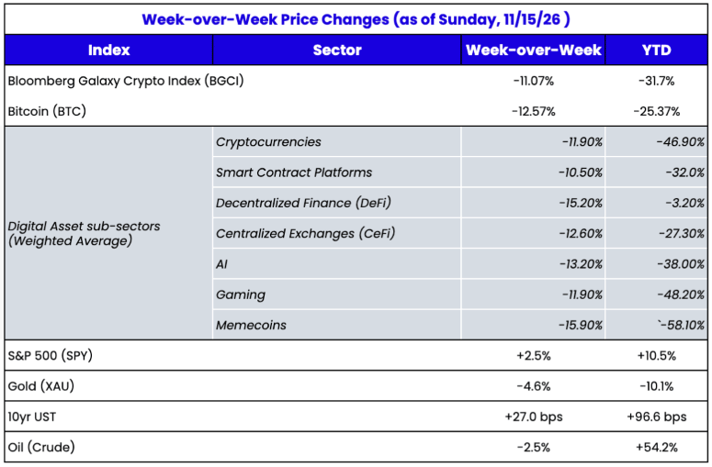
Even the most stalwart defenders of crypto as an investable asset class, including ourselves, have to pause this week. There were plenty of legitimate reasons for crypto to trade lower, and we’ll discuss those below. But there were far fewer reasons for another weekend crash, particularly one where some of the industry’s fastest-growing, most profitable businesses led the decline, falling 2–3x more than Bitcoin and other large-cap tokens. This is becoming an all-too-familiar problem for digital asset investors.
Let’s start with some of the stronger rationales for a crypto sell-off.
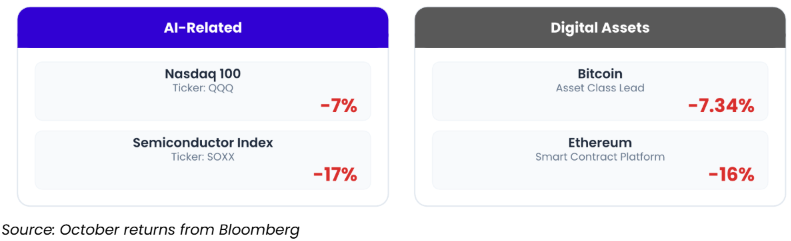
First, October was a difficult month for risk assets in general, particularly those associated with what we view as two of the most important technological developments of the past decade: artificial intelligence and blockchain. Interestingly, the magnitude of the selloff was remarkably similar across both sectors. The Nasdaq 100 (QQQ) declined approximately -7%, while the Semiconductor index (SOXX) fell -17%. Meanwhile, Bitcoin declined -7.34% and Ethereum fell -16%. The similarities are striking, and the correlation is real, so the continued selloff in both QQQs and SOXX in November are likely still weighing on crypto. It looked like this might dissipate following strong earnings and an even stronger outlook for AI demand from CoreWeave (CRWV), combined with high demand for the upcoming Anthropic (ANT) IPO (rumored to be 6x oversubscribed). But that too faded following Nvidia (NVDA)’s extra-marital crash.
Second, the market is now pricing in another Fed rate hike in December following the latest hot CPI report. According to CME Fed Funds futures, the probability of a 25 bp hike has risen to approximately 92%. Meanwhile, Treasury yields have resumed climbing, with longer-term rates rising another 25 bps from their recent lows. Higher nominal and real yields continue to pressure Bitcoin and other long-duration risk assets.
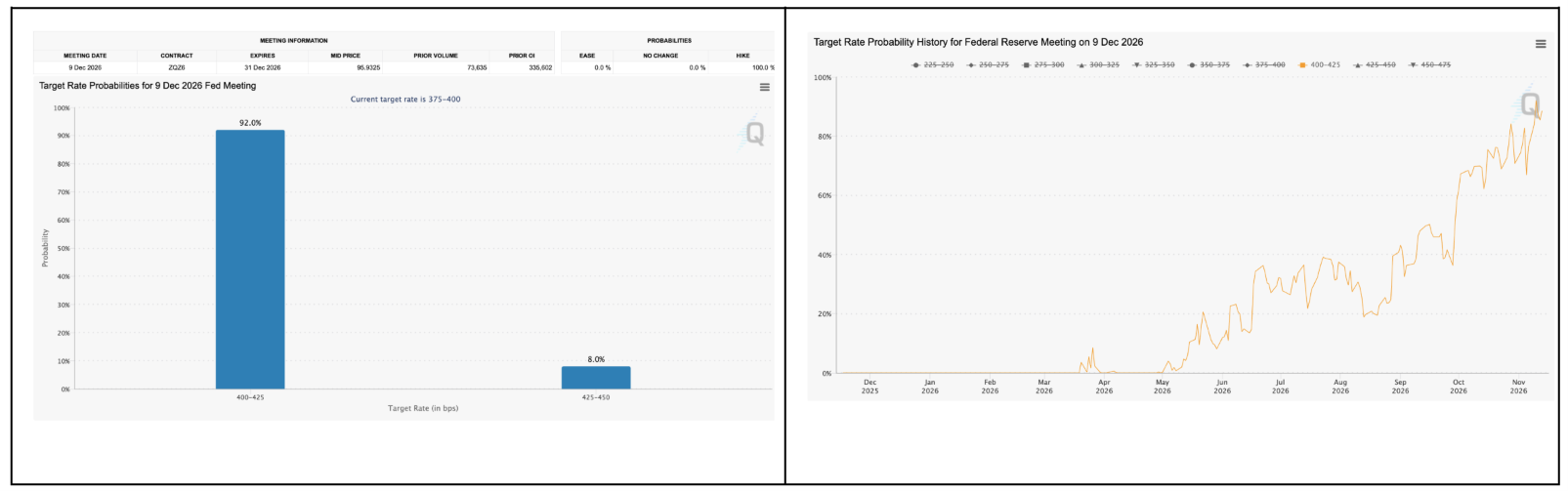
Source: CME Fed Funds Futures
Third, the Binance hack is having a real impact on crypto confidence. While Binance has supposedly been able to backstop all customer losses from its own balance sheet, the impact of the hack is still permeating. Perhaps the best way to see this is via stablecoin AUM. While stablecoin supply has largely been “up and to the right” for 7 straight years, growing to over $300 billion in total, the last few weeks have seen significant outflows. Total stablecoin AUM has fallen over $15 billion in just 10 days, led by declines at USDT and USDC. Unlike falling token prices, which can simply reflect changing valuations, declining stablecoin supply represents an actual contraction in the amount of dollar-denominated liquidity available on-chain. This is a much more concerning development, particularly when combined with persistent ETF outflows.
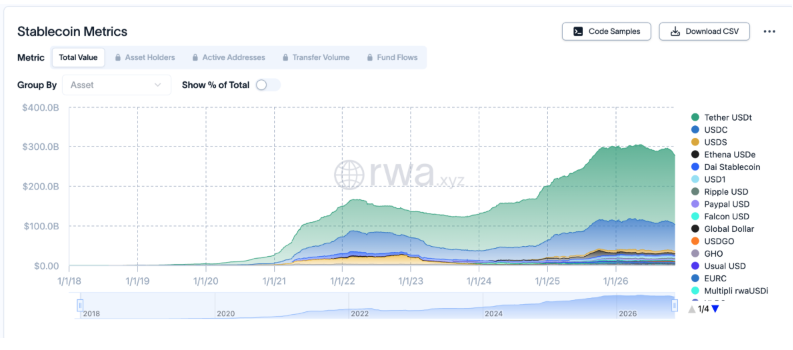
Source: rwa.xyz
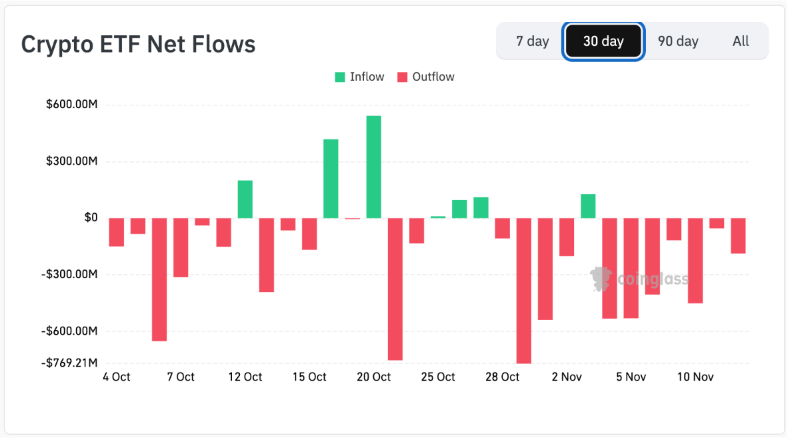
Crypto ETF flows have also been very negative in recent weeks, indicating even more money leaving the ecosystem.
Source: Coinglass
Finally, Bitcoin miners and Digital Asset Treasury companies (DATs) represent another potential source of forced or strategic selling. Falling BTC prices are pressuring mining economics, while the industry’s pivot toward AI infrastructure requires significant capital. Meanwhile, leveraged DATs may eventually be forced to liquidate crypto holdings to fund operations or meet financing obligations. This past week, Marathon Digital (MARA) announced that they sold over $1 billion worth of BTC.
So, it’s not entirely surprising that crypto, in general, has been weaker. All of the above, plus cyberattacks, terror plot rumors, a strong U.S. dollar, and real yields pressing up against cycle highs, are enough to be somewhat cautious, if not outright bearish.
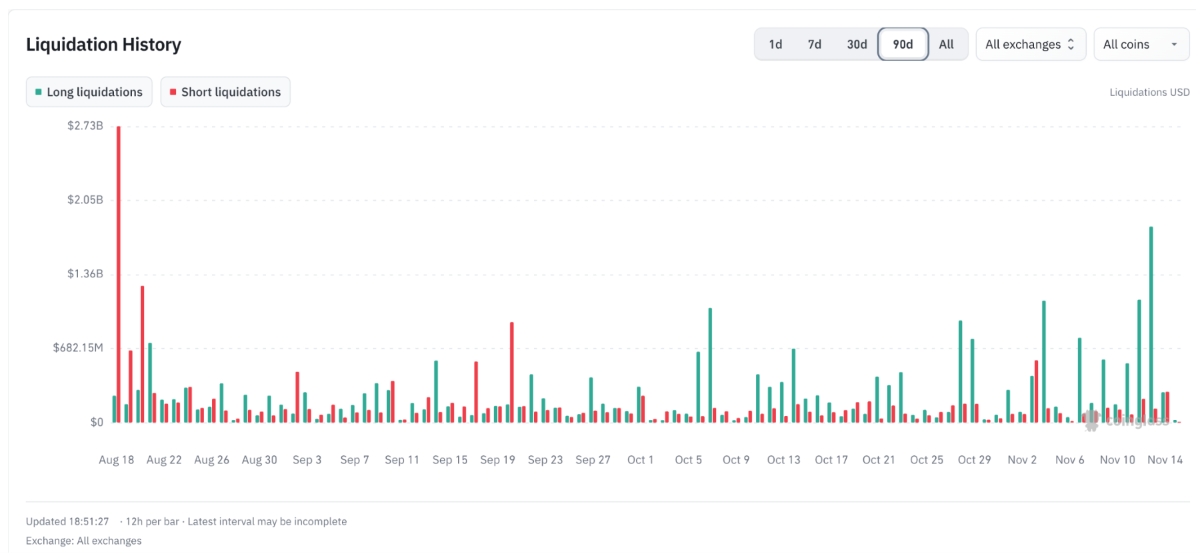
Of course, none of this explains why the selling becomes so violent over weekends. Unlike equities, crypto trades 24/7, but liquidity certainly doesn’t. Market makers reduce risk, institutional trading desks are less active, and order books become significantly thinner. When large sell orders hit an already fragile market, prices can move dramatically, triggering leveraged liquidations that create even more selling pressure. Perp exchanges are starting to become lauded across all of finance, but this is the biggest known drawback – those who want to push a market up or down can easily take advantage of thin-liquidity weekends and public stop-loss price triggers.
And because many crypto assets are still traded as a basket of correlated risk rather than as individual businesses, fundamentally unrelated tokens get dragged into the same liquidation cycle. The result is a market where a relatively small amount of incremental selling can create an enormous amount of market-cap destruction.
 Source: Coinglass
2026 is the first year in which real fundamental businesses within crypto with strong tokenomics have meaningfully outperformed Bitcoin and large-cap L1 tokens. Which is why it’s surprising to us that a Bitcoin-led spot selloff still has such a large impact on other crypto assets that have nothing to do with Bitcoin at all. The problem isn’t that Bitcoin is falling. It’s that Bitcoin’s weakness is dragging down businesses whose fundamentals are actually improving, sometimes precisely because of the conditions causing Bitcoin to fall.
For example, decentralized exchanges (DEXs) are among the biggest beneficiaries of the very volatility that’s causing their tokens to collapse. Higher volatility generally means higher trading volumes, which translates into higher fees and revenues. In other words, the same market conditions that are destroying their token prices are simultaneously improving their underlying businesses. The leader in on-chain options trading, Derive (DRV), just closed its highest week in revenue/fees ever, yet the token is still -60% from the highs and fell -30% over the weekend before recovering almost the entire move late Sunday.
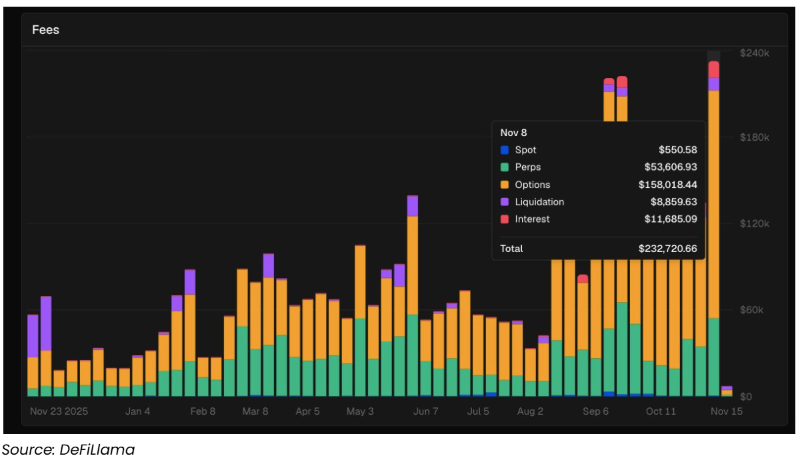
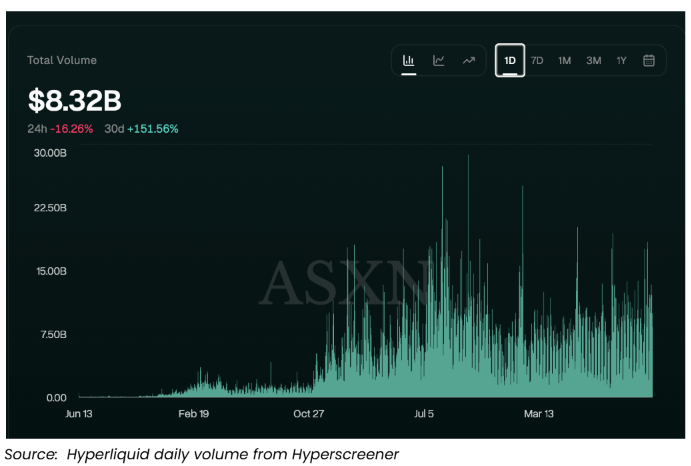
Meanwhile, market darling Hyperliquid (HYPE), which is benefiting from both the crypto volatility and the Anthropic pre-IPO futures trading via TradeXYZ, fell -11% over the weekend and is now -24% MTD and -35% from recent highs. Hyperliquid weekend volume hit $21.6B (+186% vs. weekend average), and open interest is up 80% since the start of Q3, now surpassing Bybit, Kraken, and OKX. Lighter weekend volume was $7.4B (+122%).
Aerodrome (AERO) and Uniswap (UNI) each fell -27% this week alone despite being the biggest beneficiaries of the increase in crypto volumes as trading continues to move on-chain and away from the centralized exchanges.
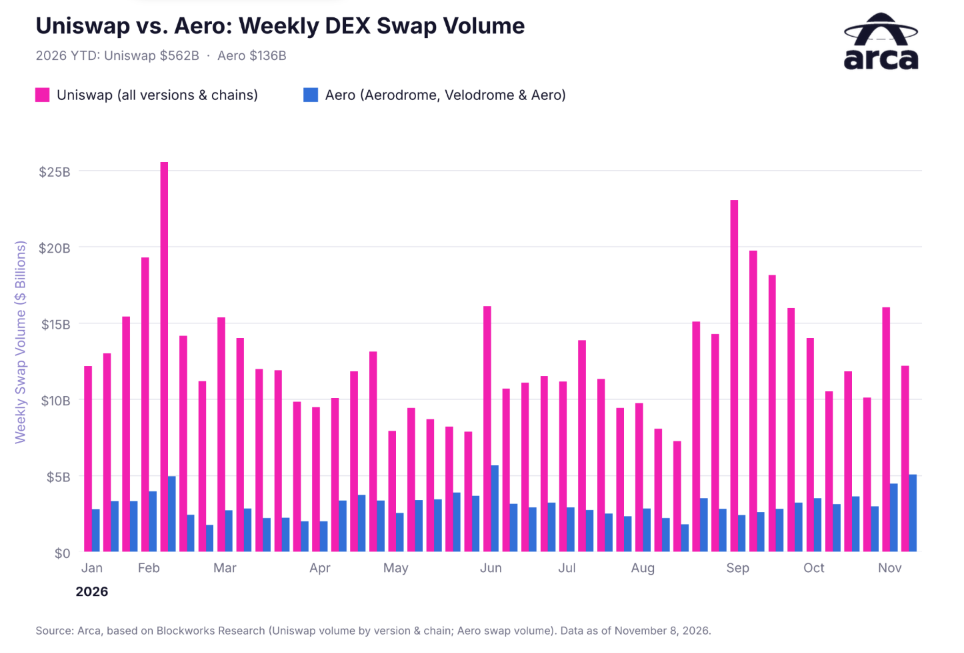
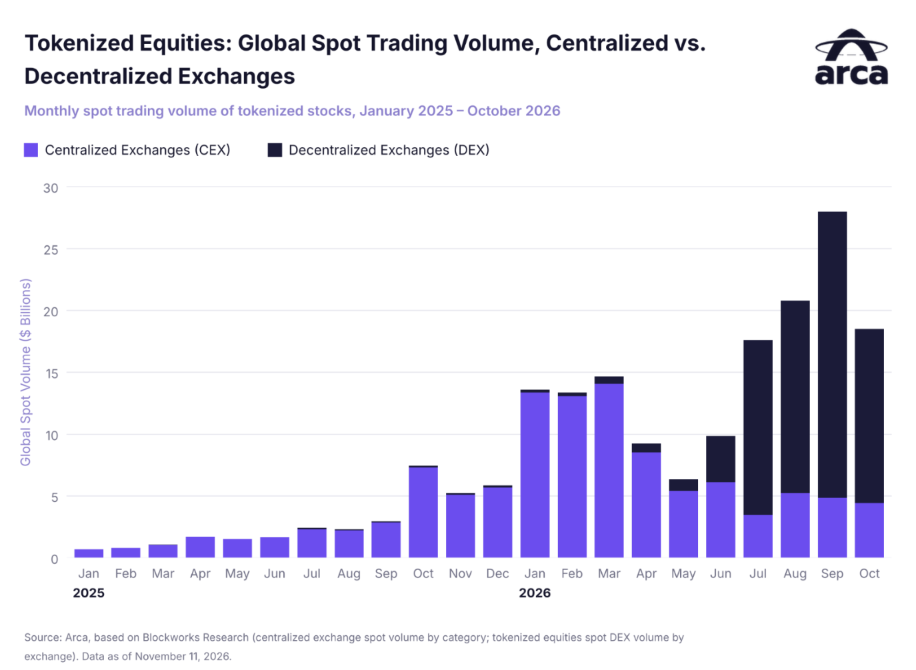
And this isn’t limited to crypto-native assets. Trading in tokenized equities is increasingly moving toward decentralized exchanges as well, with DEX volumes now dwarfing their centralized counterparts. The migration of financial activity on-chain is accelerating even as the tokens associated with this infrastructure are being indiscriminately sold.
Ultimately, this is what makes investing in digital assets so frustrating. We can understand why Bitcoin is falling. We can even potentially understand why Layer 1 protocol tokens are falling, given the lack of strong ties between the tokens and the protocols. We also understand why investors are reducing risk, why liquidity is deteriorating, and why leveraged positions are being liquidated. What we can’t understand is why a Bitcoin miner selling BTC to fund an AI data center should cause a decentralized exchange generating record revenues to lose 30% of its value over a weekend.
These are fundamentally different businesses with distinct revenue drivers, growth trajectories, and valuations. Yet the market continues to trade them as one homogeneous asset class. The irony is that the very volatility driving investors away from crypto is simultaneously creating record business activity for some of its most promising companies and protocols. Eventually, fundamentals will matter more than correlations, and the winners and losers will separate. Until then, crypto investors are being forced to endure a market where being right about the fundamentals doesn’t necessarily mean being right about the investment, at least in the short term.
Crypto assets have evolved considerably, maybe even finally becoming an investable asset class. Its market structure and investor behavior haven’t necessarily evolved alongside it.
Disclosure: The Arca Funds and/or their affiliates hold positions in HYPE, AERO, and UNI discussed in this article.
And That’s Our Two Satoshis!