




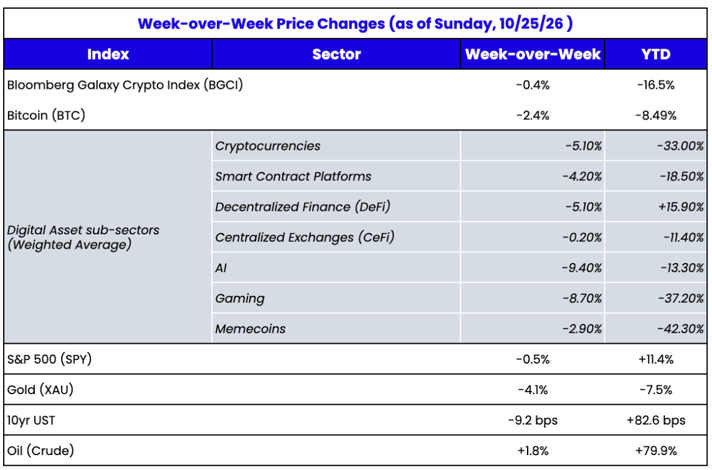
The selloff in crypto continued, though there was more dispersion. This year’s laggards (BTC, ETH, SOL and XRP) outperformed the downside over the past two weeks, as many of this year’s best performers traded with a 2-3x downside beta to the majors. AI-related assets were hit especially hard, as were assets on Robinhood Chain, which has lost most of its early momentum. That said, the tokens we track and discuss as representing the “asset class” via price action are becoming increasingly irrelevant relative to the growth of blockchain outside of the token world.
Traditional Finance Is Fighting Crypto, Embracing Crypto, and Becoming Crypto
For years, the digital asset industry has been fighting for legitimacy. Crypto companies wanted regulatory clarity, access to traditional financial infrastructure, and recognition that blockchain technology could improve an antiquated financial system. Meanwhile, traditional financial institutions largely dismissed the industry, fought against it, or waited patiently on the sidelines.
That dynamic has changed dramatically.
Today, the debate is no longer about whether blockchain technology has a place in the financial system. It’s about who gets to control that financial system as more of it moves on-chain. Three seemingly unrelated developments this past week illustrate this transition perfectly.
First, traditional banks continued their efforts to prevent stablecoins from competing with bank deposits, even as regulators moved forward with implementing the GENIUS Act. Second, more than 20 publicly traded companies reportedly objected to tokenized versions of their shares trading on a new platform, raising questions about who should control how publicly owned assets are held and transferred. And third, JPMorgan continued to expand its tokenized money-market fund offerings on public blockchain infrastructure, demonstrating that some of the largest incumbents have decided that embracing crypto is a better strategy than fighting it.
These are three very different responses to the same technological disruption.
Some incumbents are trying to protect their existing businesses. Others are trying to control how the technology develops. And still others recognize that the future of finance is moving on-chain and they intend to participate.
The irony is that all three developments are bullish for the long-term adoption of blockchain technology.
Banks Have Finally Identified the Real Threat From Crypto: Competition
For most of crypto’s existence, the banking industry’s objections have focused on familiar concerns: fraud, money laundering, financial instability, consumer protection, and systemic risk. Some of those concerns were legitimate, but they also conveniently served to protect one of the most profitable business models in financial history.
Banks take customer deposits, pay depositors relatively little, and earn substantially more by lending or investing those funds. The difference (Net Interest Margin) is an important source of bank profitability. Customers tolerate this arrangement largely because banking relationships are familiar, convenient, and deeply embedded in the existing financial system.
Stablecoins threaten to change that equation.
Under the GENIUS Act, stablecoin issuers are prohibited from paying interest directly to holders. However, the distinction between an issuer paying interest and a third-party platform offering rewards has become one of the most contentious issues in the implementation of the law. Banks have pushed for broader restrictions, arguing that stablecoin rewards could encourage customers to move deposits out of traditional banks.
Think about what that argument actually means.
The banking industry is effectively acknowledging that if consumers have access to a dollar-denominated financial product offering better economics, some will choose to move their money. Rather than competing by improving the products they offer depositors, banks are asking regulators to limit the alternatives.
Of course, stablecoins are not identical to bank deposits. They generally lack FDIC insurance, may involve different redemption and custody risks, and do not necessarily provide the same consumer protections. Those differences matter, and any comparison should acknowledge them.
But the fundamental competitive threat is undeniable.
Stablecoins offer the potential for faster settlement, global accessibility, programmability, and integration with financial applications that operate continuously rather than according to traditional banking hours. And when combined with lending protocols, tokenized money-market funds, or other on-chain financial products, they can provide access to yields that historically required a relationship with a financial intermediary.
This is where the conversation becomes much bigger than stablecoins.
We’ve written extensively about how decentralized finance could fundamentally change the relationship between consumers and financial institutions. In the traditional model, banks control the customer relationship, determine what products are available, and retain a meaningful portion of the economics. In an on-chain financial system, customers can increasingly choose where to hold their assets, how to deploy them, and which financial services to use.
And as AI becomes more capable of managing financial decisions, the competitive pressure on traditional banks could accelerate. An AI agent tasked with optimizing someone’s finances is unlikely to care whether that person has maintained a checking account at the same bank for 20 years. It will care about yield, liquidity, risk, convenience, and cost.
The banking industry’s fight against stablecoin rewards is therefore about much more than one provision of the GENIUS Act. It’s about protecting a business model that has rarely faced meaningful competition from an entirely new financial infrastructure.
And the fact that banks are fighting so aggressively suggests they understand exactly what’s at stake.
Public Companies Are Trying to Prevent the Inevitable
While banks are fighting to protect their deposits, publicly traded companies are beginning to fight a different battle: controlling how their shares are owned and traded.
This past week, Reuters reported that 22 publicly traded companies, including Microsoft, Alphabet, Goldman Sachs, and Wells Fargo, objected to tokenized versions of their shares being offered through a new trading platform associated with OKX and Intercontinental Exchange (ICE). The objections came amid a changing regulatory environment in which tokenized securities are becoming an increasingly viable alternative to traditional market infrastructure.
This might seem like a relatively minor dispute over market structure, but the implications are much bigger.
When an investor purchases shares of MSFT, who should determine how those shares can be held, transferred, or used? The company that originally issued them? The brokers, exchanges, and clearinghouses that facilitate trading? Or the investor who actually owns the economic interest?
In traditional financial markets, investors already have surprisingly little direct control over the infrastructure supporting their investments. Most publicly traded securities are held through layers of intermediaries, with beneficial ownership recorded through brokerage accounts and centralized clearing systems. Investors own economic interests in their shares, but the mechanics of ownership, transfer, settlement, and collateralization are largely dictated by financial institutions.
Tokenization offers an opportunity to rethink that entire structure.
We’ve argued for years that the most compelling application of blockchain technology isn’t creating entirely new speculative assets but improving how existing financial assets are issued, owned, transferred, and utilized.
A tokenized stock could eventually trade around the clock, settle more efficiently, move between financial applications, and potentially serve as collateral for loans or other financial transactions. A Treasury bond could become collateral for a decentralized loan. A money-market fund could become a payment instrument. An equity position could be integrated into financial products without requiring a completely separate chain of intermediaries for every transaction.
In other words, tokenization isn’t simply about putting a stock certificate on a blockchain. It’s about making financial assets more productive and useful.
Of course, not every product marketed as a tokenized stock actually delivers those benefits. There are meaningful differences between directly tokenized securities, custodial receipts backed by actual shares, and synthetic instruments that merely track the price of an underlying stock. Investors need clarity regarding legal ownership, voting rights, dividends, custody, redemption, and counterparty risk.
And public companies may have legitimate concerns about products that use their names or reference their shares without providing investors the rights they would normally expect from equity ownership.
But those concerns should be addressed through transparent product structures, disclosure requirements, and appropriate regulation, rather than allowing incumbent institutions to dictate which technological infrastructure investors are permitted to use.
After all, the company issuing a stock shouldn’t necessarily control every subsequent innovation in how that stock is held or traded.
The irony is particularly striking when the companies resisting tokenization include some of the world’s largest technology and financial institutions. These businesses have benefited enormously from technological innovation, disruption, and the removal of inefficient intermediaries in other industries. Yet when similar innovation begins challenging the infrastructure surrounding their own shares, the enthusiasm appears considerably more limited.
And while resistance may slow adoption in certain markets or through certain platforms, it is unlikely to stop the broader transition. As we wrote recently, the opportunity is not limited to tokenizing existing securities. It’s about creating a financial system in which assets become more liquid, interoperable, programmable, and productive.
Once investors experience the benefits of holding and using assets in this way, it will become increasingly difficult to justify why financial markets should remain constrained by legacy settlement processes, limited trading hours, and fragmented infrastructure.
The transition won’t happen overnight. And the first generation of tokenized equity products certainly won’t get everything right. But the direction of travel seems increasingly clear. The question is no longer whether financial assets will move on-chain. It’s how quickly the existing financial system will adapt, and how much resistance it will create along the way.
JPMorgan Has Decided That If You Can’t Beat Crypto, Join It
While banks are fighting stablecoin competition and public companies are resisting the tokenization of their shares, JPMorgan is taking a very different approach. Rather than trying to stop the transition to blockchain-based finance, it’s actively participating in it.
This past week, JPMorgan announced the expansion of its tokenized money-market fund offerings onto Solana, bringing two products, MONY and JLTXX, to a public blockchain. The latter is particularly interesting because it is designed to serve stablecoin issuers operating under the GENIUS Act, allowing them to invest reserve assets in a regulated money-market product.
One of the world’s largest and most systemically important banks is now building financial products specifically designed to support an industry that traditional banking organizations have spent years trying to restrict.
And it’s doing so on public blockchain infrastructure.
This isn’t JPMorgan’s first venture into blockchain technology. The bank has been experimenting with tokenized deposits, blockchain-based settlement, and digital asset infrastructure for years. But there’s an important distinction between building proprietary blockchain systems that preserve existing financial relationships and deploying regulated financial products on public networks that anyone can build applications around.
The former largely represents an improvement to existing financial infrastructure. The latter begins to embrace an entirely new financial architecture.
To be clear, JPMorgan isn’t suddenly abandoning its traditional business model or embracing the entire DeFi ecosystem. It will still control its products, manage its customers, and operate within the existing regulatory framework. But that’s the point. Blockchain adoption doesn’t require financial institutions to abandon everything that made them successful. It simply requires them to recognize that the underlying infrastructure is changing.
Blockchain technology isn’t revolutionary. It’s evolutionary. And JPMorgan clearly recognizes the opportunity.
As more assets move on-chain, investors will still need custody, asset management, lending, risk management, liquidity, and other financial services. But the institutions providing those services will increasingly compete on the quality and economics of their products rather than on their exclusive control over financial infrastructure.
This is something we’ve been arguing for years. We’re now exiting the “dot-crypto” era. During the early days of the internet, companies rushed to attach ‘.com’ to their names, often with little consideration for whether their businesses actually benefited from being online. Eventually, the internet stopped being a separate industry and became the underlying infrastructure supporting nearly every industry.
We believe the same thing is happening with blockchain technology.
There won’t always be such a clear distinction between crypto companies and traditional financial companies. There will simply be financial companies, some of which are better at utilizing blockchain infrastructure than others. It’s not surprising that a16z Crypto just dropped the name “Crypto” from their flagship fund. It’s becoming so obvious and ubiquitous that it no longer needs clarification.
The winners won’t necessarily be the companies that were first to embrace crypto, nor will they necessarily be the institutions with the largest existing customer bases. The winners will be those that use the technology to offer better products, lower costs, improved liquidity, and more efficient access to financial services.
Importantly, the success of blockchain technology doesn’t automatically guarantee the success of every cryptocurrency or crypto-native business. As traditional institutions enter the market, they will compete directly with existing crypto companies. Some will acquire them. Others will build competing products. And in many cases, the economic value created by blockchain adoption may accrue to applications, asset managers, infrastructure providers, and end users rather than the native tokens of the underlying networks.
For digital asset investors, understanding where that value accrues will become increasingly important.
This is how technological disruption usually unfolds. The internet didn’t eliminate retailers, media companies, or financial institutions. It changed how those businesses operated, dramatically reduced certain barriers to entry, and redistributed economic value toward companies that adapted most effectively. Blockchain technology appears to be following a similar path.
And while existing digital asset prices will continue to fluctuate based on macroeconomic conditions, investor sentiment, and market liquidity, the underlying adoption story is becoming increasingly difficult to ignore.
Crypto no longer needs to convince traditional finance that blockchain technology matters. Traditional finance is already proving that it does. The remaining question is who will benefit most from the transition.
Disclosure: The Arca Funds and/or their affiliates hold positions in BTC, ETH, SOL, and XRP discussed in this article.
And That’s Our Two Satoshis!