




The Largest Crypto Hack in History
Just when it seemed like the crypto industry was finally moving beyond its reputation for hacks, fraud, and operational incompetence, the world’s largest cryptocurrency exchange suffered what appears to be the largest theft in the industry’s history.
Last week, Binance was reportedly exploited for approximately $6.3 billion across multiple blockchains, dwarfing the $1.5 billion Bybit hack in February 2025. The scale of the theft was staggering, but perhaps even more concerning was the apparent initial simplicity of the attack. The hackers didn’t discover a vulnerability in Bitcoin or Ethereum, break cryptographic encryption, or exploit a flaw in blockchain consensus mechanisms. Instead, preliminary reports suggest they compromised a Binance engineer's laptop, gained access to internal infrastructure, and used legitimate authorization mechanisms to execute fraudulent withdrawals.
In other words, the attackers didn’t break into the vault. They gained access to someone who was authorized to open it.
According to preliminary investigations, the attackers drained assets across as many as ten blockchains, including Bitcoin, Ethereum, Solana, XRP, and others, with much of the theft occurring within approximately 20 minutes. Blockchain analytics firms have attributed the attack with high confidence to North Korean state-sponsored hackers associated with the Lazarus Group, the same organization believed responsible for the Bybit exploit. While the full forensic investigation remains ongoing, the evidence thus far points toward compromised internal systems and authorization controls rather than a fundamental vulnerability in blockchain technology.
The immediate financial damage may actually prove manageable. Approximately half of the stolen assets were reportedly frozen shortly after the attack (USDT and USDC). Ironically, the same blockchain technology that critics will inevitably blame for this theft also allowed investigators to trace billions of dollars in stolen assets almost immediately, helping issuers freeze a substantial portion of the proceeds. Imagine trying to follow billions of dollars moving through ten different traditional banking systems in real time, with every transaction publicly visible to investigators. Separately, Binance has committed to making affected customers whole through a combination of corporate resources and its Secure Asset Fund for Users (SAFU). Frozen assets are not necessarily recovered assets, and the ultimate economic loss remains uncertain, but Binance appears to have sufficient financial resources to absorb the damage.
The reputational damage, however, may be far more difficult to repair.
Binance is effectively the JPMorgan of crypto. It is the industry’s largest exchange, a major source of liquidity, and a critical intermediary for traders, institutions, and token issuers worldwide. Yet unlike JPMorgan, Binance does not have a traditional banking charter, FDIC insurance, or an established government safety net behind it. Its business depends heavily on customers trusting that their assets are secure. If an institution of Binance’s size and sophistication can be compromised so spectacularly, what does that say about the hundreds of smaller exchanges and custodians operating throughout the industry?
There will undoubtedly be consequences. Institutional investors and market makers may demand higher compensation for leaving assets on centralized exchanges, reduce unsecured counterparty exposure, or move toward alternative custody and settlement arrangements. New exchanges will face greater scrutiny, and the industry may consolidate around institutions with more established security practices. The attack could even accelerate the end of crypto’s casino era, as the market increasingly rewards operational discipline over speed and aggressive growth.
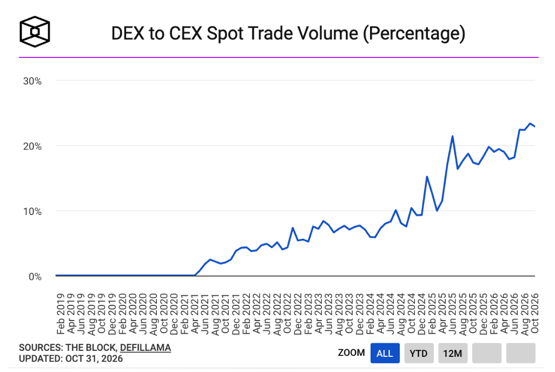
In fact, we’ve already seen Binance (and other centralized exchanges) lose significant market share to decentralized exchanges over the past few years, with each exploit like this moving the needle even further in the direction of DEXs.
The Binance incident highlights a distinction that investors frequently misunderstand: owning digital assets does not necessarily mean benefiting from blockchain’s security model. When assets are held on a centralized exchange, investors are relying on that exchange’s internal systems, employees, and custody arrangements.
When assets are held in self-custody, they eliminate that particular intermediary risk, although they assume other risks involving private keys, wallets, and smart contracts.
Blockchain can reduce reliance on centralized intermediaries, but users who choose to use centralized intermediaries reintroduce many of the same vulnerabilities that exist in traditional finance.
Predictably, critics will use this incident as another opportunity to question the safety, legitimacy, and long-term viability of cryptocurrency and blockchain technology. But there’s a fundamental problem with that conclusion.
Binance was hacked. Blockchain wasn’t.
The underlying blockchains continued operating exactly as designed. They processed transactions that appeared to have been legitimately authorized, even though the people initiating them were criminals. The failure appears to have occurred within the organization responsible for safeguarding customer assets, not within the technology used to transfer them.
And if that distinction sounds familiar, it should.
Because traditional financial institutions have been suffering from compromised employees, inadequate internal controls, cybersecurity breaches, and outright criminal misconduct for decades. The only difference is that when a bank gets hacked, nobody blames the dollar. When a brokerage suffers a security breach, nobody questions whether stocks should exist.
Yet when a cryptocurrency exchange gets hacked, the entire blockchain industry is suddenly put on trial. That double standard deserves a closer look.
The Weakest Link in Finance Has Always Been Human
For all the criticism directed at cryptocurrency exchanges following security breaches, traditional financial institutions have an extraordinarily long history of cybersecurity failures, employee misconduct, inadequate internal controls, and outright fraud. The difference is that these incidents are generally viewed as failures of the institutions involved, rather than evidence that the underlying financial system is fundamentally flawed.
Consider some of the largest cybersecurity incidents involving traditional financial institutions:
These weren’t failures of the U.S. dollar, the stock market, or the banking system’s underlying payment infrastructure. They were failures of cybersecurity, employee access controls, vendor oversight, and operational risk management.
And cybersecurity breaches are only part of the story. When we expand the analysis to include employee misconduct, fraud, and compliance failures, the numbers become even more staggering.
These four cases alone resulted in nearly $10 billion in regulatory and criminal settlements, and they represent just a small fraction of the misconduct and operational failures that have occurred throughout traditional finance.
Of course, regulatory fines are not the same as stolen customer assets, and exposing personal information is not equivalent to losing billions of dollars in cryptocurrency. But the common denominator across these incidents is that sophisticated financial institutions, despite decades of regulatory oversight and enormous investments in compliance and cybersecurity, remain vulnerable to human error, compromised credentials, inadequate controls, and employees who deliberately circumvent the rules.
And when these failures occur, the response is generally to punish the offending institution, strengthen internal controls, improve oversight, and hold responsible individuals accountable.
Nobody suggested abandoning the dollar because Wells Fargo employees committed fraud. Nobody concluded that equities or bonds were fundamentally unsafe because JPMorgan traders manipulated markets. And nobody questioned the long-term viability of electronic banking because Capital One suffered a massive data breach.
Yet the crypto industry is routinely subjected to precisely that kind of criticism. This is especially ironic given that blockchain technology was designed, in part, to reduce the need to trust centralized intermediaries. The technology allows transactions to be independently verified, ownership to be transparently recorded, and assets to be transferred without relying on a traditional financial institution to maintain the ledger.
But when customers deposit their assets onto a centralized exchange, they reintroduce many of the same risks that have always existed in traditional finance. They are once again trusting an institution to safeguard their assets, maintain appropriate internal controls, protect employee credentials, and prevent unauthorized transactions.
The technology may be different, but the weakest link remains exactly the same: people.
And as the Binance hack demonstrates, even the most sophisticated technology in the world cannot protect customers from an institution that fails to adequately secure the systems and people responsible for operating it.
The End of the Casino Era
Ironically, the Binance hack may accelerate one of the most important trends already underway in digital assets: the institutionalization of crypto. For years, crypto-native companies competed primarily on speed, innovation, leverage, token listings, and customer acquisition, often treating operational controls as an afterthought. But as institutional capital enters the ecosystem, the competitive advantage is shifting toward security, custody, compliance, and risk management. Investors will increasingly demand stronger protections, while exchanges that cannot meet those standards will face higher costs of capital, reduced liquidity, and declining market share.
This is precisely why we’ve argued that the industry is moving beyond the dot-crypto era, when blockchain companies operated largely in isolation from traditional finance. As banks, brokerages, asset managers, and payment companies increasingly adopt blockchain infrastructure, they bring decades of experience managing operational and counterparty risks. They certainly aren’t immune to failures, as the examples above demonstrate, but their participation should raise standards across the industry. And importantly, the solution isn’t necessarily to abandon centralized intermediaries in favor of decentralized finance, or vice versa. It’s to build a financial system where customers have better choices, stronger protections, and less dependence on any single institution.
Ultimately, the lesson from Binance isn’t that blockchain technology has failed. It’s that the companies operating on top of it must mature. The same technology that enables transparent, programmable, 24/7 financial markets also demands rigorous security and operational discipline. As blockchain becomes embedded in the global financial system, the distinction between crypto companies and traditional financial institutions will continue to disappear.
The future of finance may increasingly run on blockchain technology. The question is no longer whether the technology works, but whether the institutions using it can be trusted.
As an Investor, I’m Frustrated
At Arca, we’ve been investing in digital assets for more than eight years. During the early years, one of our biggest challenges was simply figuring out how to value these investments. But that has changed dramatically. Today, many of the best investments in blockchain are ordinary, boring public equities that can be analyzed using traditional valuation methods. Others are tokens that, for all intents and purposes, look and behave just like stocks. The difference is that instead of relying exclusively on quarterly filings and management commentary, we can often track revenues, transactions, users, and other fundamental metrics in real time, directly on the blockchain.
It’s never been easier to make informed, fundamentally driven investment decisions in crypto.
Which is why this latest hack is so frustrating.
It’s already difficult enough to educate new investors about this industry when so much misinformation continues to circulate. It’s even harder when, every six to twelve months, another exchange failure, exploit, or fraud forces us to write yet another article defending the entire asset class against the actions of a handful of bad actors.
We’ve spent years explaining why blockchain technology can improve financial markets through greater transparency, efficiency, accessibility, and accountability. And the evidence supporting that thesis has never been stronger. Yet incidents like this continue to overshadow the progress being made, reinforcing outdated perceptions of an industry that has evolved dramatically.
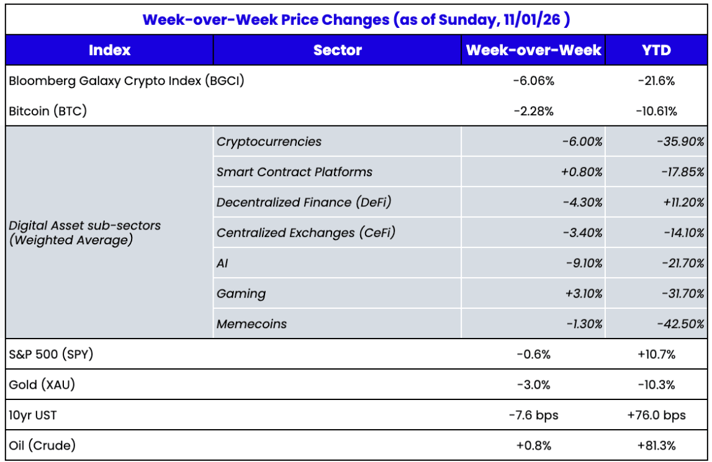
The technology has matured. The investment opportunities have matured. It’s time for the companies operating this technology to mature as well. Fortunately, from a price standpoint, this hack will likely come and go with little fanfare.

And That’s Our Two Satoshis!