




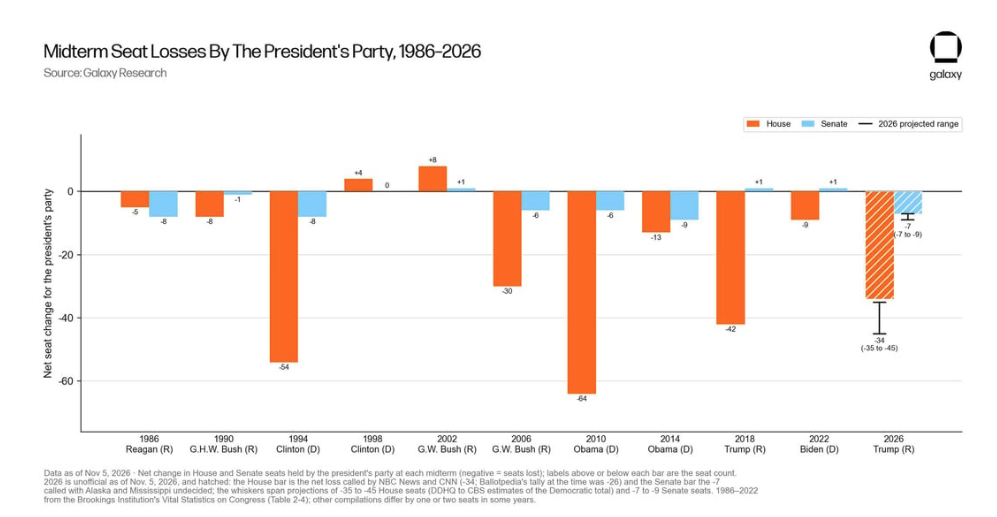
The Democrats delivered a resounding victory in Tuesday’s midterm elections, flipping both the House and Senate and effectively ending Republican control of Washington for the remainder of President Trump’s second term. According to Galaxy Research, Democrats flipped at least seven Senate seats and 35 House seats, marking one of the strongest midterm performances by an opposition party in decades.
The results were particularly interesting given the ongoing disconnect between economic fundamentals and consumer sentiment. We’ve written extensively about the surprisingly resilient U.S. economy, with strong GDP growth, relatively low unemployment, and healthy corporate earnings despite consumers repeatedly telling pollsters how miserable they are. Perhaps those surveys weren’t telling us much about the economy at all. Instead, they were telling us how unhappy voters were with the cost of living and the political establishment. Markets never go down, but politicians do.

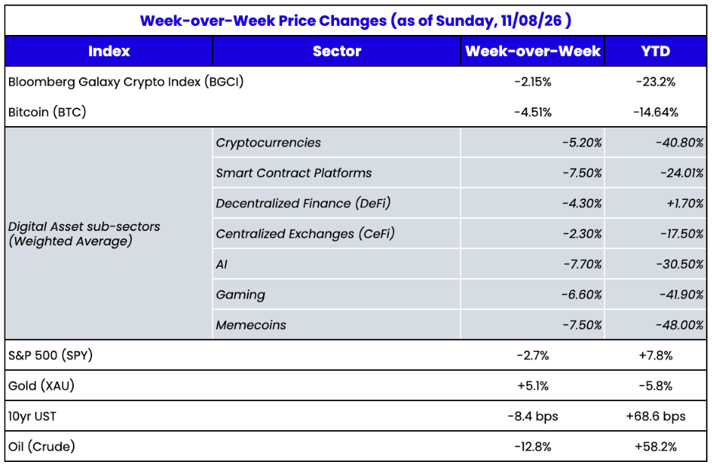
Financial markets initially shrugged off the election results, with both equities and digital assets rallying on Wednesday. But that optimism disappeared quickly on Thursday, as the S&P 500 declined 4.4% and the Nasdaq fell 5.5%. AI and semiconductor stocks were hit particularly hard amid concerns that a Democratic Congress and growing opposition to data-center development could threaten one of the market’s biggest investment themes. Crypto assets declined alongside the broader technology sector.
Crypto Spent a Fortune on Washington. What Did It Buy?
Perhaps no industry invested more aggressively in the political process over the past few years than crypto. And while the industry’s political spending helped elect numerous pro-crypto candidates, Tuesday’s results raised some uncomfortable questions about the effectiveness and durability of that strategy.
The most glaring example came in Ohio, where former Senator Sherrod Brown defeated Republican incumbent Jon Husted despite approximately $64 million in spending by crypto-backed political groups like Fairshake that supported Husted and opposed Brown. Brown, a longtime critic of digital assets and former Chairman of the Senate Banking Committee, had himself been defeated in 2024 by crypto-friendly Bernie Moreno. Just two years later, he headed back to Washington.
To be fair, the industry’s political spending wasn’t universally unsuccessful. Many pro-crypto candidates won, including Democrats Ritchie Torres, Josh Gottheimer and Kirsten Gillibrand. But the election demonstrated that crypto money alone cannot overcome broader political dissatisfaction. More importantly, it raises the question of whether the industry has become too closely associated with one political party.
We’ve long argued that blockchain technology should be politically agnostic. Financial infrastructure shouldn’t be Republican or Democrat, any more than the internet, credit cards or electronic trading systems should be. The industry’s goal should be sensible, durable regulation that survives changes in political leadership, not simply electing politicians who promise favorable treatment.
What Actually Changes for Crypto?
The immediate legislative outlook has undoubtedly deteriorated. The CLARITY Act, which was already facing obstacles, now faces a much more difficult path toward passage. Democrats are reportedly considering their own broader market structure legislation, but meaningful bipartisan progress seems unlikely in the near term.
Committee leadership will also change dramatically. Elizabeth Warren is positioned to chair the Senate Banking Committee, while Maxine Waters is seeking to lead the House Financial Services Committee. Neither has been particularly friendly toward the digital asset industry, and both will have considerably more power to investigate crypto companies and influence future legislation.
In fact, the investigations are already beginning. On Thursday, Senator Richard Blumenthal, the incoming Chair of the Senate Permanent Subcommittee on Investigations, sent letters to Binance, Tether, World Liberty Financial and Fight Fight Fight LLC, demanding cooperation with ongoing investigations by January 4, 2027, or potentially face additional measures to compel compliance. The inquiries cover everything from illicit cryptocurrency transactions to potential conflicts of interest involving the Trump family’s crypto businesses. No wrongdoing has been established, but the message is clear: congressional scrutiny of crypto is about to intensify.
Perhaps the most obvious potential losers are investments directly tied to President Trump himself. The TRUMP memecoin and World Liberty Financial (WLFI) are particularly vulnerable to increased congressional oversight, investigations into potential conflicts of interest, and a deterioration in political sentiment. Unlike most blockchain businesses, whose value should be determined by customers, revenue, and adoption, these investments are much more closely tied to the political fortunes of one individual.
However, there is an important distinction between legislation and regulation.
The GENIUS Act has already been signed into law, providing a federal framework for stablecoins, with implementation continuing into 2027. Meanwhile, the SEC, CFTC and banking regulators still have the authority to advance much of the regulatory work already underway. The administration has two more years to clarify rules governing custody, tokenization, trading and other digital asset activities, even without new legislation. That said, both Democratic seats on the SEC are vacant, and the CFTC is operating with one commissioner, Chairman Selig, with four vacancies. Beginning in January 2027, a Democratic Senate will decide on every nominee. It's plausible that until Democrats fill their seats, they may argue that rules written by a one-member CFTC lack legitimacy. Courts may agree: bipartisan House Agriculture leaders warned in May that a sole-commissioner CFTC writes less durable rules.
This could also create winners and losers within crypto. Established, regulated stablecoin issuers like Circle (CRCL) may benefit from an environment in which compliance becomes increasingly important, while less established competitors face greater scrutiny. And although the political environment has changed, the SEC’s ability to provide regulatory guidance on token buybacks, liquid staking, and tokenized securities has not disappeared.
The Investment Opportunity Hasn’t Changed
We’ve spent much of the past eight years arguing that the most important applications of blockchain technology will ultimately be stablecoins, payments, decentralized finance, and the tokenization of traditional financial assets. None of those opportunities disappeared on Tuesday.
Companies will continue tokenizing stocks, bonds, and commodities. Stablecoins will continue improving the efficiency of global payments. DeFi will continue to offer financial services that can be faster, cheaper, and more accessible than traditional alternatives. These trends are driven by technological improvements and economic incentives, not election results.
In fact, there is something almost ironic about the industry’s reaction. Crypto investors spent years demanding regulatory clarity. Now that much of that clarity is finally emerging, the market still seems determined to treat crypto as a political trade rather than an investment in a rapidly evolving financial system. The good news is that so few people care about crypto anymore that it’s unlikely to be a hot-button issue in Congress as it was in years past.
The election may delay certain legislation, increase regulatory scrutiny, and create volatility for digital asset prices. It may also force the industry to rethink its political strategy. But it doesn’t change the fundamental investment thesis.
The best blockchain investments shouldn’t require Republicans to win elections any more than the best technology companies require Democrats to win them. The sooner investors start distinguishing between political speculation and actual economic value, the better off this industry will be.
And That’s Our Two Satoshis!