
Source: TradingView, CNBC, Bloomberg, Messari
What exactly do crypto investors want to see?
The digital assets market struggled again last week, though to a lesser extent than in recent weeks. The most interesting fact about the continued weakness in crypto is that all of the supposed reasons for the decline have reversed, except price. Over the past 8 weeks, numerous fears and ex post explanations have been advanced regarding the cause of the market weakness. These include:
- A decline in rate cut expectations via a more hawkish Fed
- An expectation of tariffs being rolled back or more tariff headlines from Trump
- The repo and credit markets are showing signs of stress
- The TGA and QT were draining liquidity
- Strategy (MSTR) and DATs were going to be forced sellers of BTC and ETH
- Crypto winter is coming, and exchange volumes are going to fall off a cliff
- The Market Clarity bill was going to be delayed further in Washington
- ETF flows are decisively negative, and OG whales keep selling
Over the past few weeks, all of these concerns have dissipated.
- The Fed cut rates again in December, and a more dovish Fed Chair will soon be announced, and at least 50 bps more cuts are baked into 2026
- Tariffs aren't being rolled back
- Repo and credit are back to functioning perfectly fine, and credit spreads are back to the tights, while the VIX is also back to the recent lows
- TGA has been restored, and the Fed is now starting some version of QE while QT is ending
- MSTR and the DATs are not forced sellers (in fact, quite the opposite, as MSTR and BMNR were both big buyers the last few weeks)
- Crypto exchange volumes are showing remarkable resilience, with volumes still elevated
- The Clarity Act is moving along very quickly now, with many signs pointing to a quick resolution here
- ETF inflows have returned, and many whales are starting to accumulate
I'm not saying crypto will, or should, rally, but I’m definitely saying that the reason for the market decline has nothing to do with any of the above factors. And all of those who were definitively saying these were the reasons are just plain wrong.
However, the fact remains that crypto prices are still performing poorly. Which means we are still searching for a better answer as to why. The most plausible explanation is that the industry faces a valuation issue, a structural issue, or a misinformation problem.
From a misinformation standpoint, the disconnect between Bitcoin as an investment and blockchain as a growth engine persists. The growth of stablecoins, real-world asset tokenization (RWAs), and DeFi (spot, derivs, and lending) has become undeniable. These sectors are not just growing; they are exploding higher. Every graph showing usage, AUM/TVL, or revenues is up and to the right. But here’s the disconnect. The majority of conversations about crypto happening on Wall Street and in FinTech are squarely focused on utilizing stablecoins and RWA (i.e. issuance and fee capture), not investing in it. Meanwhile, the majority of actual investment discussions still center around Bitcoin. These big banks and investors are not asking about which tokens have value. No Wall Street firms are writing research about tokens. No Wall Street salesmen are pitching token investments. For whatever reason, the majority of new investors seem to think they can capture this growth solely by investing in Bitcoin, while simultaneously building on DeFi, stablecoins, and RWAs, even though there is no overlap whatsoever between these instruments. Bitcoin is largely decoupled from broader growth in the blockchain ecosystem, yet it still dominates both investment flows and price action. I’m not sure what changes that.
From a valuation and structure perspective, it may be much deeper. We’ve long been in the camp that most investors put equities on too high a pedestal compared to tokens, but that narrative persists. The majority of TradFi investors don’t believe in token rights and value capture, and even crypto-native investors are starting to turn against token structures. When people blindly attack the lack of “token holder protections” as if stockholders have so much better protections, I often remind them that stockholders are also completely at the mercy of management decisions. The structure of the investment rarely matters compared to the management team’s decisions. Companies can stop stock buybacks or dividends at any time, just as token issuers can start or stop buybacks. Companies can make poor capital allocation decisions by making bad acquisitions, spending too much on R&D, or paying employees too much, just as token issuers can. Not to mention that the only time you have a claim on assets as a shareholder is when they go bankrupt, at which time your claim is almost always $0.
In fact, if crypto investors had more knowledge about the history of capital markets, they’d probably realize "rug pulls" happen all the time in stocks, bonds, and real estate too. They just don't have a collection of retail investors on crypto Twitter complaining about it constantly, because it mostly happens to institutional investors, not retail. WeWork equity investors, Hovnanian debt investors, and Harrahs/Caesars holdco debt investors are examples in which equity or debt holders were seriously harmed by management decisions and by investors from other parts of the company’s capital stack. All of the magic "protections" that come with equity, debt, and real estate investing often become more show than substance as lawyers and distressed investors constantly find loopholes.
ALL investing comes with risks. The instrument (tokens versus stocks) is rarely the problem. The issue is that there are higher barriers to entry in other asset classes before you can issue these instruments to uninformed investors.
The majority of your gains or losses in any instrument will likely come at the mercy of management's decisions on how they run their business and how they allocate their capital. Not from laws or "protections".
As such, we’ve argued that many tokens appear substantially cheaper than the stocks of similar companies. That said, it’s not all rosy in token land either, as the following debacle with Aave demonstrates.
The Downside of Tokens That Have No Corporate Governance Structures - An AAVE Story
Written by Alex Woodard, Analyst at Arca
Over the past few years, we have spent considerable time discussing how DAOs and digital asset investors repeatedly encounter problems that traditional companies and established corporate governance frameworks have already solved. This week, the DeFi lend/borrow protocol Aave was in the spotlight after unilaterally redirecting a long-standing DAO (token) revenue stream to the Aave Labs entity (equity).
What happened?
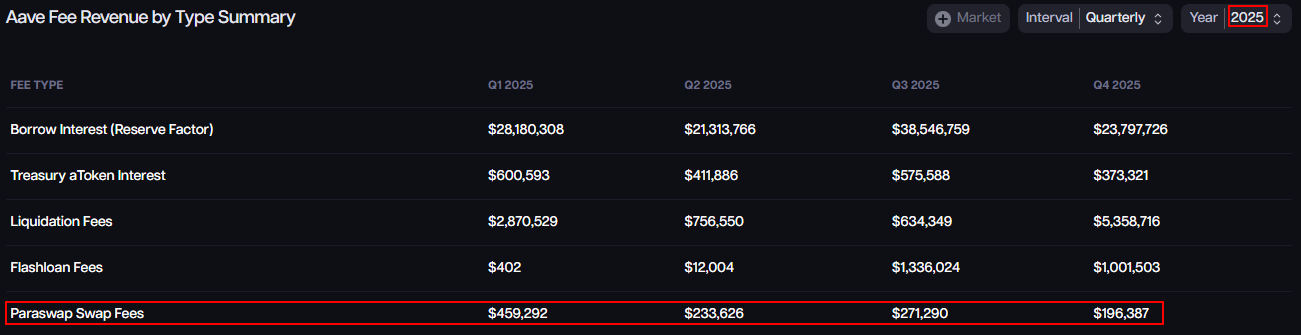
Aave recently migrated its on-site swapping feature from Parawap to CowSwap. This feature is best understood as a UX enhancement rather than a core product, where the primary function for users, as described in this governance post, is “...not to have to leave Aave (the protocol) to do any kind of swaps. This helped to increase user retention and resulted in an additional revenue source for the Aave DAO.” With the migration to CowSwap, Aave introduced a 15–25 bp fee on the swapping feature. Rather than flowing to the DAO (token) as under the Paraswap integration, these fees now flow to an address controlled by Aave Labs (equity).
Ultimately, these fees are not a large portion of Aave’s business, only accounting for ~$270K versus the $38.5M in borrow interest paid in 3Q2025.
The primary concerns center on ownership and alignment. DAOs and governance tokens have emerged in a model in which token holders own the protocol and fund its development. In contrast, the core development team and the primary user interface are owned by a private entity with its own equity. In response to the proposal above, Aave Labs stated (in the second comment), “The interface is operated by Aave Labs and sits entirely outside the protocol the DAO stewards. This has always been the separation of responsibilities. In practice, this means the DAO funds protocol development and approves changes to the protocol’s smart contracts on-chain. Aave Labs funds, builds, and maintains its own interface.”
At this point, it is increasingly clear that equity and token models seem inherently misaligned. While both are aligned early in a product’s life, when both are tasked with finding product market fit, Aave’s success is largely driven by the development work of Aave Labs. As the protocol matures, the equity can become directly competitive with the token. In Aave’s case, this is evident in actions such as redirecting swap fees or attempting to launch a second token for an RWA platform.
Ultimately, the best solution may be to eliminate either the equity or the token, as having both makes a project nearly uninvestable. While they can work together (Binance and Pump.fun both have equity and tokens, and each part of the capital stack is growing in a symbiotic way), such examples are rare and much harder to execute. As an investor, I want to bet on growth and the management team’s ability to make sound capital-allocation decisions—not have to heavily discount my position because the team might introduce a feature that benefits equity at the expense of the protocol.