


I’m a die-hard baseball fan, historian, coach, and former player, so it doesn’t take much to excite me. But I was genuinely impressed by the quality of play, the players' personalities, and the league itself (considering it’s less than a week old, privately funded, and has only 4 teams, all playing in the same stadium). So immediately, I wondered, “Does anyone even know this exists?”
My answer is probably not. There is a lot of educational friction.
So it dawned on me. This isn’t a product problem; it’s a distribution problem. Sound familiar?
Great Products Can Hide Behind Terrible Distribution
Most investors assume that if something is truly great, everyone would already know about it. The reality is often the opposite.
Crypto has spent a decade in this same predicament.
People judge crypto solely based on what they see and hear the most:
… instead of:
Attention and importance are rarely the same thing. The media doesn’t always report what’s most important. It reports what’s easiest to explain, or what evokes the highest emotional response.
The National Anthem vs. The Baseball
Opening weekend of the WPBL should have been about incredible athletes, the history of professional women’s baseball dating back to the WWII era All-American Girls Professional Baseball League (see “A League of Their Own”), and the individual journeys many of these women took to get here considering there is no clear path for women in baseball (many are forced to switch to softball at an early age as baseball doesn’t exist beyond 12 years old for girls). There is a 38-year-old rookie (Meggie Meidlinger) alongside women who are still in college, as well as women who have full-time jobs who took 2 months off to join this new league.
Instead, the biggest story on social media became a mockery of a very rough national anthem (admittedly, it was bad). Clips of the anthem quickly generated millions of views—orders of magnitude more attention than anything that actually happened on the baseball field.
Crypto has lived that story for years. When something meaningful happens:
… almost nobody notices.
But…one hack, one meme coin, one celebrity rug pull… and everyone writes about it. I’ve been talking to financial media about crypto for 8 years now. I’d estimate that 99% of the inquiries I receive are about fraud, scams, or Trump.
It’s much easier to report on the circus than the construction. Building is slow. Infrastructure is boring. Progress happens one brick at a time. Failure, controversy, and embarrassment generate immediate clicks.
Kelsie Whitmore is the Bitcoin of the WPBL
If you know anything about women’s baseball, there’s a decent chance you’ve already heard of Kelsie Whitmore. And for good reason. Whitmore has spent most of her career playing baseball against men because, until now, there simply wasn’t a professional women’s league for her to play in. At just 17, she joined the Sonoma Stompers in 2016, becoming one of the first women to play professional baseball since the 1950s. She later joined the Staten Island FerryHawks in 2022, becoming the first woman to play in the Atlantic League, and has since played for the Oakland Ballers and the wildly popular Savannah Bananas, while also representing Team USA internationally. So when the WPBL held its inaugural draft, it wasn’t much of a surprise that Whitmore was selected No. 1 overall by San Francisco. She’s been the face of women’s baseball for years, repeatedly breaking barriers and generating national media coverage along the way. In many ways, she’s the WPBL’s Bitcoin—the name even casual observers are most likely to recognize, the pioneer who helped prove this could actually work, and completely deserving of the attention she receives.
But just like Bitcoin, focusing solely on Whitmore obscures how much other talent lies beneath the surface.
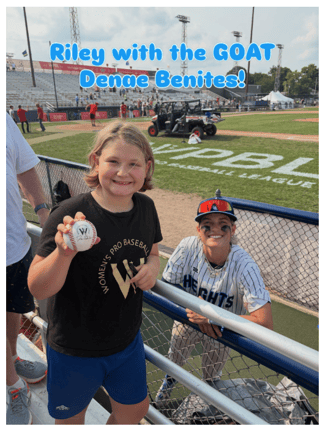
Like most of you, I had never heard of Denae Benites before last month. The 25-year-old catcher has been a fixture on the U.S. Women’s National Baseball Team, helping Team USA win gold at the 2019 COPABE Women’s Pan-American Championships and competing at the Women’s Baseball World Cup. She also plays in the Savannah Bananas league (for the Coconuts), and was one of the top prospects entering the WPBL, where the New York team selected her 6th overall. At the games this weekend, it is easy to see why she is a bona fide star. Not only is she a stud defensive catcher, but she is 14 for her first 17 at the plate (.823 BA) with 5 HRs in just 4 games and leads the league in every single offensive category (MVP, MVP, MVP!!!). More importantly, during a game in 100°F heat (where the umpire passed out from heat stroke), Benites caught a pre-game bullpen, caught the entire game, was the first person to high-five her teammates after every inning, and spent 30 minutes signing autographs after the game despite being exhausted (including signing a ball and taking a picture with my daughter). Just a class act all around (she’s also a firefighter when not playing baseball, so that probably helped against the heat). The fact that none of you know who she is is not a reflection of her talent, character, or résumé; it’s a reflection of how little infrastructure has existed to turn great women’s baseball players into recognizable stars.
The Stars Are Already Here
Now, let’s bring this back to crypto again for a second. If you go to the WPBL website and look at the rosters, this is what you see:
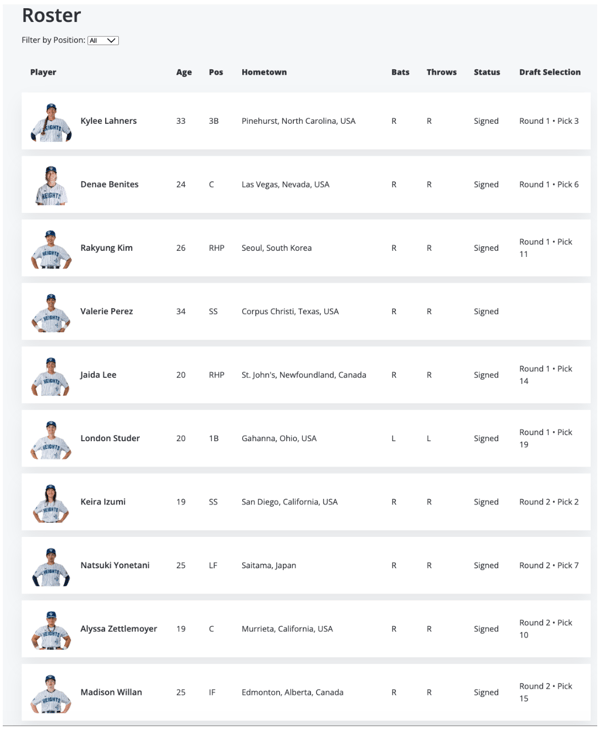
Does that excite you? Of course not. Can you differentiate Denae Benites from any of her teammates? Of course not. Nothing against her teammates, but they are not Denae Benites. It didn’t take much research to find out how incredible she is, but it did take some effort and time.
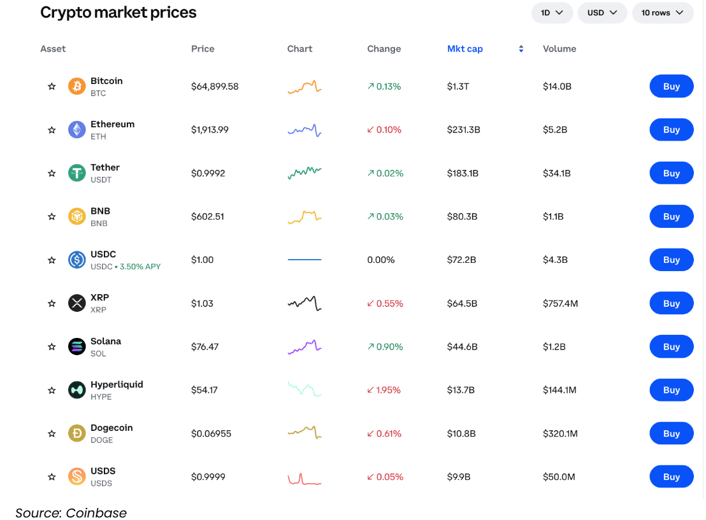
This is the equivalent of going to Coinbase, Robinhood, Kraken, or Binance and seeing this. Does this excite you at all? When you see this, can you differentiate a memecoin like Dogecoin (DOGE) from a stablecoin (like USDC and USDT), from a complete hoax of a token like Ripple (XRP), from Hyperliquid (HYPE), which is an innovative company with $1 billion in run-rate annual revenues and three great product offerings, and an equity-like token that is bought back with 99% of the company’s revenues? The distribution and marketing of these crypto assets is a complete joke. Misinformation is everywhere.
I went to the WPBL and watched all 4 teams play. I’ve watched every other game on ESPN+. I saw rising stars like Denver Bryant, probably the most athletic person on the field. I saw the slickest fielding middle infielder, Joely Leguizamon, the first Dominican woman to play professional baseball in the United States. I saw a player born one-handed, Britt Apgar, who hits and plays the field as well as any of them. I saw 19-year-old Keira Izumi, who is still in school at USC and coaches an all-girls baseball league for kids here in Los Angeles (go LA Heat!). I saw women from Canada, Japan, South Korea, and all over Central America.
The point is, I had never heard of most of them, but now I’m curious enough to research all of them and find out more. And when I do, I can’t stop talking about them, and my daughter can’t stop talking about them. But I had to do all of this research on my own.
Granted, independent companies are picking up the slack. In crypto, companies like Artemis, Dune Analytics, The Block, Blockworks, Messari, DeFiLlama, and many more are trying to do the work that Coinbase, Kraken, Binance, and other industry leaders should have been doing. They are showcasing the talented assets, whereas the big behemoths simply plead ignorance. Similarly, while ESPN and MLB won’t showcase the WPBL stars, independent analytics companies are already building dashboards to highlight the women ballplayers. One of the biggest differences, though, is that all of the WPBL players and staff are celebrating one goal – to amplify the game. Their social media presence is unified, and stars and support staff alike are all posting the same content. Whereas in crypto, it’s all infighting, so maybe one protocol wins over another, or one exchange wins over another, but collectively the entire crypto industry loses due to misinformation.
Watching the WPBL felt a lot like discovering Hyperliquid two years ago. The stars aren’t hidden, and the assets aren’t the problem. They just weren’t being talked about, and I didn’t know where to look. Everything is publicly available; you simply have to care enough to find it.
For example, did you know all of these Hyperliquid dashboards are available to track the company’s real-time revenues, volumes, and progress? Just like the WPBL stats, it’s all available if you know where to look. But the biggest companies in crypto, and the media, won’t help you find it.
| Dashboard Description | Link |
| Best overall dashboard | https://hl.eco/ |
| Dashboard built by Hyperliquid Team | https://stats.hyperliquid.xyz/ |
| Artemis dashboard | https://app.artemis.xyz/project/hyperliquid?from=chains |
| Dune analytics dashboard | https://dune.com/lajota_777/hyperliquid-metrics-link-by-0xjota |
| Hyperliquid burn dashboard | https://www.hypeburn.fun/ |
| Hyperliquid builder codes revenue dashboard | https://www.hypeburn.fun/builders |
| Builder codes master dashboard | https://www.flowscan.xyz/builders?builder=phantom |
| Hyperliquid financials dashboard | https://www.skewga.com/hyperliquid |
| Builder codes dashboard | https://www.flowscan.xyz/builder-intelligence |
| HIP-3 dashboard | https://hyperzap.io/hip3 |
| Hype User Bias dashboard | https://app.coinmarketman.com/hypertracker/perps/btc |
The Players in 2036 Will Be Better Than the Players in 2026
Now, I don’t want to entirely glaze the WPBL. These women are very good, but they are not a finished product. It’s year 1, and many of these women are migrating over from softball, which is a completely different sport. They don’t get the reps or the instruction that the men get. Many have other full-time jobs while playing in the league. Sometimes routine fly balls drop simply because the women aren’t as fast or as strong as the men, and can’t cover as much ground. But if you have eye-black on your face and dirt on your pants, you’re a ball player. And they are creating a path to future success. One of the coolest parts of the weekend wasn’t watching today’s stars; it was imagining the stars we’ll see ten years from now, once the infrastructure is built out and the pipeline exists for girls like my daughter to follow in their footsteps.
For the first time, little girls can realistically dream about becoming professional baseball players. My daughter currently plays on all-boys teams in Los Angeles. Soon, she will have the chance to play with other girls. There will be more participation, better coaching, more competition, more development, and a much deeper talent pool.
Crypto evolves exactly the same way. Bitcoin proved that decentralized money was possible. Ethereum showed that blockchains could be programmable. But HYPE, AAVE, AERO, SYRUP, and today’s generation of crypto assets had something Bitcoin and Ethereum didn’t have when they launched: 10+ years of successes and failures to learn from.
Now, that doesn’t mean the whole industry is great. It’s not. There are very few “investable crypto assets” today. Similarly, I’d estimate half of the WPBL players will probably be replaced next year by better players. There were 600 women trying out for 60 roster spots… I bet those other 540 are working their butts off right now to make the team next year. Similarly, the good token issuers are working hard to improve their token and their product, to outpace the deadbeat L1 tokens and memecoins from yesteryear.
These assets aren’t replacing the early crypto pioneers any more than the girls playing baseball in 2036 will diminish what Kelsie Whitmore and Monae Davis accomplish in 2026. They’re standing on their shoulders. They can build better tokenomics, better user experiences, and better business models because someone else already trailblazed the path and made the mistakes. The first generation proves that something is possible. The next generation figures out how to make it better.
Good Things Take Time
The WNBA is perhaps the best example of why good things take time. The NBA Board of Governors approved the creation of the WNBA in 1996, and the league tipped off a year later with eight teams. For nearly three decades, the NBA and its owners continued investing in the league despite persistent losses and plenty of critics questioning whether the business would ever work. And while the WNBA’s profitability is still debated, its trajectory no longer is. Attendance, viewership, sponsorships, and franchise values have exploded, and its new media rights agreements are worth billions of dollars. It took almost 30 years to become an overnight success.
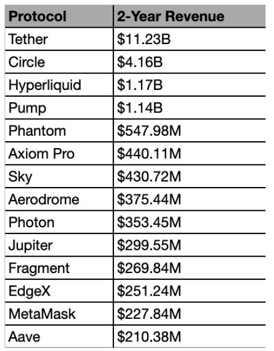
Crypto looked exactly the same. For years, critics asked, where are the profits? Well, look under the hood. Blockchain businesses are booming. There are now 14 on-chain businesses generating $200M+ in 2-year revenue. The 10 largest crypto apps generated $5.9 billion in revenue over the past year. These are real businesses earning real fees from trading, lending, and staking. In 2021, very few decentralized apps made money. If this industry hadn’t blown itself up on fraud, memecoins, and false promises, you could argue the blockchain industry has never been in a better position than it is today. Infrastructure businesses could become highly profitable. The ecosystem simply needed time to mature.
Source: DeFiInvestor
Maybe the WPBL Should Have Its Own $WPBL Token?
And while we’re drawing parallels between the WPBL and crypto, here’s a free idea: the WPBL should issue its own token.
One of the league’s biggest challenges today is capital. It needs money to market its players, improve its website and statistics, develop youth programs, expand the league, and ultimately pay these women more. Issuing a crypto token could potentially help fund that growth while simultaneously turning the league’s earliest and most passionate fans into stakeholders in its success. As I’ve always said, digital assets are one of the greatest capital formation and customer bootstrapping mechanisms we’ve ever seen, aligning all stakeholders, from customers to founders to employees to passive token holders, and turning customers into power users and evangelists.
Imagine if WPBL token holders received discounts on merchandise and tickets, exclusive access to players or events, voting rights on certain league decisions, or other benefits. And imagine if some portion of the league’s future economics were ultimately used to buy tokens back from the open market. Suddenly, the same people helping fund and evangelize the league in its infancy could participate financially if the league succeeds.
That’s exactly what tokens can be when designed correctly: a combination of capital formation, ownership-like economics, utility, and community.
And if anyone from the WPBL happens to read this, we have some ideas worth considering.
The Investing Lesson
Spending a weekend around the WPBL reminded me why I love investing in crypto. The headlines weren’t the story. The story was about dozens of incredibly talented women playing professional baseball at a level almost nobody knew existed.
Crypto is the same.
The headlines are hacks, scams, and meme coins. The real story is an entirely new financial system quietly being built underneath them.
Investors constantly tell me they’re looking for asymmetric opportunities. Then they avoid every market where discovery is difficult and alpha is prevalent. The best opportunities rarely arrive with polished marketing, perfect websites, prime-time television coverage, and Wall Street analysts.
Sometimes they arrive with terrible distribution, almost no media coverage, and products that require you to do a little work.
That’s where alpha lives.
And That’s Our Two Satoshis!