




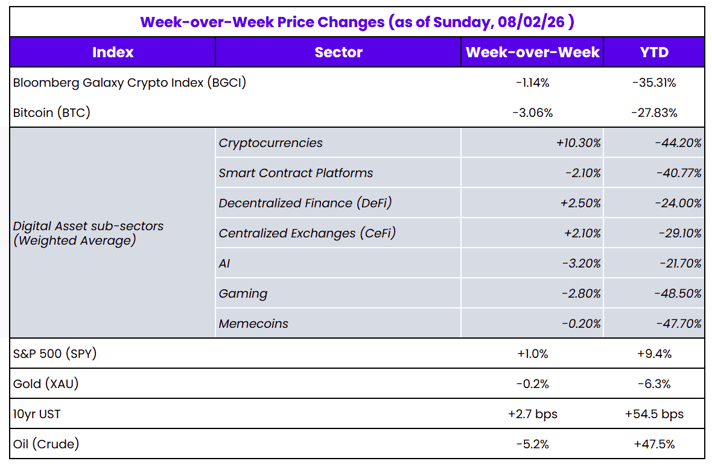
The most important development in digital assets this summer isn’t legislation, macro, or earnings. It’s that investors are finally learning the difference between noise and signal. One of the hardest parts about investing in digital assets over the last decade hasn’t been figuring out what matters. It’s been figuring out what should matter.
For years, crypto was a market driven almost entirely by narratives. Every Federal Reserve meeting, every SEC lawsuit, every ETF filing, every exchange listing, every politician’s comment, and every new Layer-1 blockchain seemed capable of moving the market by double digits. Price action wasn’t necessarily a reflection of fundamentals; it was a reflection of whatever headline happened to dominate Crypto Twitter that day.
Last week felt different.
Think about everything that happened over the past several days. The CLARITY Act, which many expected to become the first comprehensive market-structure legislation for digital assets in the United States, appears increasingly unlikely to become law this session. The Federal Reserve left interest rates unchanged, but three governors dissented from the decision, and Fed Fund futures are now pricing in an 85% chance of at least one hike by year-end. One of the highest-profile AI hedge funds in the world (Situational Awareness) became a forced seller, dragging AI infrastructure stocks sharply lower. Coinbase reported another disappointing earnings quarter and watched its stock get punished once again.
Five years ago, or frankly even two years ago, that collection of headlines probably would have produced a meaningful correction across digital assets.
Instead, Bitcoin barely moved. Ethereum continued its quiet march higher. And the market largely shrugged.
That’s not because these stories weren’t important. They were. It’s because the market is finally getting better at distinguishing between headlines that change intrinsic value and headlines that simply dominate social media for 24 hours. That’s a healthy evolution.
The CLARITY Act Is Probably Dead. The Market Doesn’t Seem To Care.
Over the past two months, my colleague David Nage has done an outstanding job chronicling both the promise and the political reality surrounding the CLARITY Act. His recent articles (More CLARITY on CLARITY, CLARITY’s Home Stretch, and The CLARITY Act’s Last Fight Isn’t About Crypto) captured what became an increasingly frustrating realization: the debate in Washington slowly stopped being about digital assets and became another proxy battle over politics.
David repeatedly pointed out that the bill itself continued to enjoy meaningful bipartisan support. The underlying policy questions weren’t the obstacle. The politics were. As he wrote, the final hurdle wasn’t about whether America needs digital asset legislation. It was about ethics concerns, partisan maneuvering, and whether either side was willing to hand the other a legislative victory.
Anthony Scaramucci perhaps summarized the situation most bluntly this week:
“It now feels like Republicans don’t want the CLARITY Act to pass so they can blame Democrats and raise more money from the crypto industry. Put the bill on the floor. If Republicans won’t do that, the industry should stop donating until they do. Let’s see who actually supports it.”
Whether you agree with Scaramucci or not, his broader point reflects what many in the industry increasingly suspect: market structure legislation has become political theater.
Ironically, that’s exactly why the market’s reaction has been so encouraging. Not long ago, the apparent death of the industry’s most important piece of legislation would have triggered widespread selling. Instead, digital assets barely blinked. Investors seem to be recognizing something important: legislation certainly matters over the long run, but it doesn’t necessarily determine the value of networks that are already growing, generating fees, onboarding users, and attracting developers.
Washington matters. It just doesn’t matter as much as it used to.
Market Leaders Changed Without Anyone Really Noticing
While everyone was focused on Washington, something much more interesting was happening beneath the surface.
For most of 2026, market leadership came from what I’d describe as the “next generation” of crypto assets. Hyperliquid (HYPE), Aerodrome (AERO), Near (NEAR), Venice (VVV), Akash (AKT), Jito (JTO), and a variety of AI-related infrastructure projects consistently outperformed Bitcoin and Ethereum. Investors wanted higher-beta exposure to the fastest-growing corners of crypto, particularly AI, stablecoins/payments, RWA tokenization, decentralized infrastructure, and next-generation DeFi.
Then July happened. Many of those winners got absolutely slaughtered.
Some of that was profit-taking after extraordinary runs. Some of it reflected broader weakness in AI-related equities. Some of it was simply a reminder that the highest-beta assets usually become the highest-beta losers whenever sentiment cools. At the same time, something equally notable occurred.
For the first time all year, the majors quietly reclaimed leadership.
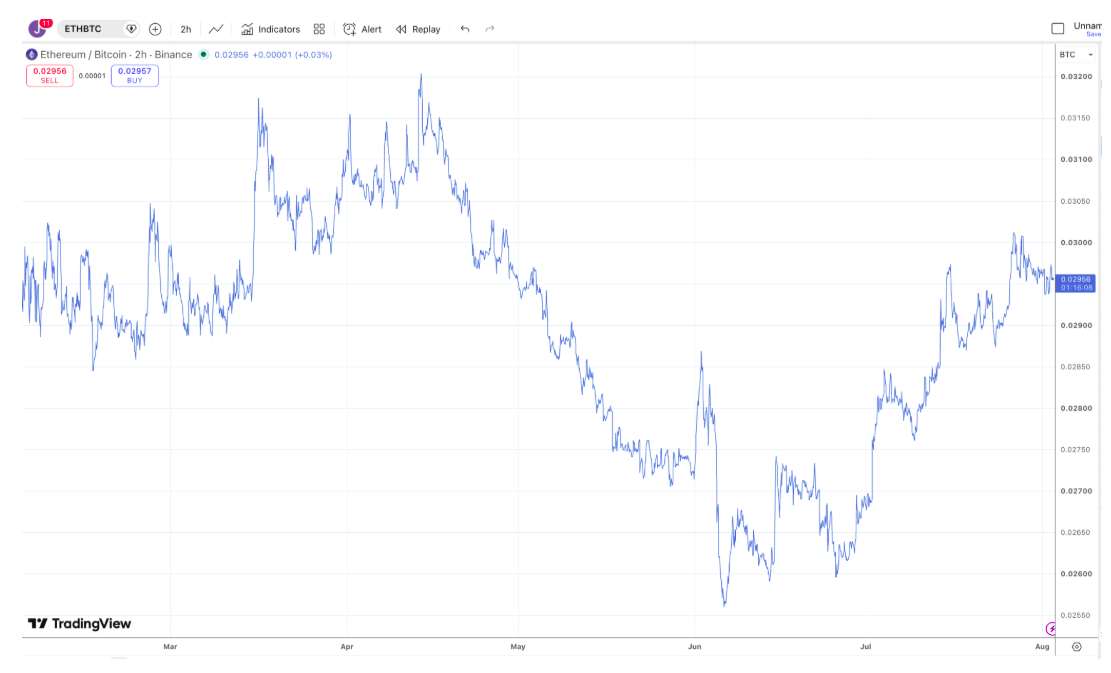
That’s a remarkable shift. For years, Ethereum was a perpetual disappointment. It consistently underperformed Bitcoin, lost mindshare to faster Layer-1s, and became the favorite punching bag of crypto Twitter. Suddenly, it’s acting like the institutional-quality asset many investors always hoped it would become.
None of this means the AI trade is over. Nor do I think HYPE, AERO, or many of the other projects that sold off have fundamentally changed. Healthy bull markets don’t have the same winners forever. They rotate. That’s exactly what appears to be happening now.
Even The Fed Couldn’t Move Crypto
The same pattern played out on a macro level. The Federal Reserve left interest rates unchanged this week, though, for the first time in years, it wasn’t a telegraphed slam-dunk decision. More interestingly, three Fed governors dissented from the decision, as Warsh has indicated that he wants more free thinking inside the Fed, not just groupthink. Normally, markets obsess over these meetings. Every word in Jerome Powell’s press conferences got dissected. Every comma in the FOMC statement gets interpreted. Rate probabilities swing wildly based on nuances that most people outside financial markets would never notice.
Crypto used to be especially guilty of this. Every Fed meeting became an excuse to explain whatever prices happened to do afterward.
This week? Not much happened. That’s actually a good sign.
Markets are increasingly separating macro from crypto-specific fundamentals. Monetary policy obviously still matters. Liquidity always matters. But we’re reaching a point where digital assets don’t need every macro headline to justify their existence.
Not Every Forced Seller Is Archegos
One of the biggest stories this week had nothing to do with crypto. It was the unraveling of Leopold Aschenbrenner’s Situational Awareness fund.
The headlines immediately drew comparisons to Archegos Capital, and on the surface, it’s easy to see why. A highly leveraged fund, forced selling, and sharp declines in many of its largest positions. Rumors are spreading faster than facts.
But I think that’s the wrong comparison.
Archegos wasn’t simply overleveraged. Archegos owned enormous percentages of many of the companies it invested in – sometimes 25%, 30%, or even more. Once it became a forced seller, there simply weren’t enough buyers. Those stocks didn’t just decline. Many of them stayed impaired for years because the market had to absorb an extraordinary amount of stock with no natural bid.
Aschenbrenner wasn’t sitting on controlling stakes in illiquid companies. He was running a highly leveraged portfolio of some of the most liquid AI companies in the world. When leverage got too high, the solution wasn’t bankruptcy or liquidation; it was finding someone willing to take the other side (Citadel).
The fund sold positions, reduced leverage, and will survive. More importantly, the underlying investment thesis didn’t suddenly become wrong simply because leverage management became a problem. If anything, Aschenbrenner has spent the last several years establishing himself as one of the sharper long-term thinkers on artificial intelligence. Nothing that happened this week changes the broader view that AI infrastructure spending will likely remain one of the defining investment themes of this decade.
And I would not be surprised if Aschenbrenner raises $5-10 billion in additional funds sometime in the next few months and slowly builds back all of these positions, this time without leverage.
Bitcoin Miners Aren’t Just Bitcoin Miners Anymore
The knock-on effects from the Situational Awareness / AI carnage were particularly interesting for digital asset investors. Many of the companies that sold off weren’t crypto companies at all. They were AI infrastructure names. Over the past two years, however, the line between those two industries has become increasingly blurred.
Some of the biggest Bitcoin miners have quietly transformed themselves into AI infrastructure companies. Companies that once competed almost exclusively on hash rate are now competing on power availability, data center capacity, cooling technology, and GPU infrastructure.
That’s why the WGMI Bitcoin Miners ETF has increasingly traded like an AI infrastructure ETF rather than a pure Bitcoin proxy, and it got slaughtered last week.
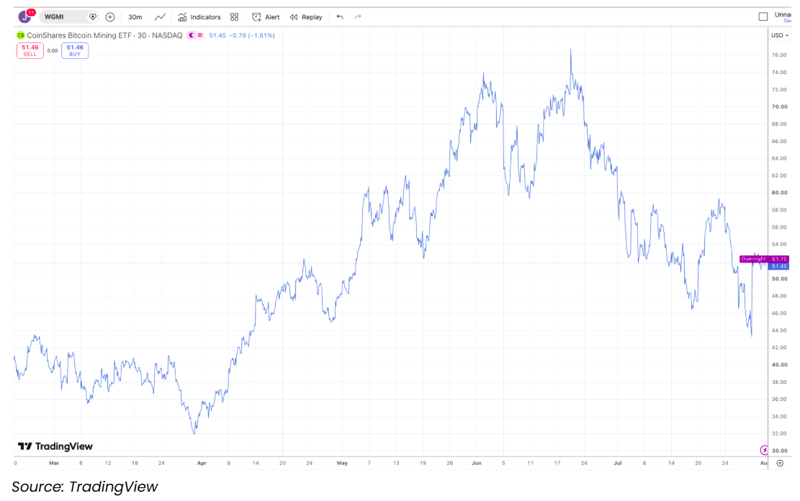
When AI multiples expand, miners benefit. When AI infrastructure sells off, miners get caught in the crossfire. The market has already repriced many of these businesses based on the value of their power assets rather than simply the Bitcoin they mine.
Again, none of this invalidates the long-term thesis. If anything, it reinforces it.
Companies with access to abundant power and world-class infrastructure remain incredibly valuable. But investors should recognize they’re no longer buying “Bitcoin miners.” Increasingly, they’re buying infrastructure businesses whose revenues happen to come from whichever customer — AI or Bitcoin — is willing to pay the highest return on electricity.
Coinbase Continues To Chase Everything
If there was one company that perfectly illustrated the difference between narratives and execution this week, it was Coinbase.
Another quarter. Another earnings miss. Another sharp decline in the stock.
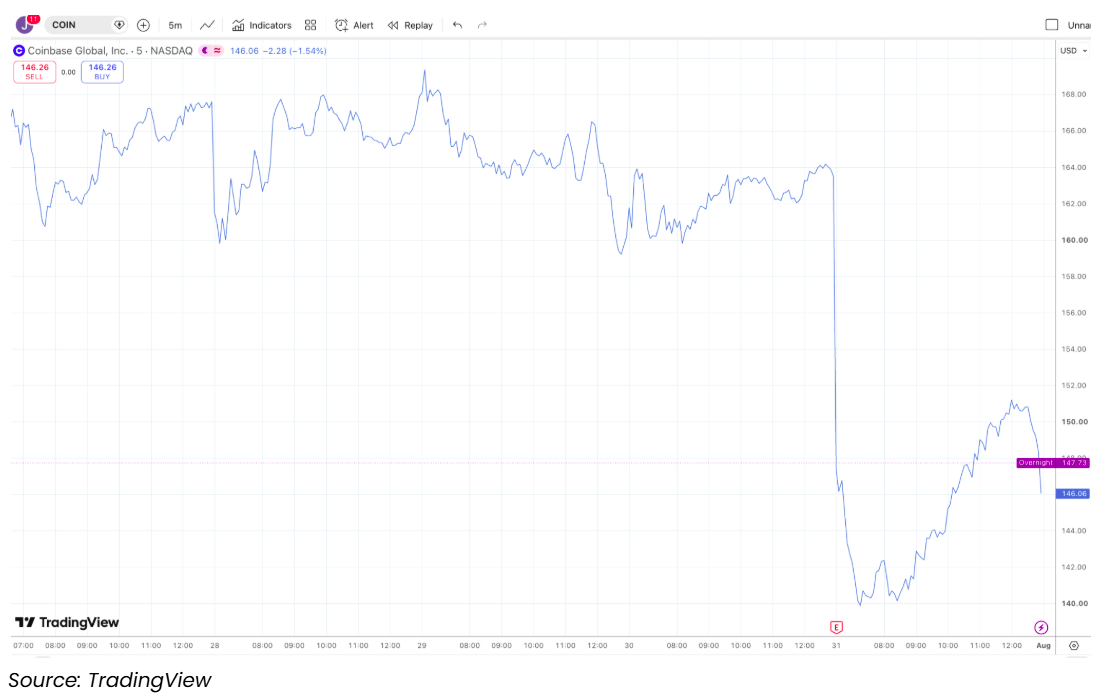
To be fair, some of the earnings weakness was simply a function of the environment. Trading activity remains subdued. Stablecoin revenue disappointed. Accounting rules continue to create enormous swings in reported earnings because Coinbase marks its crypto holdings to market every quarter.
That’s not really my takeaway.
My takeaway is that Coinbase increasingly feels like a company trying to be everything to everyone, while competitors continue to win by doing one thing exceptionally well. The timing of Jesse Pollak’s announcement last month that he’s stepping back from leading the Base app could hardly have been more telling.
In a remarkably candid post, Pollak admitted something many of us have believed for quite some time. The creator coin experiment failed. The broader bet that on-chain social would become crypto’s next killer application simply didn’t play out the way they expected. Meanwhile, the areas that have actually driven meaningful adoption—stablecoins, prediction markets, perpetual futures, tokenization, and AI—continued to grow elsewhere.
That’s the part that matters. Coinbase isn’t losing because it tried something ambitious. It is losing because it spent valuable time, engineering resources, and marketing efforts chasing the wrong opportunity while competitors focused relentlessly on products users actually wanted.
Coinbase, meanwhile, spent months talking about content coins. To Pollak’s credit, he admitted the mistake. Brian Armstrong acknowledged it as well, publicly saying it’s time to “turn the page.” Owning mistakes is important. But it doesn’t erase the opportunity cost.
Perhaps the biggest irony is that Coinbase actually has several genuine success stories. Its Morpho integration has become one of the more successful institutional lending products in crypto. Its AI initiatives are beginning to generate meaningful developer activity. Coinbase One subscriptions continue to grow. Those are real businesses.
Yet Coinbase consistently seems distracted by whatever narrative is capturing attention on Crypto Twitter. It’s becoming even more difficult to argue that they’re executing better than competitors who have far fewer resources but a much sharper focus.
The Market Is Finally Growing Up
Looking back on the week, it’s remarkable how many potentially negative headlines investors had to digest.
And yet…
For years, crypto was a market where narratives created prices. Today, we’re beginning to see a market in which fundamentals increasingly determine prices, while narratives merely explain them after the fact.
That’s healthier and much more investable. And, perhaps most importantly, it’s exactly what you’d expect from an asset class that’s slowly growing up.
The irony is that many investors still believe crypto is driven almost entirely by headlines. This week suggests the opposite. Crypto hasn’t stopped paying attention to the news. It’s simply becoming much better at deciding which news actually matters.
And that’s probably the most bullish headline of them all.