




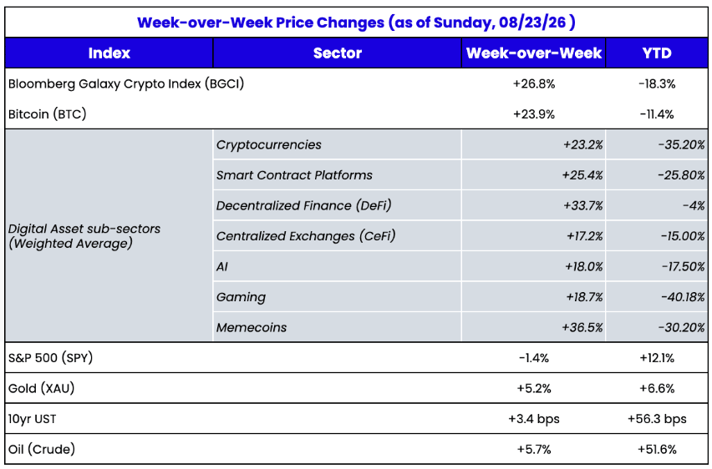
For the past few months, we’ve been writing some version of the same thing: the crypto bear market increasingly felt like it was running out of sellers. The setup was improving, but the catalyst was missing.
Valuations were attractive. Fundamentals at many of the leading protocols continued to improve. Regulatory progress was underway beneath the surface through the SEC's “Project Crypto.” Institutional adoption hadn’t stopped. And yet prices continued to languish because there was no clear catalyst forcing investors back into the market. Retail investors were largely gone, and casual investors were focused more on AI.
We thought the bottom was probably in. We just didn’t know what would make prices go up. This week, we may have gotten our answer.
In a matter of days, the catalysts arrived. The SEC proposed Regulation Crypto Assets, the first set of U.S. securities rules designed specifically around the offer and sale of crypto assets rather than adapted from rules written for corporate stock. President Trump explicitly said that the CFTC was working to bring Hyperliquid, one of crypto’s most successful on-chain businesses, into the United States in a fully compliant manner. He acknowledged that the U.S. acquiring significant amounts of Bitcoin has been discussed. And Treasury Secretary Scott Bessent unexpectedly doubled long-duration Treasury buybacks to at least $4 billion per operation, immediately igniting speculation that the government was beginning to push back against rising long-term yields. Technically, the Treasury didn’t announce Yield Curve Control, but markets immediately understood the implication: with long-term yields screaming higher, the U.S. government had demonstrated a willingness to step into the market as a buyer. As a result, gold ripped, Bitcoin ripped, and suddenly the “debasement trade” had another catalyst.
None of these developments by themselves necessarily change the fundamental value of every digital asset. But that’s almost beside the point. Markets don’t need ten catalysts when positioning is already washed out. Sometimes they just need one reason to stop going down.
If we are back in a bull market, what are you supposed to do? Digital assets have a short public-market history, but not a shapeless one. Since August 2018, the asset class has moved through five clearly delineated regimes — three bear markets and two bull markets — and the drawdown that began in October 2025 is now ten months old. Using the Bloomberg Galaxy Crypto Index (BGCI), which is notoriously BTC, ETH, and XRP heavy (almost 90%), and the S&P Ex-Mega Cap Crypto Index (SPCBXM), which is more of a small-cap index and removes BTC and ETH, you can see how big these cycles can be.
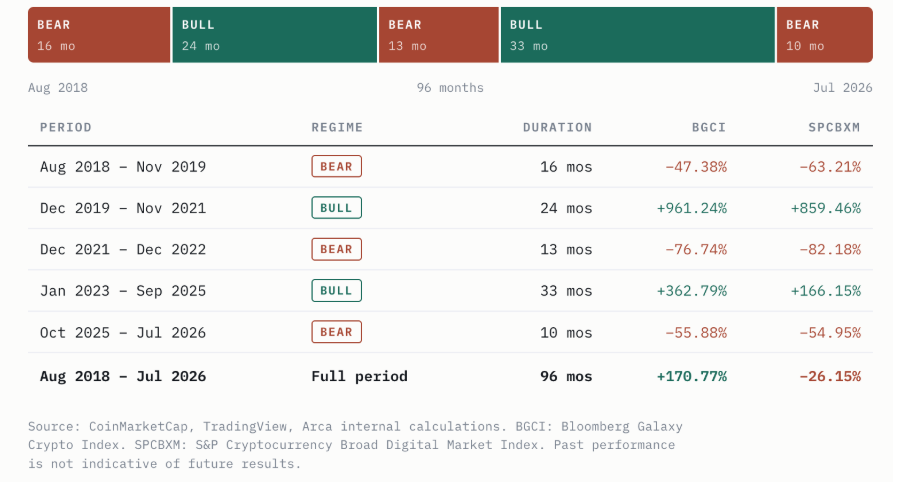
Two features of that record are worth exploring further:
Looking more closely at the most recent bull market (the 33 months from January 2023 through September 2025), this was a pretty strong stretch, but the Index returns actually sit closer to the laggards than the leaders.
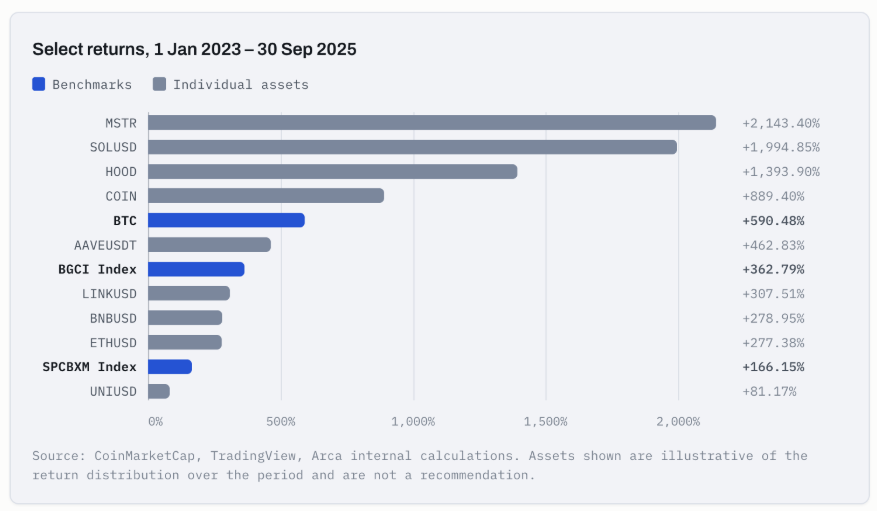
Bitcoin on its own returned +590.48% and beat the BGCI. So did five other tokens and stocks in this set, four of them by a very wide margin. Meanwhile, the broadest measure, the SPCBXM, returned +166.15% — less than half the BGCI and roughly 8% of the best performer. Owning the asset class meant owning the laggards in the same breath as the leaders, and the laggards did most of the work of pulling the average down.
In a market this dispersed, breadth is not risk management. It is more like a tax on the positions that are actually working.
The case for broad exposure rests on the assumption that you cannot know in advance which parts of an asset class will lead. The last cycle suggests that the assumption is doing less work in digital assets than it does elsewhere. The leaders were not obscure. The largest exchanges, which dominated volume, and the most well-known digital assets did the best. And we don’t think the areas of likely leadership are particularly obscure this time either. Tokenization, payments, DeFi infrastructure, and the compute layer supporting AI are identifiable themes well before prices run, and the names attached to them are liquid and investable today.
What the record argues for is not more exposure but better-targeted exposure: concentration in the pockets of the market showing genuine strength and growth, held through the drawdown rather than rotated into whatever is working for a month. This is why we’ve been constantly harping on the “charts that are up and to the right” — DeFi, RWA tokenization, and stablecoins/payments. These aren’t narratives anymore; they’re measurable areas of growth. For example, three years ago, the tokenized RWA market was worth roughly $2.3 billion. Today, it stands at $44.5B, an increase of 1,819.5%.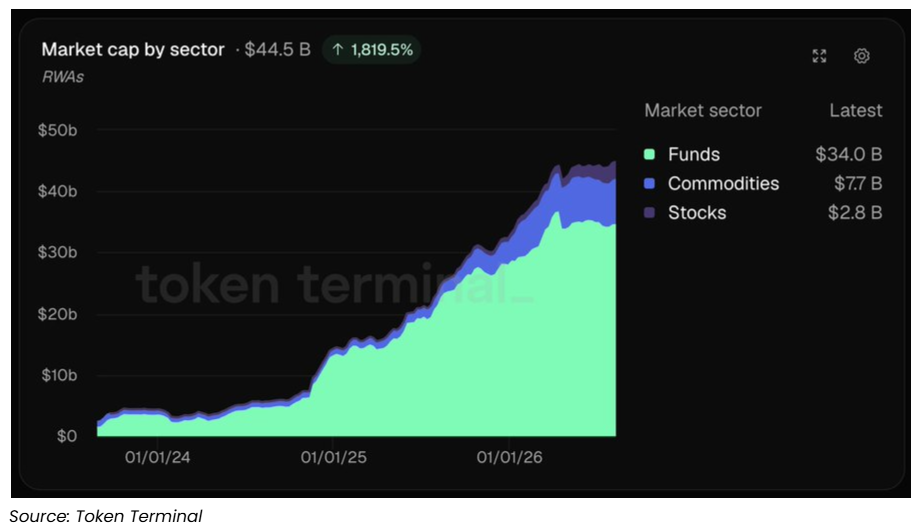
Without a broad tailwind lifting the asset class, a concentrated book will spend stretches out of step with the index and with the trade of the month, and there is no way to smooth that without giving up the thing that generates the return in the first place. But it is likely the best strategy – trade less.
The lesson isn’t that diversification is bad. The lesson is that when a beaten-down crypto market finally turns, the winners can move extraordinarily fast, and being positioned before the catalyst matters.
But there appears to be a big difference between today’s setup and 2021. During the 2021 bull market, there wasn’t one “crypto trade.” Leadership changed almost monthly. DeFi led in January. CeFi took over in February. Fan experience and social tokens like Chiliz (CHZ) exploded in March. And by April, legacy cryptocurrencies and memecoins were suddenly flying. Then we dipped for 2.5 months before “SOL-LUNA-VAX” took the market higher in the 3rd and 4th quarters, led by meteoric rises of Solana, Luna, and Avalanche.
We documented this in our July 2021 mid-year review, noting that thematic investing and sector rotation had driven enormous dispersion in returns. By June 30th, DeFi was up 409% for the year, CeFi 637%, and NFTs/Gaming 580%. Individual winners were even more extreme: CHZ +1,121%, AXS +857%, ENJ +747%, and HNT +830%. The important part wasn’t predicting the exact order. It was being invested when the rotations happened.
But there is a big difference between those 2021 rotations and what we’re seeing today. Many of those areas of growth in 2021 were untested, uncertain, and more “flavor of the month” than substance. Back then, crypto was searching for use cases, so the market bet on ANY up-and-coming use case. Almost all of these areas of 2021 growth (gaming, social, sports and entertainment, NFTs, memecoins, DeFi yield plays, etc.) were down 90% or more in 2022. But from 2023 to 2025, the winners were companies and protocols that had already proven that they were heavily utilized and growing. We think 2026 and beyond will look similar, and again, it’s incredibly obvious which areas of growth are happening in crypto — RWA tokenization, stablecoins/payments and DeFi.
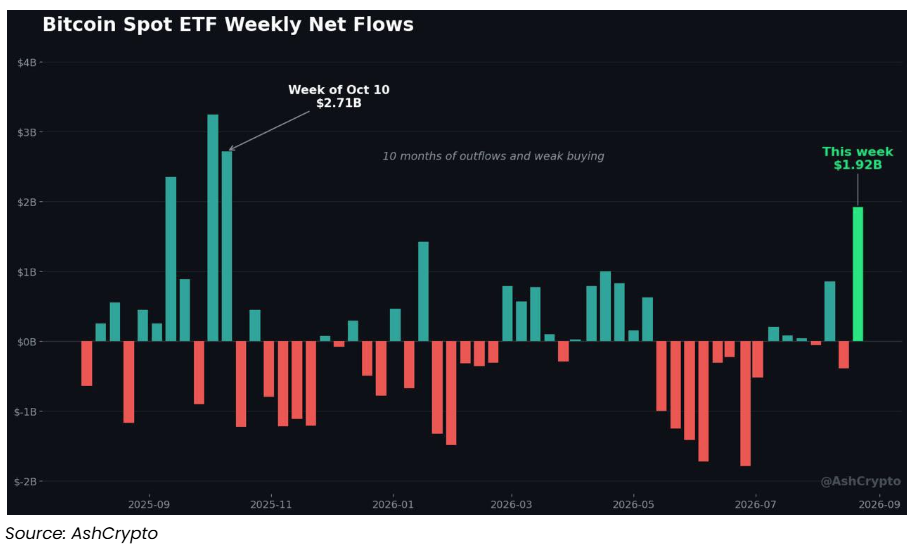
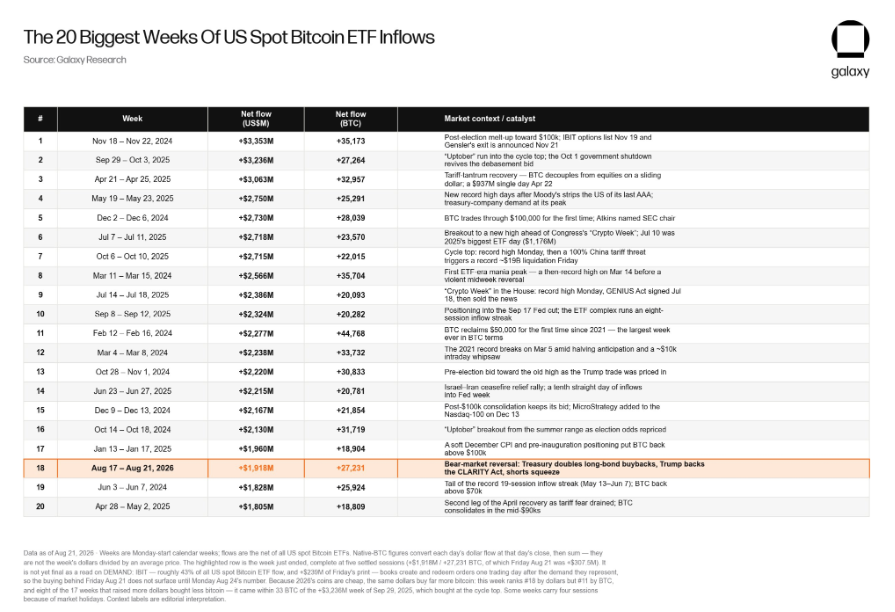
Let’s start with BTC. It gained more than 23% during the week on the debasement trade, outpacing gold’s 5.2% rally but underperforming most good crypto assets. ETFs bought $1.92 billion worth of Bitcoin this week, the largest buying since the Oct 10 flash crash of 2025 and a top-20 week all time.
Then there was HYPE, which gained +41% last week. Trump’s comment immediately sent it higher; it subsequently reached a new ATH above $82.
Pump.fun (PUMP) gained +92% last week, as the new “bull market” environment has suddenly made people realize that it is one of the most profitable companies in crypto, with a token that accrues value from these revenues.
But there were plenty of other assets that also had huge moves higher that make less sense. We’ve been in a “bull market” for less than a week, and already, once-respected analysts, influencers and even fund managers immediately started shilling the same garbage inflationary L1s and profitless apps that accrue no economic value for the token. After a decade of evidence that the fat protocol thesis is nonsense, the only remaining thesis for why another inflationary L1 should outperform seems to be that ‘no one ever learns.’ And that may be true. Ripple (XRP), for example, rose +52% last week. Trump coin (TRUMP) rose +82%. But those are outliers. For the most part, the old guard failed to keep pace with the new tokens of profitable companies in sectors that are actually growing.
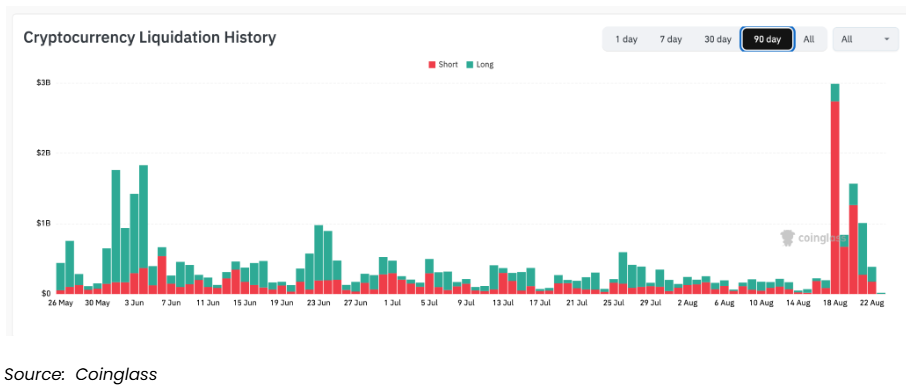
In total, over $3 billion worth of shorts were liquidated this week, the largest short squeeze ever in crypto history.
There will be plenty of attempts to explain why each individual asset moved. Some of those explanations will be correct. But they’re missing the bigger point. This is just what crypto does. Months of seemingly endless declines can be erased in days. Assets that nobody wants at $30 suddenly become must-own investments at $50. Fundamentals that investors ignored throughout the bear market suddenly become incredibly important when prices start rising.
Which is why waiting for the catalyst has always been such a difficult investment strategy. By the time the catalyst becomes obvious, prices have already moved… A LOT.
We don’t know whether this week’s move marks the beginning of another sustained bull market. After a move this violent, some retracement would hardly be surprising. But this past week was a useful reminder of why you can’t perfectly time it. Crypto spends an extraordinary amount of time making investors regret owning it — and remarkably little time giving them an opportunity to buy it once everyone wants it again.
And That’s Our Two Satoshis!