



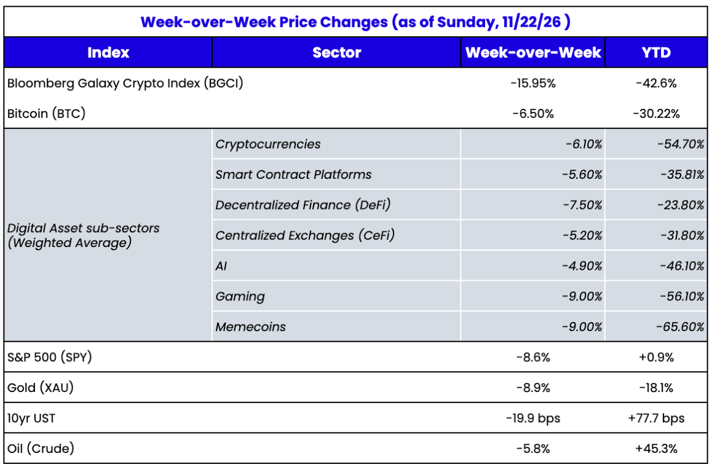
Some of you may follow me on X/Twitter. As you can imagine, this is not a major focus of mine. I only tweet sporadically, for three reasons:
To that last point, I learn in a variety of ways. Most of the time, I simply read or ask questions to other thought leaders. Other times, I write something that I think fulfills #1 or #2 above, but it creates such a stir that I end up learning more from the responses and reactions.
Earlier this week, amidst one of the worst equity and crypto crashes of the decade, I tweeted what I thought was a well-thought-out opinion about Bitcoin, which was pretty consistent with the views I share in this letter every week. But based on the responses I received, it clearly wasn’t articulated very well. Not only did it receive almost half a million views and thousands of engagements, but it was split basically 50/50 between retweets/likes agreeing with me and comments telling me I’m an idiot. There were 3 takeaways that I learned from this:
So, let me try again.
I can understand why some people interpreted my tweet as an attack on Bitcoin. Saying that Bitcoin “does nothing,” “has no properties,” and has “failed” at several of its original use cases certainly sounds like criticism of the asset itself. And while I stand by the broader point, I could have articulated it better.
But here’s what I was NOT saying.
I wasn’t saying Bitcoin is a bad investment. I wasn’t saying Bitcoin is worthless. I wasn’t saying investors should sell their Bitcoin, or that Bitcoin won’t appreciate significantly over the next decade.
I like Bitcoin as a VERY long-tail asset. I think it has established itself as a legitimate, scarce, globally recognized store-of-value asset, and there are plenty of reasons to believe it will remain relevant for decades. I don’t think it will outperform the handful of tokens with strong revenue and tokenomics that operate in higher-growth areas of blockchain, but I understand and appreciate that others disagree.
But what I was trying to say is much simpler than how it was interpreted.
Bitcoin is no longer the most interesting thing happening in blockchain. Not even close. Yet it continues to dominate virtually every conversation about the industry.
And I think that’s the problem.
Bitcoin Hasn’t Changed. So Why Are We Still Talking About It?
Bitcoin was introduced nearly 18 years ago as an alternative to traditional money and financial intermediaries. It was designed to allow individuals to transfer value without relying on banks, governments, or other trusted third parties.
And in many respects, it has been remarkably successful.
It has survived countless market crashes, regulatory challenges, exchange failures, government restrictions, and predictions of its demise. It has developed an enormous global network of users, miners, investors, and infrastructure providers. It has become accessible through traditional brokerage accounts and ETFs, and has earned a place in institutional portfolios around the world.
That’s an extraordinary achievement. But here’s the thing. Bitcoin today is fundamentally the same asset it was five years ago. Or ten years ago. Its supply schedule hasn’t changed. Its core functionality hasn’t changed. Its underlying investment thesis hasn’t changed meaningfully. There have been technical improvements, of course, but the fundamental reasons to own Bitcoin today are largely the same reasons people owned it a decade ago.
And that’s fine! Gold hasn’t changed much in thousands of years either. Nobody expects gold to release a new product, introduce a new revenue stream, or announce a strategic partnership. Investors own gold because they believe it serves a particular purpose in their portfolios. And you don’t really have to sell anyone gold. Investors know what it is, and either buy it or ignore it. It does very little for years and decades at a time, and once in a while (like in 2024 and 2025), it goes up a lot.
Bitcoin has increasingly become the digital equivalent. It is a scarce asset with a globally recognized brand, an established network, and a monetary policy that cannot be arbitrarily changed by a central bank. By now, everyone knows what it is. Whether that makes Bitcoin worth $50,000, $100,000, or $500,000 is ultimately a question of supply, demand, and investor preferences. But it isn’t a particularly interesting question to debate every single day.
And yet, that is precisely what the industry continues to do. Every day, we’re inundated with explanations for why Bitcoin moved 2% overnight. ETF inflows. ETF outflows. Interest rates. Inflation expectations. The dollar. Money supply. Technology earnings. Geopolitical developments. Federal Reserve speeches.
Most of these discussions aren’t even about Bitcoin. They’re discussions about macroeconomics and financial markets, with Bitcoin’s price attached to them. It’s the equivalent of giving a weather report. And while these factors undoubtedly influence Bitcoin’s price, they tell us very little about the development of blockchain technology or the growth of the digital asset ecosystem.
This industry has confused analyzing the price of Bitcoin with analyzing the blockchain industry.
Those are two very different exercises.
Bitcoin Used to React to Banking Crises. Now It Reacts to Everything Else.
One of the observations in my tweet that generated considerable controversy was my comment that Bitcoin no longer seems to respond to stress in the banking system or government the way it once did. This wasn’t intended as an indictment of Bitcoin. It was simply an observation about how its market behavior has evolved.
Historically, some of Bitcoin’s most significant periods of adoption and appreciation coincided with crises of confidence in traditional financial institutions and governments.
None of these examples proves that banking crises or government overreach cause Bitcoin to appreciate. But they illustrate how closely Bitcoin’s early investment narrative was tied to distrust of traditional financial intermediaries.
Which is why I found the events of the past few weeks so interesting.
We’ve witnessed a series of technology disruptions affecting banks, government agencies, airlines, and other critical infrastructure. Banking websites and payment systems have experienced outages. The FAA has dealt with significant technology failures that disrupted air travel. Government technology systems have also experienced disruptions.
These incidents (and many others recently) have different causes, and there is no established evidence that they are connected. Nor should temporary technology outages be confused with genuine banking solvency crises. But collectively, they highlight something we increasingly take for granted: almost every aspect of our daily lives depends on a relatively small number of centralized institutions and the technological systems that support them.
When a bank’s website goes down, customers may temporarily lose access to their money. When a payment processor experiences an outage, merchants can’t accept payments. When a government agency experiences a technology failure, critical services can grind to a halt.
These are precisely the types of centralized vulnerabilities that helped inspire the creation of Bitcoin.
And yet, rather than benefiting from renewed attention to the risks of centralized infrastructure, Bitcoin has been selling off alongside technology stocks and other risk assets. In fact, over the last month, BTC has underperformed the Nasdaq 100, Gold, and banking stocks.
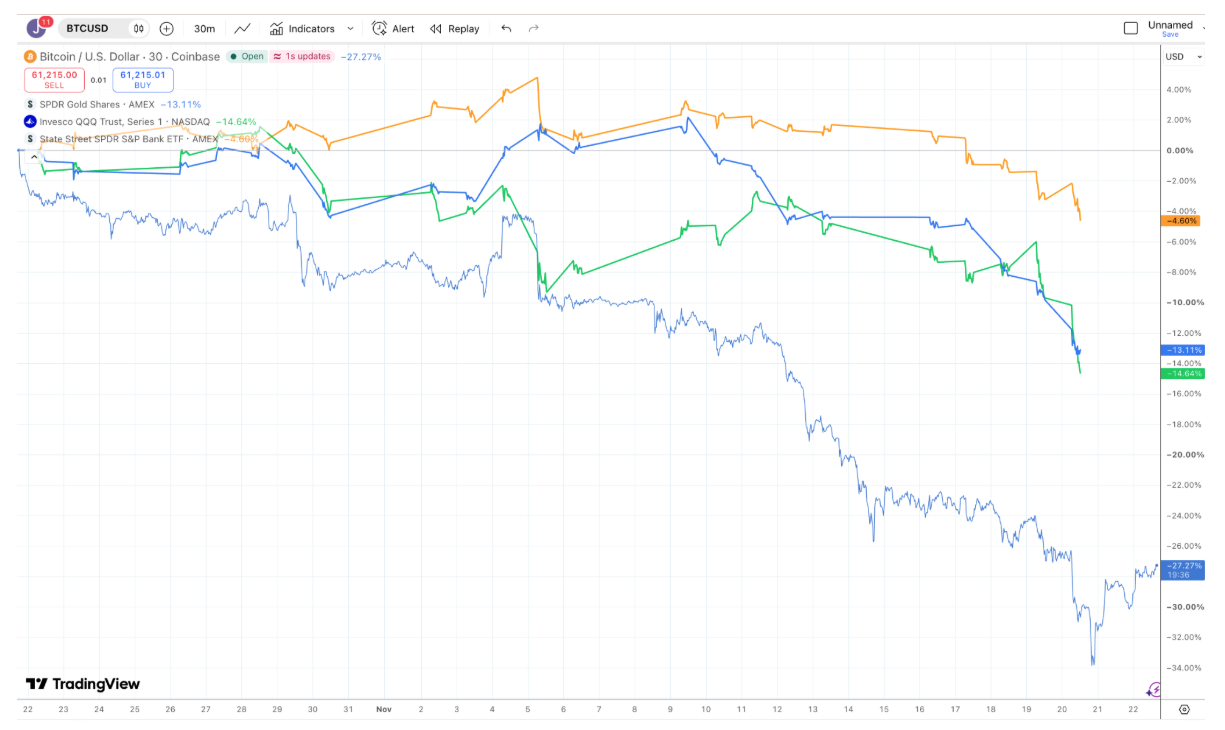
And that’s pretty surprising given how poorly technology stocks have done, especially this past week.
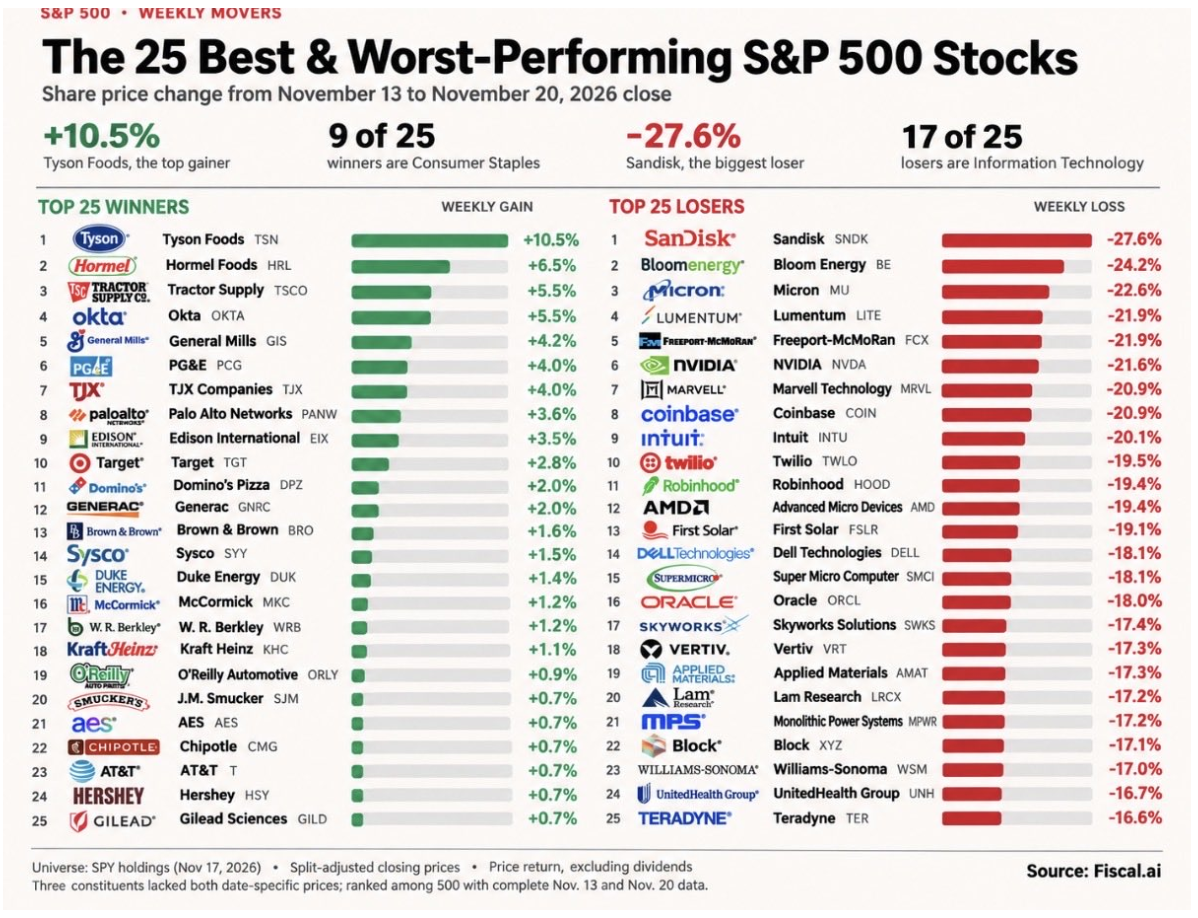
What’s particularly fascinating is that the market seems to be interpreting these events as a broader crisis of confidence in technology itself, rather than a crisis of confidence in the centralized institutions operating that technology.
These are precisely the types of centralized vulnerabilities that Bitcoin was designed to address. Yet investors appear to be selling Bitcoin alongside the very technology companies and financial institutions experiencing these problems.
The distinction between centralized and decentralized infrastructure seems to have been lost in the market’s reaction.
Of course, we can’t definitively attribute Bitcoin’s recent weakness to these outages. There are plenty of other forces affecting markets, including liquidity, leverage, macroeconomic uncertainty, and investor positioning.
But that is precisely what makes this so interesting.
Bitcoin’s network continues to operate exactly as designed, yet its price increasingly responds to factors that have little to do with Bitcoin itself. And I think the explanation is relatively straightforward.
Bitcoin’s Investor Base Has Changed
In 2013, many investors buying Bitcoin during the Cyprus crisis were specifically interested in escaping the traditional banking system. Today, many investors own Bitcoin through ETFs, hedge funds, brokerage accounts, and institutional portfolios.
They don’t necessarily own Bitcoin because they distrust banks or governments. They own it because they believe its price will appreciate. And when markets become volatile, they sell Bitcoin for the same reasons they sell other risky assets.
This isn’t necessarily bad. Institutional adoption has been an enormous success for Bitcoin. But it has also made Bitcoin increasingly sensitive to the same liquidity conditions, portfolio allocations, and risk-management decisions that drive traditional financial markets. It’s become less unique and, as a result, incredibly boring.
Perhaps the greatest irony is that Bitcoin’s success in becoming part of the traditional financial system has made its price more dependent on that very system, thereby changing the original thesis that drove these investors to own it in the first place.
Investors who own Bitcoin through ETFs are accessing a decentralized asset through the same centralized financial infrastructure that Bitcoin was designed to circumvent. While the underlying Bitcoin network may continue operating perfectly, the investment vehicles used to access it remain subject to the same liquidity constraints, custodial dependencies, and portfolio management decisions as traditional financial assets.
None of this changes Bitcoin’s underlying investment thesis. It simply changes how Bitcoin trades. But is this really interesting enough to warrant thousands of articles, podcasts, interviews, and social media posts every single week?
I just don’t think so.
Meanwhile, an Entire Financial System Is Being Rebuilt
This is where my frustration really comes from.
For most of the past decade, the blockchain industry was dominated by speculation. We had a fascinating technology looking for real-world applications, with enormous amounts of capital chasing tokens that often had little economic value.
That is no longer the case.
We are finally seeing the emergence of real businesses, real products, real customers, and real economic activity built on blockchain infrastructure.
Stablecoins and payments: Stablecoins have become one of the clearest examples of blockchain technology solving a real problem. They allow dollars and other currencies to move globally, around the clock, without relying on the traditional correspondent banking system for every transfer. Payments can settle in minutes rather than days, often at a fraction of the cost. And unlike Bitcoin, where much of the conversation revolves around price appreciation, stablecoin adoption can be measured by actual usage, transaction volumes, supply growth, and payment activity.
Real-world asset tokenization: Stocks, bonds, commodities, real estate, and other financial assets are beginning to migrate onto blockchain infrastructure. This isn’t simply about creating digital representations of existing assets. It’s about changing how financial assets are issued, traded, settled, financed, and transferred. The potential implications for market structure, liquidity, capital efficiency, and financial accessibility are enormous. There are now dozens of companies competing to bring traditional financial assets on-chain, and we’re still in the earliest stages of figuring out which business models and technologies will win.
Decentralized finance: DeFi is no longer just an experiment in speculative lending and trading. Decentralized exchanges, lending protocols, and other financial applications are processing meaningful economic activity without many of the intermediaries required in traditional finance. As stablecoins and tokenized real-world assets continue to grow, the opportunity for DeFi to become the financial infrastructure connecting these assets becomes increasingly compelling.
Artificial intelligence: And perhaps most excitingly, the rapid development of autonomous AI agents could dramatically accelerate demand for blockchain-based financial infrastructure. Traditional financial systems were designed around human identity, manual authorization, and intermediaries. AI agents, on the other hand, could interact directly with programmable money, digital wallets, and decentralized financial protocols. As AI agents begin transacting with one another, the demand for always-on, programmable financial infrastructure could grow exponentially.
These are not theoretical investment narratives dependent entirely on whether an asset’s price goes up. These are emerging markets with measurable adoption, competitive dynamics, business models, revenue streams, and increasingly identifiable investment opportunities.
Every week, new companies enter these markets. New products launch. New partnerships are announced. Transaction volumes grow. Regulations evolve. Business models improve. New investment opportunities emerge. There is an enormous amount to analyze, debate, and learn, yet these debates are few and far between compared with debates over BTC price action.
What exactly are we learning from the 47th explanation this month of why Bitcoin moved 3% because the Federal Reserve might cut interest rates?
How does another discussion about Bitcoin ETF flows help investors understand the future of tokenized securities?
How does another debate about whether Bitcoin is digital gold help explain the emergence of decentralized financial markets?
It doesn’t.
And that’s the opportunity cost that bothers me. There’s a massive universe of dollars, stocks, bonds, and real estate moving on-chain (interesting), while Bitcoin itself moved off-chain into ETFs (not interesting).
Bitcoin Doesn’t Need to Be the Center of the Crypto Universe Anymore
To be clear, I’m not suggesting that everyone should stop researching Bitcoin, that Bitcoin’s monetary properties are irrelevant, or that investors shouldn’t pay attention to its price.
Bitcoin remains an important asset, and an enormous asset as measured by market cap. There are legitimate reasons for investors to analyze its valuation, liquidity, market structure, and role in a diversified portfolio.
But Bitcoin has become so dominant in the public conversation that it frequently overshadows the more significant developments happening elsewhere in the industry. And I think that dominance is increasingly counterproductive.
Imagine if every conversation about artificial intelligence today focused exclusively on the price of Nvidia shares rather than the extraordinary range of applications being developed using AI. That’s what much of the blockchain conversation feels like to me.
Bitcoin helped introduce the world to the concept of decentralized digital assets. It proved that a globally distributed network could maintain a ledger of ownership and transfer value without a central administrator.
That was a monumental achievement.
But Bitcoin was the beginning of the blockchain industry, not the end of it.
The technology has evolved far beyond a single monetary asset. We now have programmable blockchains, stablecoins, decentralized exchanges, tokenized securities, lending markets, and an emerging ecosystem of applications that can fundamentally change how financial services operate.
And yet, to much of the outside world, crypto is still synonymous with Bitcoin.
This creates a real problem for an industry that desperately needs to educate investors, attract capital, and demonstrate that blockchain technology has applications beyond speculation.
When Bitcoin falls 20%, the headlines declare that crypto is dead. When Bitcoin rallies 20%, the headlines celebrate another speculative boom.
Meanwhile, the businesses actually building the future of financial infrastructure receive a fraction of the attention. That’s what I was trying to say in my tweet.
Looking Ahead
I have no idea where Bitcoin’s price is going next. And despite what thousands of people on X/Twitter apparently believe, I don’t particularly care whether someone else wants to buy it, sell it, or hold it forever.
I own Bitcoin. I like Bitcoin. I think it has earned its place as a legitimate financial asset.
But I don’t need to discuss it every day (and yes, I recognize the irony of me writing this article dedicated to Bitcoin).
There are far more interesting developments happening across blockchain technology, and those developments deserve considerably more attention than they’re receiving.
For years, investors criticized crypto as a solution looking for a problem. The industry promised to revolutionize finance but struggled to demonstrate meaningful adoption outside of speculation.
Now, we’re finally seeing those promises begin to materialize. Stablecoins are being used for real payments. Traditional financial assets are moving onto blockchain rails. DeFi protocols are facilitating real financial activity. And AI could introduce an entirely new category of users who need programmable, autonomous financial infrastructure.
This is the industry we’ve been waiting for.
And while Bitcoin remains an important part of its history and investment landscape, it is no longer the primary driver of its technological evolution. Bitcoin doesn’t need to fail for the rest of blockchain to succeed. And Bitcoin doesn’t need to be the center of every conversation for the industry to thrive. If anything, the industry’s ability to move beyond Bitcoin as its defining narrative may be one of the clearest signs of its maturity.
So by all means, own Bitcoin. Don’t own Bitcoin. Trade it. Hold it for the next decade. Debate whether it’s digital gold or the greatest monetary invention in human history.
But while everyone else is arguing about what Bitcoin might be worth tomorrow, I’d rather spend my time analyzing what blockchain technology is actually building today. Because that’s where the growth is.
And that’s where I believe the most interesting investment opportunities will be found.
And That’s Our Two Satoshis!