




Guest Edition — Written by David Nage, Managing Director, Portfolio Manager
A Weird Crypto Rally
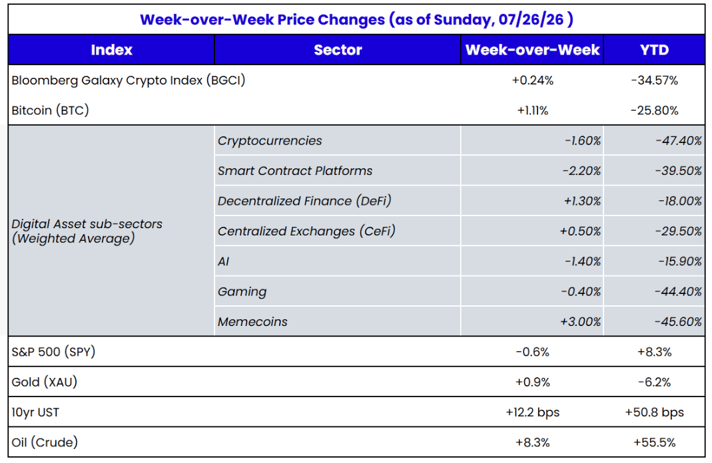
This was a very strange week. Digital assets largely moved higher last week, led by ETH and DeFi tokens. Not only would that sound strange most weeks, given how poorly ETH and DeFi tokens have traded since October 2025, but it’s even stranger given:
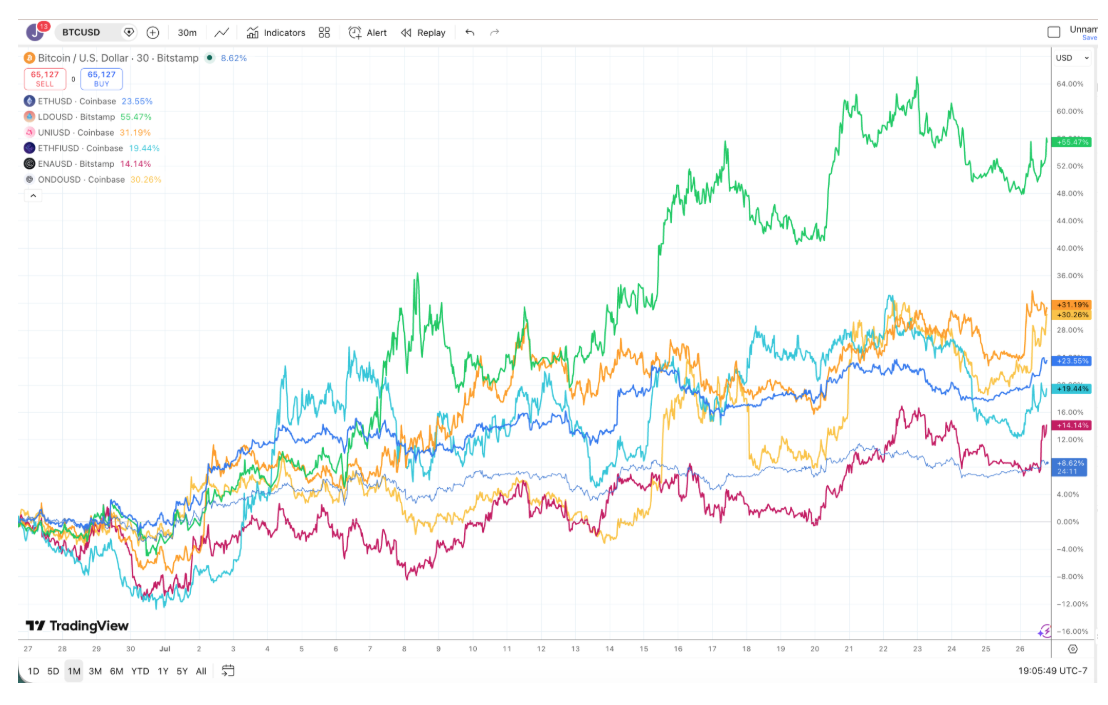
Just about every crypto bull has been waiting for digital assets to finally stop going down and trade with an idiosyncratic pulse, but even we are surprised by this week’s move. In fact, for the month, ETH is up +20%, more than double BTC’s +9% gain, while SOL is flat. Other DeFi names that would benefit from CLARITY passing are up even more.
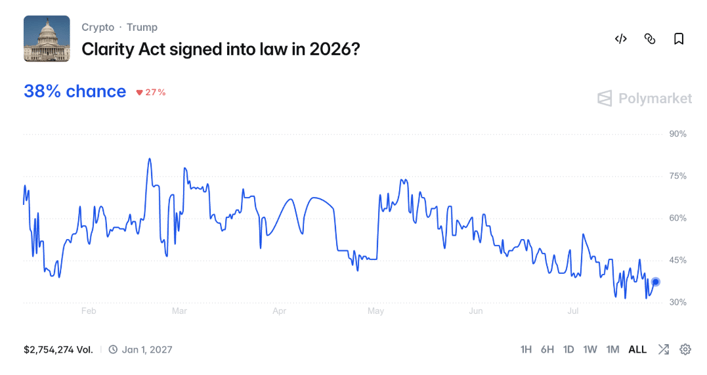
So basically, the market is pushing tokens higher that benefit from CLARITY, while simultaneously pricing in a lower probability that CLARITY passes. Bizarre.
Thirteen months ago, the CLARITY Act was the most bipartisan financial-services bill in a decade. It passed the House 294–134, with 78 Democrats crossing over. Prediction markets gave it an 87% chance of becoming law. Tim Scott wanted it on the President's desk by September.
On Thursday, the Senate Majority Leader was asked whether he could get it done before the August recess. "I don't think we'll be able to get them done," John Thune said. "I would like to at least get Clarity started. We'll see where the votes are."
That's not a whip count. That's a man managing expectations downward. And it's worth understanding how a bill that had everything going for it arrived at the point where its own floor manager is pre-writing the obituary — because the story isn't the one the headlines are telling. CLARITY didn't fail on the merits. The policy is essentially finished. It failed because it got harder as it got closer.
The Thing Nobody Lobbies Until It's Real
When market structure was hypothetical — a discussion draft, a messaging vote, a bill everyone assumed would die in the Senate — nobody spent real money fighting it. The moment it became the only moving vehicle in a Congress that passes almost nothing, it became the vehicle for everyone's unrelated ask.
Four separate constituencies discovered, more or less simultaneously, that they each held a veto over a bill that needed 60 votes and couldn't spare any. Community banks. Law enforcement. Tribal and commercial gaming. And Senate Democrats. Each of them priced their veto. And the price of a seat at the table goes up the closer the bill gets to passing, because proximity is leverage. That's the whole dynamic. Everything below is just the specifics.
The Loophole Inside the Victory
The first crack was hiding inside the bill that succeeded. When the GENIUS Act became law in July 2025, it barred stablecoin issuers from paying yield. It said nothing about exchanges. So Circle couldn't pay interest on USDC — but Coinbase could, and did, at around 4%, against near-zero at your bank. Coinbase booked $1.35 billion in stablecoin revenue in 2025 on the back of it via their partnership with Circle.
The banking lobby noticed immediately, and by late 2025, they had the numbers to make it existential. A Treasury advisory committee had identified $6.6 trillion in checkable deposits as the tier most exposed to stablecoin migration. A December Federal Reserve staff note estimated that a serious deposit drain could cut bank lending by hundreds of billions to over a trillion dollars. Whether you found those numbers persuasive or alarmist — the White House's own economists modeled the reverse and found a yield ban would mostly benefit large banks — they were now government numbers, and they turned the yield question into a war.
That war cost CLARITY its most important backer, twice. In January 2026, the day before a scheduled markup, Coinbase pulled support: "We'd rather have no bill than a bad bill." The markup died. It took until May 1 for Tillis and Alsobrooks to broker the compromise that now lives in Section 404 — no yield for simply holding a stablecoin, activity-based rewards preserved. Bitcoin broke $80,000 on the news.
And then, within days, the American Bankers Association's members sent more than 8,000 letters trying to reopen it. The provision that unlocked the bill is still under attack from both sides — the banks say it's too soft, consumer advocates say the exceptions swallow the rule. That's the tell for this entire bill: even the wins don't stay won.
The 43 Days That Moved the Calendar
Here's the piece I think gets forgotten. From October 1 to November 12, 2025, the federal government shut down for 43 days — the longest in history. It didn't just delay CLARITY. It moved it into a midterm year.
That's the quiet killer.
Lummis had a timeline: Banking markup by the end of September, signature in 2026; the shutdown made it "less attainable." It sidelined the regulators who might have relieved the pressure and pushed every subsequent step into a calendar where election politics get a vote. Thom Tillis said it out loud back in October: act by early 2026, "or risk losing momentum as election politics take over." Prediction market odds fell from 87% to 25% over those weeks. They have never fully recovered.
The Wall That Isn't About Crypto
Which brings us to the actual reason we're here, and it's the one I've written about several times in the last few months: ethics.
The provision barring officials from cashing in on the assets they regulate has now failed three times, in three different rooms.
Every time it came up, it lost — and every time, it came back, because you cannot ask Democrats to hand the President a crypto framework while he personally profits from it and expect them to do it for free.
Then, on July 1, the President's financial disclosure landed: more than $1.4 billion in crypto income for 2025. Before that number, "conflicts of interest" was a principle, and principles are negotiable. After it, there was a certified figure in a federal filing, and no Democrat could be seen accepting weak enforcement against it.
The Republicans and the White House wrote an ethics title anyway — negotiated with Lummis and Moreno, with no Democratic sign-off — and dropped it into the unified text on July 22. On paper, it's real: it bans covered officials and their spouses from issuing or sponsoring tokens, requires divest-or-blind-trust, and sunsets in January 2029. But the enforcement runs through the Department of Justice, with no role for state attorneys general, which is precisely the mechanism Democrats rejected back in June, because the DOJ answers to the President whose conduct it would be policing. Angela Alsobrooks, one of the two Democrats who voted the bill out of committee, called it "an unserious offer" and said a "lawless Department of Justice cannot oversee this." Seven Democrats put out a joint statement saying the text falls short.
The rules aren't the fight anymore. The enforcer is. And the two sides are now saying the real reasons out loud — Democrats won't accept an enforcer the President controls, Republicans won't accept fifty mostly-Democratic state AGs with standing, which usually means the polite fiction is over.
The Two Fronts That Opened While Nobody Was Looking
Two more constituencies found their leverage in the margins.
Law enforcement spent months resisting the bill's developer protections, giving specific Democrats — Cortez Masto, Warner — a non-ethics reason to hold. The unified text answers with a new Title IX full of grants and training, and it's working: the Fraternal Order of Police, with more than 380,000 members, just reversed its opposition and endorsed the revised bill. That's real progress on one of the four vetoes.
And then there's the strangest front of all. Prediction markets have nothing to do with digital-asset market structure — but CLARITY touches CFTC authority, so it became the target. In June, a coalition of more than 50 tribal governments, casino associations, and labor unions demanded that the bill explicitly ban sports and casino-style event contracts. They're pulling at exactly the Democratic votes the bill needs. A provision that isn't even in the bill is costing it support.
Where This Actually Stands
The unified text released July 22 is, on the merits, a serious piece of work — a genuine merge of the Banking and Agriculture bills, it preserves every provision Democrats negotiated, and it finally contains an ethics title. It is closer to law than any crypto market-structure bill has ever been.
And it has zero committed Democratic votes, because the one provision written without Democrats is the one that decides their votes.
The arithmetic is unforgiving. Republicans hold 53 seats but realistically deliver around 50 or 51 — Hawley and Paul both opposed GENIUS and are likely no's here, and McConnell remains out. That means the real ask isn't the seven Democrats you see quoted everywhere; it's closer to nine or ten. Zero are committed. Thune's own staff says the next floor priority is the Russia sanctions bill, not CLARITY, and Graham's funeral will occupy much of this week. Polymarket sits around 38%.
There is still a path. White House adviser Patrick Witt pushed back on Thune within hours, saying the first week of August still has potential. A phased-enforcement compromise — real rules now, enforcement mechanics settled later — is the kind of thing that could move a few votes. And this town has a habit of congealing deals at the eleventh hour; GENIUS itself came back from a failed cloture vote within two weeks. So I wouldn't write it off for the year.
But be honest about what Thursday was. When the Majority Leader stops predicting passage and starts predicting he'd "like to at least get it started," the window hasn't closed — but the man who controls the window just told you which way it's swinging.
The lesson, if there is one: a bill that becomes genuinely likely to pass stops being a policy document and becomes a bargaining table. CLARITY was never going to fail on the SEC/CFTC line. It's failing because a 43-day shutdown pushed a four-way negotiation into an election year — where every veto costs more, and there are fewer days left to pay.
Meanwhile, the SEC keeps building its own version by rule. Which means the irony sitting underneath all of this is that the more the agencies do, the less urgent the statute becomes — and the easier it is for everyone at that bargaining table to hold out for one more concession.