




An Out-of-Court (DAO) Restructuring?
On May 5th, Drift Protocol outlined its recovery plan following the April 1st DPRK-affiliated hack. We have spent quite a bit of time discussing how well-designed tokens can look like equity and, in select cases (LEO), look more like debt. So, when the recovery plan outlined the use of a recovery token, we wanted to take a look at its features.
The Hack:
We won’t spend too much time outlining the hack. Drift Protocol itself outlined the details here, and Chainalysis also wrote an article describing the hack here. The result is a $295m hole in Drift Protocol with no clear way to address it.
Assets stolen: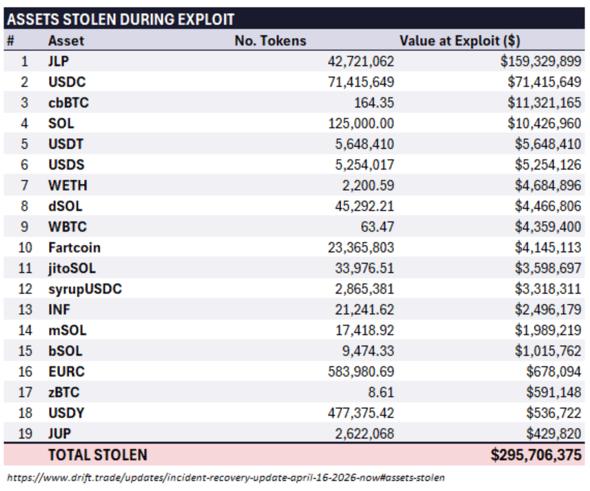
This seemed like a death blow to Drift, which has been falling behind Hyperliquid and ther perp DEXs for the past few months. Ultimately, Drift was left with just ~$3.8m of miscellaneous assets, and the exchange completely shut down.
April 16th Update
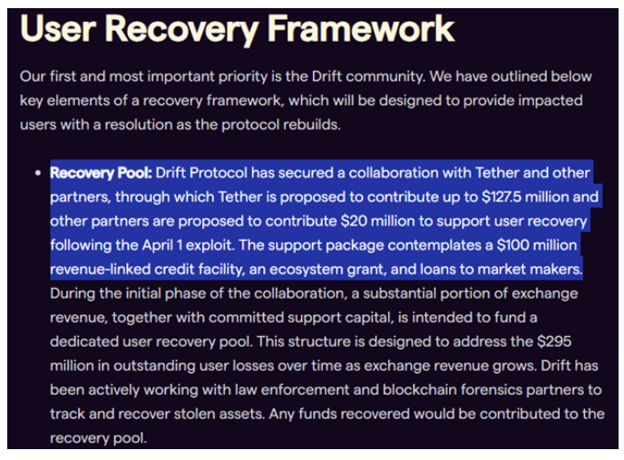
However, on April 16th, Drift Protocol announced that Tether had agreed to a distressed investment of up to $127.5m. They teased both a recovery token and different instruments to bring Drift back online and ultimately compete as a leading Perp DEX on Solana.
 Source: Link
May 5th Plan
On May 5th, Drift finally outlined the plan. Drift Foundation plans to compensate affected users by issuing transferable “recovery tokens,” where each token represents $1 of verified losses from the April exploit. These tokens are essentially bankruptcy claims on a dedicated “recovery pool” rather than an immediate reimbursement. The recovery pool starts with roughly $3.8 million from the remaining protocol assets converted to USDT. The pool will grow through 1) the contribution of the $20m insurance fund (following a DRIFT governance vote), 2) additional partner contributions outside of Tether (Drift has guided towards $20m of support), 3) a “substantial” share of future Drift exchange revenues (expected to be brought back online in Q2 2026), and 4) a quarterly revenue match by Tether up to $127.5m.
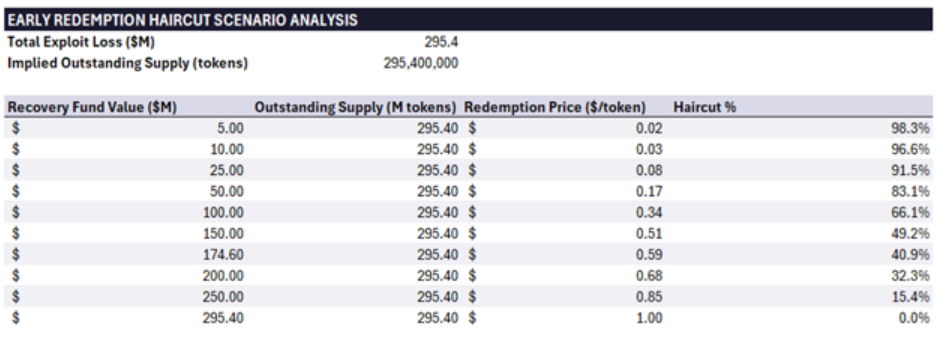
Drift recovery token holders will be able to put their claim tokens back to the company at a pro-rata share of the recovery pool value after the recovery pool hits $5m in value (starting with the $3.8m). This means that if a recovery token holder puts back their claim immediately at the $5m mark, the claimant will receive 1.7 cents on the dollar, taking a ~98% haircut on the value of the claim.
 Source: Internal Calculations
Thinking About the Recovery Token Value
Given the wide variety of outcomes here, how should we think about the recovery token’s value? We view the recovery value coming from three main areas.
1) Asset recovery
2) Revenues from the exchange reopening
3) Tether contributions
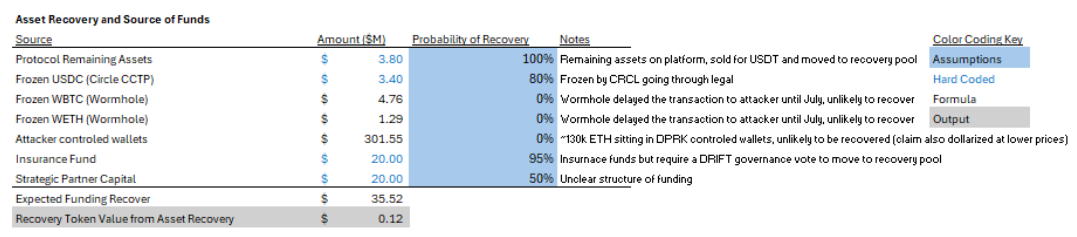
Looking at recovery assets first, Drift gave us some insights into where the assets are now in the May 5th update, so that we can make some assumptions on any potential recovery.
 Source: Drift May 5th Update, Arca Internal Calculations
For the sake of this basic analysis, I am going to skew slightly bearish and assume none of the hacked assets are going to be recovered. This may not fully reflect the true likelihood of recovery. I am merely an outside analyst looking at the value of the recovery token.
Going through the asset recovery value, let's go line by line:
Using a probability-weighted recovery, I expect $34.5m to be delivered to the recovery pool. This equates to $0.12 of value per recovery token.
Exchange Reopening
Given the 12c expected recovery from asset recovery, it seems clear that Drift will have to grow its way to a full recovery. Tether’s contribution is helping this with a revenue match of up to $127.5m paid quarterly. Tether likely benefits from this, as it gains a foothold in Solana stablecoins, but for the sake of this analysis, we will ignore that.
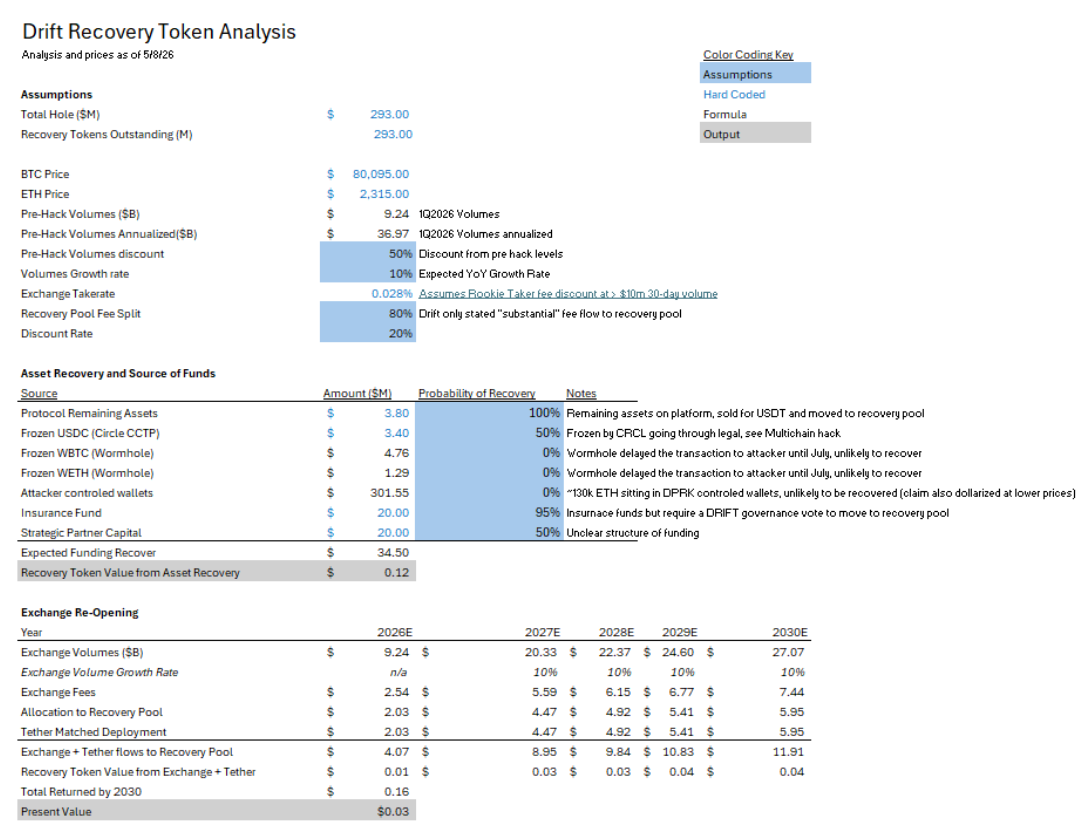
To understand the value provided to the recovery token from the exchange reopening, we have to make a series of assumptions around the volume levels following the exchange restart. Additionally, it is unclear how much of the exchange revenues will flow to the recovery pool. The May 5th update only says “a substantial portion of the exchange’s net revenue flows directly into the recovery pool, denominated in USDT.”
Source: Arca Internal Calculations
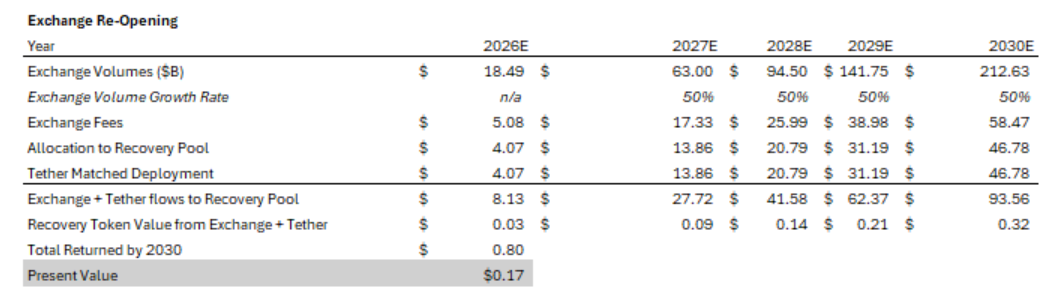
Forecasting the exchange out for 5 years, I am discounting volumes by 50% from their pre-hack levels (Q1 2026 levels) and growing volumes by 10% YoY. I am setting the recovery pool fee split rate at 80% of total revenues. Discounting the recovery value per token back to the present value at a 20% discount rate, we get another 3 cents of recovery value. Again, I view these assumptions as bearish. In 2030, total yearly Perp volumes would be just $27bn in Perp volumes. It is important to remember that Q1 2026 volumes were already depressed compared to previous quarters. Drift did ~$42bn in Perp volumes in Q3 2025 and ~$25bn in Q4 2025. If we were to start at the volume highs with no discount and a more bullish YoY growth rate, the analysis is much more bullish and has a very different outcome.
 Source: Arca Internal Calculations
Again, this is a very simplistic version of the analysis and does not account for recovery token holders redeeming early through the recovery pool. Additionally, I think there are some pretty important questions we don’t yet have answers to. The primary question, in my opinion, is where in the capital stack Tether and the strategic partners invested. Should their investment be considered DIP financing (debtor-in-possession) and sit at the top of the capital stack? Or did they buy into something like Drift Labs' equity, which may still hold assets walled off from the recovery token and retain residual value? It is also important to get some clarification from Drift about what the recovery pool net revenue split is. I made the assumption that it is 80% since Drift has stated “a substantial portion”, but clarification around that and other uses of these revenues is still necessary.
Overall, it is great to see continued experimentation with tokens, especially on the debt side of things. This recovery token is almost like an out-of-court restructuring, or maybe an out-of-DAO restructuring? Not sure, but we are excited to see how the recovery token trades.