




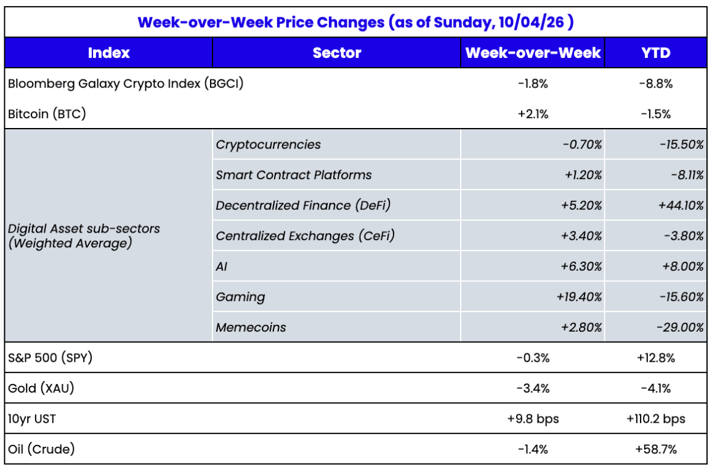
Crypto Shouldn’t Be Performing This Well
For much of the past few years, it has been relatively easy to explain broad movements in digital asset prices through the macro backdrop. Falling interest rates, abundant liquidity, tighter credit spreads and rising equities generally provided a tailwind for crypto, while higher rates and tighter financial conditions created a headwind. But if that relationship still holds, crypto probably shouldn’t be performing nearly as well as it is today.
The macro backdrop has become increasingly hostile. The 10-year Treasury yield recently climbed above 5.3%, reaching levels not seen in more than two decades. The move has hardly been isolated to the U.S., as long-term government bonds have sold off globally. There are plenty of explanations—persistent inflation, enormous government borrowing needs, surprisingly resilient economic growth, and even the enormous financing requirements associated with AI and data-center buildouts—but regardless of the cause, the result is the same: the risk-free rate is suddenly competing much more aggressively with every other asset in the world.
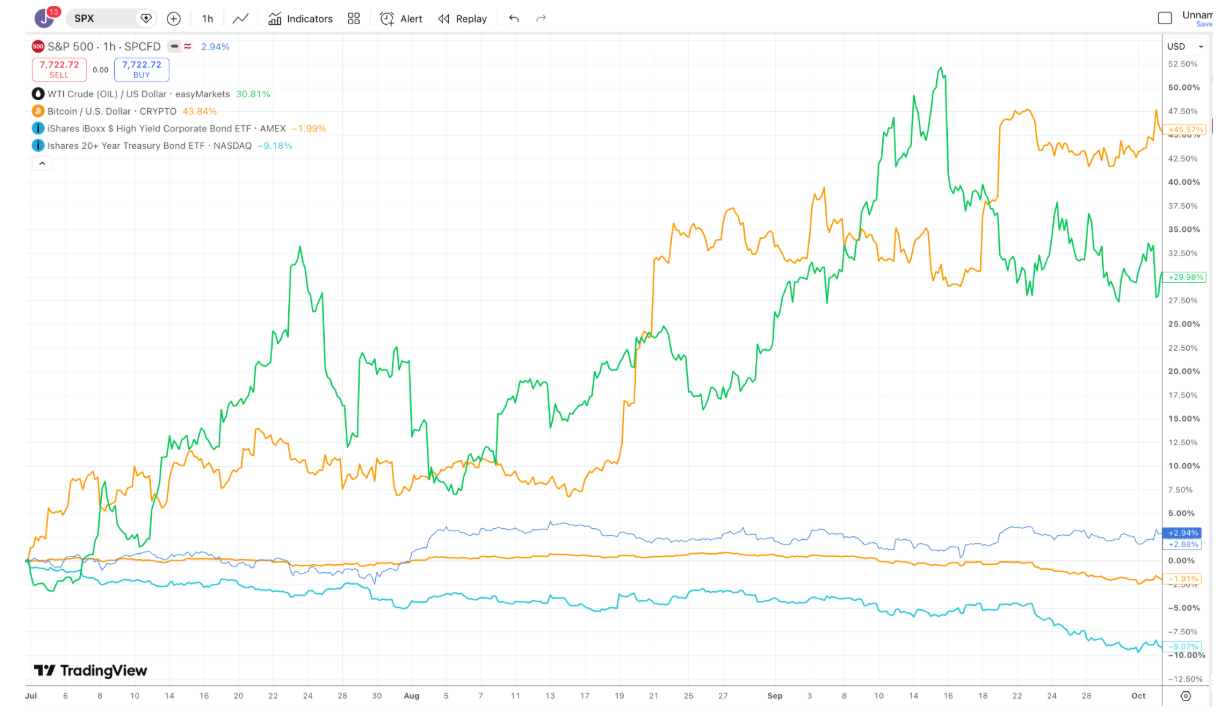
Meanwhile, the war with Iran has added another inflationary shock. Brent crude moved back above $100/barrel as hopes faded for a full reopening of the Strait of Hormuz, further complicating the outlook for inflation and monetary policy. In other words, investors aren’t simply dealing with higher real rates; they’re facing higher rates and an energy shock simultaneously.
For a while, credit markets seemed remarkably unconcerned. Even as Treasury yields moved higher, high-yield credit spreads remained near historically tight levels, suggesting that investors largely viewed higher rates as a byproduct of strong economic growth rather than a warning about deteriorating corporate fundamentals. But that resilience finally began to crack over the past few weeks. High-yield spreads, which had hovered around 260-270 basis points for much of the summer, quickly widened above 300 basis points. That’s hardly a distressed level, but the change in direction matters. For the first time in this move, Treasury yields are rising, and investors are demanding greater compensation to own risky corporate debt. The widening has been particularly pronounced among lower-quality CCC borrowers.
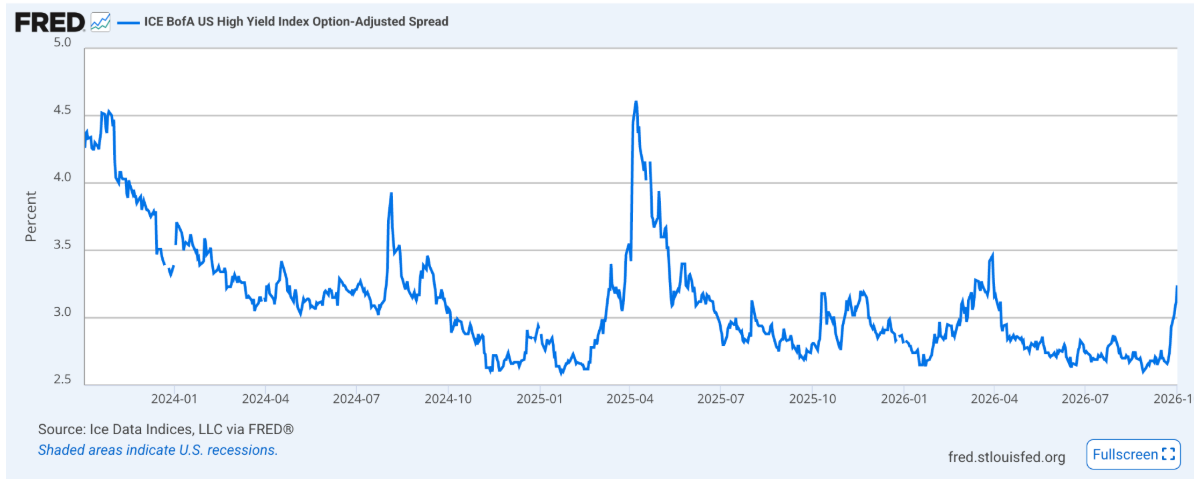
Higher Treasury yields alone don’t necessarily signal tighter financial conditions if they’re being driven by stronger expected growth. But higher Treasury yields, higher oil prices, and widening credit spreads, all occurring simultaneously, are a considerably less friendly cocktail for risk assets. Financing gets more expensive, leveraged borrowers become less attractive, and a 5%+ risk-free return raises the hurdle rate for owning virtually everything else.
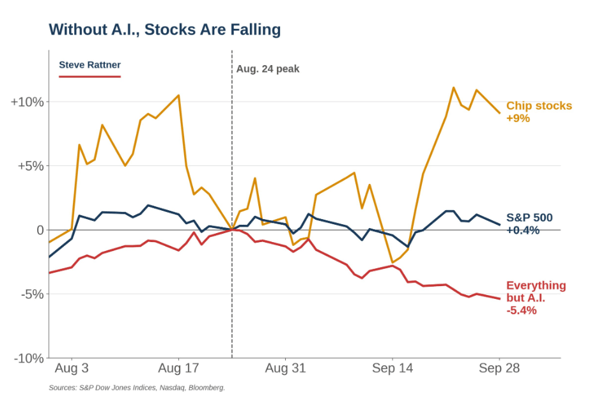
While equities overall have performed ok, they are beginning to show some cracks as well. The headline S&P 500 remains near record highs, but that strength masks an increasingly bifurcated market. As the chart below illustrates, since late August, AI-related stocks have continued to rally, while the rest of the market has fallen by roughly 5%. AI is simultaneously helping hold up the headline equity indices while contributing to some of the forces (stronger expected growth, enormous capital expenditures, and increased corporate borrowing) that are putting upward pressure on long-term rates. AI-related forces are estimated to account for roughly 20% of the recent rise in long-term Treasury yields.
So take a step back and consider the setup. Treasury yields are at generational highs. Oil is above $100. Credit spreads are widening. The Federal Reserve remains restrictive. And outside of a relatively narrow group of AI beneficiaries, equities are already struggling.
This should be a terrible environment for digital assets, yet strangely, it hasn’t been.
In fact, given everything happening around it, one of the most impressive things about crypto over the past few months isn’t how much it has gone up. It’s how difficult it has been to knock it back down.
Bitcoin and Ethereum Aren’t Even Telling the Story
And if you’re judging that resilience based solely on Bitcoin and Ethereum, you’re looking at the wrong assets.
For most casual investors, and much of the financial media, “crypto” still means Bitcoin, with Ethereum occasionally thrown in for good measure. That shorthand has always been imperfect, but this year it has become downright misleading. Bitcoin and Ethereum performed well during the third quarter, particularly compared with other risk assets that were contending with the macro headwinds discussed above. But within digital assets, they have been relative laggards.
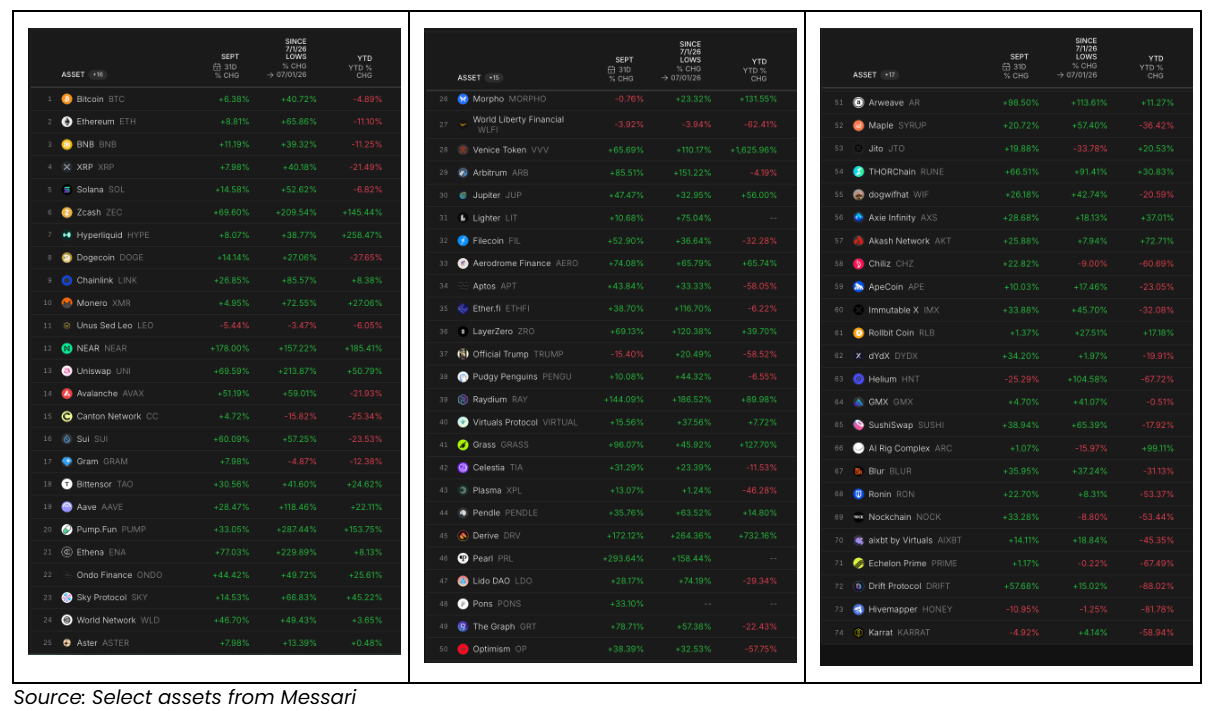
The divergence is particularly noticeable since the market bottomed in early July. Bitcoin has risen roughly 40% from those lows and Ethereum roughly 66%, which would ordinarily look like the beginning of a very healthy crypto rally. Except that dozens of other digital assets have done considerably better. The tables below show many tokens that have dramatically outperformed one or both of the two largest digital assets, while several remain significantly positive year-to-date, even though BTC and ETH are still negative on the year. You can see below just how poorly BTC and ETH have done in September, since the July 1 lows, and YTD relative to other digital assets.
But simply calling this an “altcoin rally” misses what we think is happening.
For most of crypto’s history, an “altcoin rally” meant investors were moving farther out on the risk curve. Bitcoin went up, then Ethereum, and eventually investors became sufficiently confident or aggressive to start buying smaller, more speculative assets. Fundamentals were often irrelevant. In fact, during previous cycles, the assets that rose the most frequently had the least fundamentals. The entire trade was driven by liquidity, narratives and reflexivity.
There is certainly still plenty of that happening today. Some of the biggest winners in the table above have little to do with fundamentals. But buried within the noise is a group of assets that we’ve been highlighting for months: tokens tied to actual businesses and protocols generating real revenues, with increasingly direct mechanisms for returning that economic value to tokenholders.
This is a theme we’ve written about repeatedly this year. Crypto investors are finally beginning to think about revenues, earnings, capital allocation, and tokenholder value accrual—the same concepts investors use to evaluate virtually every other financial asset. And recent SEC guidance has further strengthened that trend by reducing legal uncertainty that historically encouraged projects to create intentionally useless governance tokens rather than explicitly connecting token ownership with the economics of the underlying protocol.
Perhaps the most interesting evidence, though, isn’t simply price performance. It’s where traders choose to allocate their risk.
Since Bitcoin’s September 21st high, perpetual futures open interest in BTC has declined from roughly $28 billion to $23 billion, while ETH open interest has fallen from approximately $18 billion to $16 billion. Yet open interest across the rest of the digital asset market has moved in the opposite direction, rising from roughly $20 billion around Bitcoin’s high and then remaining at or above that level.
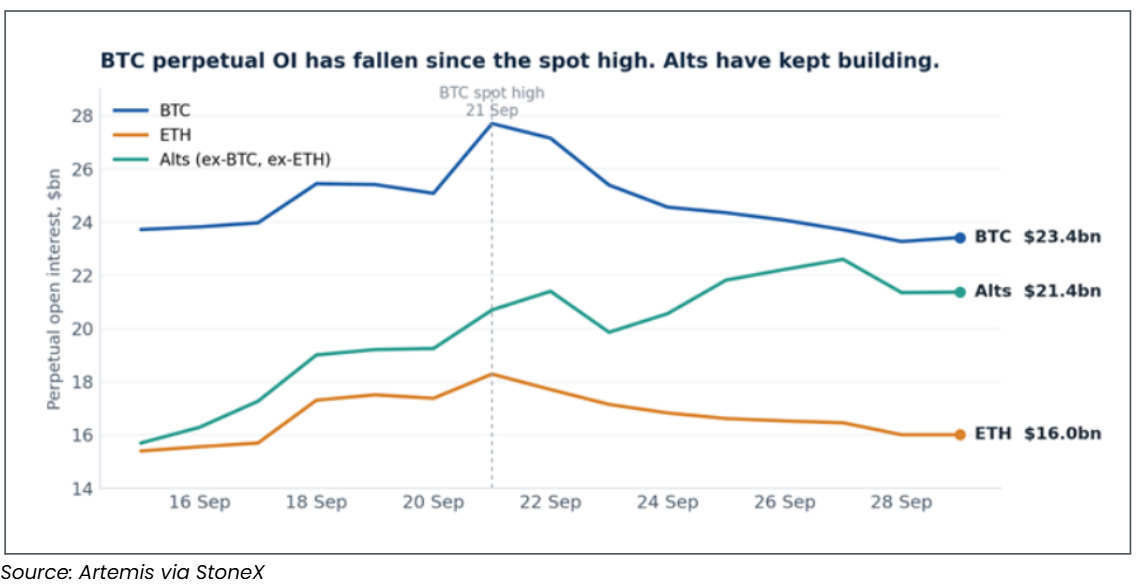
That doesn’t prove investors are suddenly performing discounted cash-flow analyses on every token they buy. And it certainly doesn’t mean speculative behavior has disappeared from crypto. But it does suggest that investor attention is shifting away from the industry’s traditional bellwethers, even as the overall market remains remarkably resilient.
And that may be the bigger story.
We’ve spent years arguing that crypto eventually needs to stop trading as one giant asset. There is no fundamental reason that Bitcoin (a decentralized monetary asset), Ethereum (a Layer-1 smart-contract blockchain), Aave (a lending protocol), Hyperliquid (a derivatives exchange) and Aerodrome (a decentralized exchange) should all rise and fall together simply because Bloomberg puts them in the same “crypto” bucket. They are completely different assets attached to completely different businesses, networks and economic models.
Public equity investors don’t expect Nvidia, JPMorgan and DraftKings to trade identically simply because all three are stocks. Eventually, digital asset investors should behave the same way.
Maybe we’re finally starting to see that happen.
But that creates another puzzle. If these assets are performing so well and investors are increasingly moving their risk away from BTC and ETH toward the rest of the market, where are all of these buyers coming from? Unlike every previous crypto bull market, they aren’t particularly easy to find.
So Where Are the Buyers?
That brings us to perhaps the strangest part of this rally: it’s surprisingly difficult to figure out who is actually buying.
During the 2020 and 2021 crypto bull markets, there wasn’t much mystery. New retail investors flooded into the market through Coinbase and Robinhood, both of which routinely climbed to the very top of the Apple App Store rankings. Coinbase briefly became the #1 downloaded app in the entire U.S. App Store during the height of the 2021 mania. The path into crypto was fairly predictable: download an exchange app, deposit dollars, buy Bitcoin or Ethereum, and eventually venture farther out onto the risk curve.
Nothing about today’s market looks like that.
As of October 1st, Coinbase ranked #44 among free finance apps in the U.S., while Robinhood was #24. Meanwhile, Kalshi was #1, and Polymarket was #5. Clearly, retail investors haven’t lost their appetite for speculation; they may simply be expressing it somewhere else.

There is certainly evidence of new institutional money entering through a different door. U.S. spot Bitcoin ETFs attracted approximately $2.39 billion of net inflows during the five trading sessions from September 21-25, while spot Ethereum ETFs added another $690 million. Those are meaningful numbers, making it difficult to dismiss the recent crypto rally as nothing more than short covering or leveraged offshore speculation.
But even those flows don’t fully explain what’s happening underneath the surface.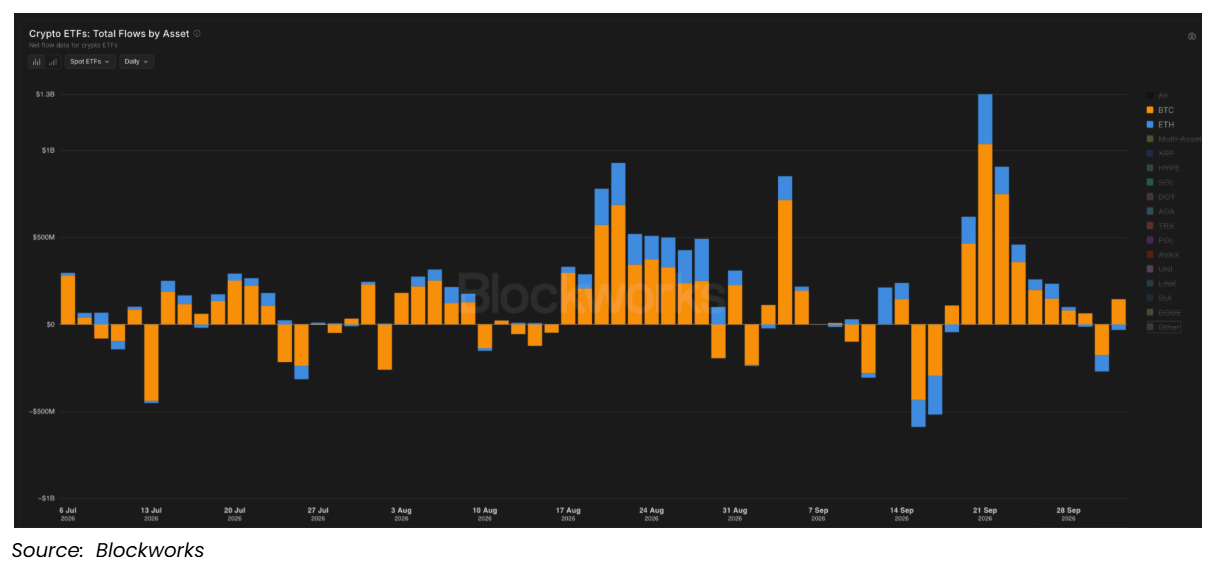
ETF creations tell us that investors wanted exposure to Bitcoin and Ethereum. They don’t explain why so many assets farther down the crypto market have been outperforming them.
Nor can we simply assume that every dollar of ETF creation represents a new directional bet on higher Bitcoin prices. ETF shares can be paired with futures shorts or incorporated into basis and arbitrage trades. The flows demonstrate demand for the products and associated spot exposure, but they can’t tell us exactly what motivated every buyer.
So we’re left with an unusual combination. Institutional demand for BTC and ETH is clearly present, but hardly accelerating. Traditional retail doesn’t appear to be stampeding through Coinbase and Robinhood. Bitcoin and Ethereum futures positioning has declined from its September highs. And yet dozens of smaller digital assets continue to outperform.
In previous cycles, we’d likely conclude that there simply wasn’t enough new money entering crypto to sustain this kind of move. But perhaps we’re looking for buyers in the wrong place.
Because while Coinbase’s position as the front door to crypto may be less visible than it was in 2021, something else has changed dramatically over the past five years:
Crypto has built its own financial system.
Today, hundreds of billions of dollars already exist in stablecoins. Investors increasingly hold assets directly in wallets rather than exclusively on centralized exchanges. And a rapidly growing percentage of crypto trading takes place entirely on-chain.
Maybe We’re Looking in the Wrong Place
Perhaps the buyers aren’t actually missing. Perhaps we’re just looking for them using an outdated map.
Coinbase and Robinhood App Store rankings were incredibly useful indicators during the last crypto cycle because centralized exchanges were the primary gateway into the asset class. If someone wanted to buy crypto in 2020 or 2021, chances are they opened an account at a centralized exchange, deposited dollars, bought BTC or ETH, and only later discovered the rest of the digital asset universe.
But a lot has changed since then. Today, an enormous amount of capital already exists inside the crypto economy.
Stablecoins are perhaps the clearest example. The total stablecoin supply now sits above $300 billion. More importantly, that capital doesn’t need to leave the ecosystem when investors sell a digital asset. An investor can sell HYPE, AAVE, or ETH for USDC, hold dollars for weeks or months, and then redeploy that capital into another asset without ever touching a bank account or centralized exchange. Stablecoins have effectively created a massive pool of digital cash that can continuously rotate throughout the ecosystem.
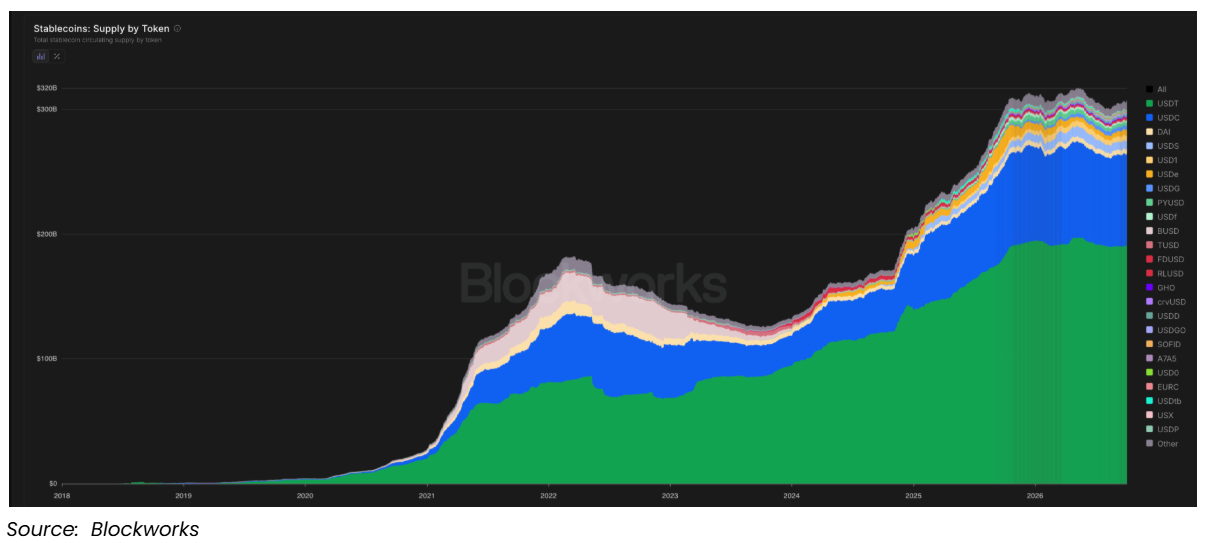
That doesn’t mean we’re witnessing another 2021-style liquidity explosion. In fact, that may be precisely the point. Stablecoin supply isn’t currently growing at anything like the pace we saw during the most speculative periods of previous cycles. There’s little evidence that hundreds of billions of dollars in fresh retail money are suddenly pouring into digital assets.
There’s simply a lot more money already here.
And increasingly, that money is trading on-chain.
At first glance, current decentralized exchange volumes aren’t particularly remarkable. Monthly DEX volumes remain well below the peaks reached in 2024 and 2025, which again argues against the idea that we’re experiencing a broad speculative mania.
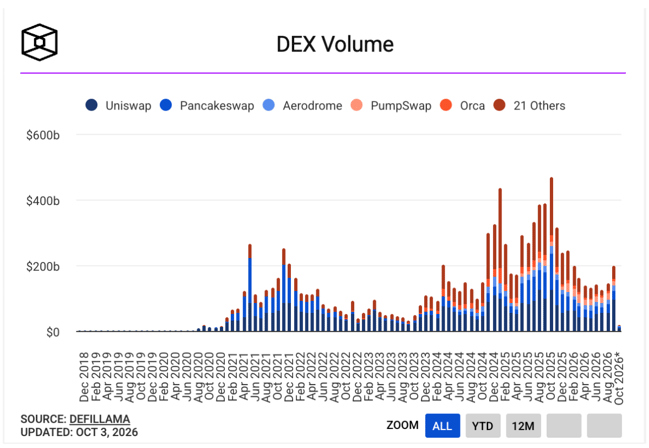
But looking at DEX volumes in isolation overlooks one of the biggest structural changes taking place in crypto.
As a percentage of centralized exchange spot volume, DEX trading has been steadily gaining share for years. The DEX-to-CEX spot volume ratio was only a few percent in 2021, reached roughly 10% at times in 2024, and has recently climbed toward 25%.
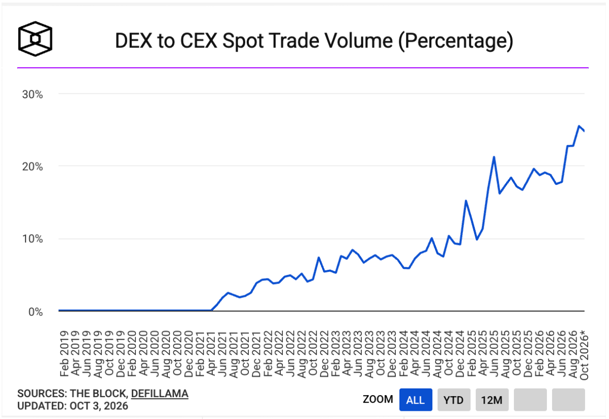
That is a pretty extraordinary change. Crypto trading activity isn’t disappearing. It is migrating.
This may help reconcile some of the seemingly contradictory data we’ve discussed throughout this piece. Coinbase can rank #44 in the Finance category without implying that no one is trading crypto. DEX volumes can remain below their absolute highs even as DEXs capture a record percentage of the overall trading market. And application tokens can outperform BTC and ETH without requiring millions of new investors to first download Coinbase and work their way down the traditional crypto risk curve.
The infrastructure simply doesn’t require that path anymore.
An existing crypto investor can hold USDC in a wallet and move directly into HYPE, AAVE, ENA, AERO, PUMP or dozens of other assets. They can lend, borrow, trade spot, use derivatives, earn yield, and rotate between investments without ever converting back into fiat or interacting with a centralized exchange.
In other words, crypto has spent the past five years building its own distribution layer.
This is particularly relevant to something we’ve discussed repeatedly this year: crypto has historically suffered from a distribution problem as much as an asset problem. There have been interesting businesses and protocols for years, but getting investors to discover, understand, and ultimately purchase their tokens has been unnecessarily difficult, and often purposefully misleading. Meanwhile, nearly every crypto rally was filtered through the same handful of assets and centralized venues.
That bottleneck is slowly disappearing.
Institutions now have access to ETFs through which they can gain exposure to Bitcoin and Ethereum. Crypto-native investors have hundreds of billions of dollars of stablecoin liquidity and increasingly sophisticated on-chain markets through which they can access everything else. And the assets themselves are finally giving investors better reasons to own them through revenues, buybacks and improved tokenholder economics.
Which brings us back to where we started.
The Strangest Crypto Rally Yet
The more we look at this market, the stranger it becomes.
The macro backdrop should be terrible for crypto. Yet digital assets have been remarkably resilient.
Bitcoin and Ethereum should theoretically lead any crypto rally. Instead, both have dramatically underperformed dozens of smaller assets since the July lows, including a growing collection of tokens connected to real businesses that generate real revenue and increasingly return that value to tokenholders.
A rally of that magnitude would normally be accompanied by unmistakable signs of retail speculation. Yet neither Coinbase nor Robinhood resembles the retail frenzy we saw in 2020 and 2021.
ETF inflows explain some of the demand, particularly for Bitcoin and Ethereum, but they don’t explain why so many assets farther down the market are outperforming the assets the ETFs actually own.
And data on stablecoins and DEXs suggest another possibility. Maybe this isn’t a traditional crypto bull market at all. Perhaps we are witnessing the early stages of something crypto has been trying to become for more than a decade: an actual capital market.
In an actual capital market, investors don’t simply buy every asset because the largest one went up. They evaluate businesses. They compare valuations. They follow revenues and earnings. They evaluate capital allocation. They move capital toward assets offering better expected returns and away from those offering worse ones.
That doesn’t mean crypto has suddenly become perfectly rational. Far from it. Memecoins still trade at ridiculous valuations. Narratives still drive enormous moves. Leverage remains pervasive. And three months of differentiated performance certainly isn’t enough to declare the old crypto cycle dead.
But the direction is certainly encouraging.
For years, we complained that almost every digital asset traded together. Bitcoin went up, Ethereum followed, and then a rising tide indiscriminately lifted virtually every token in existence. When Bitcoin fell, the process simply worked in reverse. It was difficult to argue that fundamental analysis mattered when an asset’s biggest determinant of performance was whether Bitcoin happened to be going up or down that day.
What we’re seeing today looks different.
The macro environment is hostile, yet crypto is holding up. BTC and ETH are no longer dictating every move. Capital appears to be rotating toward individual assets rather than blindly moving down the market-cap curve. Stablecoins have created a permanent pool of capital inside the ecosystem. DEXs are steadily taking share from centralized exchanges. And, perhaps most importantly for us, many of the tokens performing best are attached to exactly the kinds of businesses and token structures we’ve spent years arguing investors should care about.
We don’t yet know whether this can last.
Maybe Treasury yields keep climbing and eventually overwhelm everything. Maybe credit spreads continue widening, and risk assets finally capitulate. Maybe the recent strength in application tokens proves to be nothing more than another short-lived altcoin rotation.
But given everything else happening in financial markets, crypto’s resilience deserves more attention than it’s receiving. And the relative strength underneath Bitcoin and Ethereum deserves even more.
The strangest part of this crypto rally isn’t simply that it’s happening despite an awful macro backdrop. It’s that, for once, market participants may actually be getting smarter.
Disclosure: The Arca Funds and/or their affiliates hold positions in HYPE, AERO, and PUMP discussed in this article.
And That’s Our Two Satoshis!