


The SEC / CFTC “Frenemy” Relationship

Jeff Dorman, CFA
Mar 23, 2026

Thats Our 2 Satoshis Logo

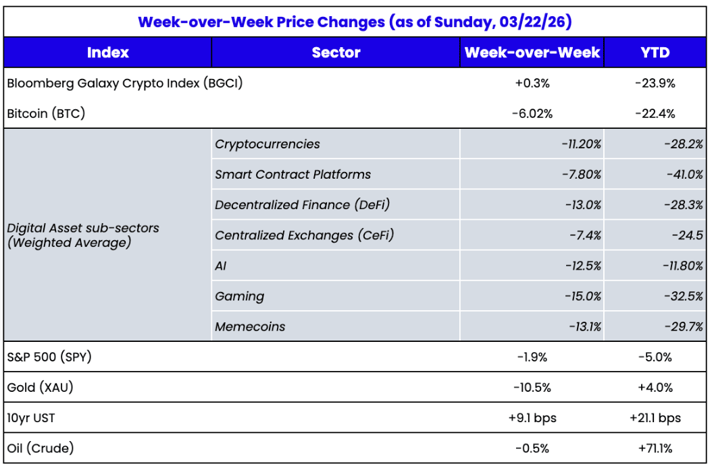
WoW 3-23-26 chart

Source: TradingView, CNBC, Bloomberg, Messari
 

Making Sense Of The Recent Reactions In Prices

There are a lot of factors affecting markets currently.

  • The war in Iran and the subsequent oil price surge
  • The takeover of AI, mainly affecting software stocks and bonds, but also seeping into other sectors
  • The fear over private credit markets, which is seeping into the stocks of private equity giants
  • Rising inflation fears, which are pushing back rate cut expectations into 2027

So, how have markets been reacting, and does it make sense?
  • Oil rose another 9% last week, and is now up 72% YTD. That one needs little explanation.
  • Gold has fallen 15% from recent highs, and silver has fallen over 30%. Silver has always been a bit of a joke market, so we’ll ignore that, but the move in gold makes some sense, as the market has shifted from fear of the future (AI & recession) to fear of the present (war, inflation).
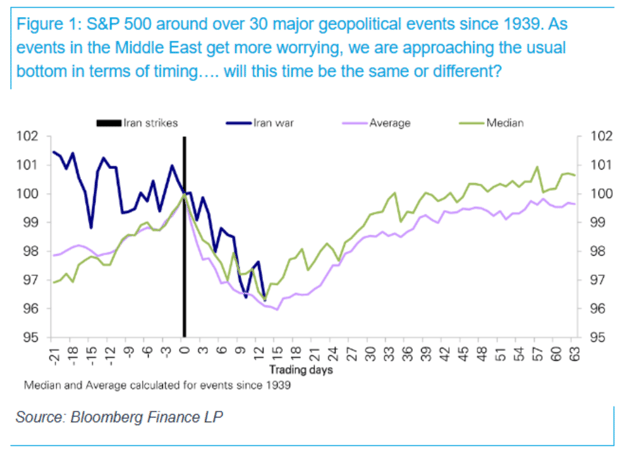
  • The S&P 500 is down over 6% from recent highs. The Russell 2000 has now fallen more than 10% from its recent high. Small caps are the most exposed to higher oil prices, tighter financial conditions, and slowing economic growth, so they should feel the stress before large caps do. This too makes sense, as rate cuts are seemingly off the table for now, and the knee-jerk reaction lower from the Iran war is following a familiar path. According to Jim Reid at Deutsche Bank, this episode is tracking the historical geopolitical pattern for U.S. equities, and we are now approaching the point where markets have typically bottomed on average. Historically, when looking across more than 30 geopolitical shocks since 1939, the average path by day shows that U.S. equities tend to bottom around T+15 (we are at T+14), at a little over 4% below their pre-shock level (we are at -6%).
Figure 1 - Bloomberg Finance LP Chart
  • The 10-year U.S. Treasury yield rose 13 basis points last week, and has risen 44 bps since the war began. This one makes the least sense to me. Yes, the U.S. dollar is rising, and that should lead to higher Treasury yields, but the USD appreciation is mostly because oil prices are denominated in USD, which mathematically pushes up demand for USD to cover rising import costs. And yes, we’ve seen recent inflationary scares from the PPI report, but AI growth coupled with war are likely deflationary ultimately. The oil shock is likely temporary, but either way, there are only 2 real scenarios that play out due to rising oil prices: 1) oil prices stay elevated, which will likely lead to a consumer-driven recession, which should send Treasury yields lower in a flight to quality bid or 2) Oil prices come right back down on a resolution to the Middle East war, which should also send rates lower as inflationary pressures subside. It’s not entirely clear to me why Treasury yields would be rising, though yields remain squarely in the middle of a 4-year range, so it might be much ado about nothing.
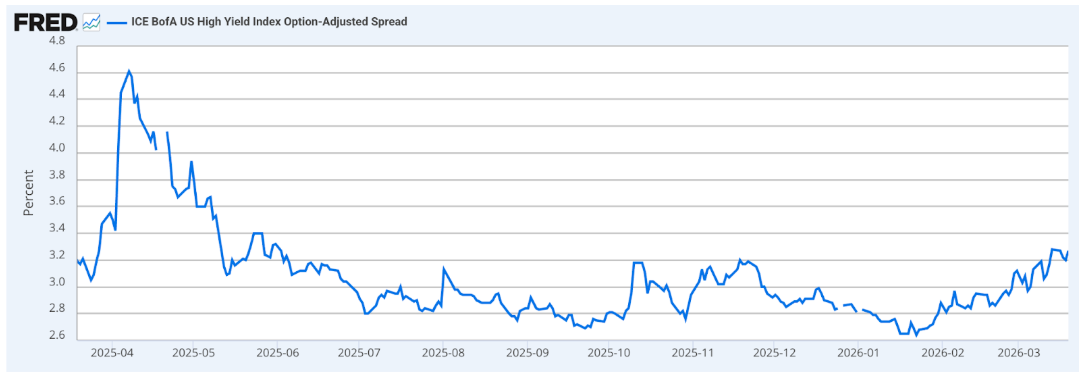
  • Credit spreads are starting to finally leak. What was once fairly isolated to software loans/bonds and a few CCC-rated credits has now seeped into the broader credit market. High-yield bond spreads have risen 50 bps since the March lows, and, when coupled with rising government debt yields, have led to overall borrowing costs up almost 1% for corporates. Typically, credit spreads widen before equities fall if we are headed towards a real recession. The fact that equities fell before credit likely means that this is not something to worry about (from a credit standpoint).
FRED ICE BofA US High Yield Index Option-Adjusted Spread - Chart 1
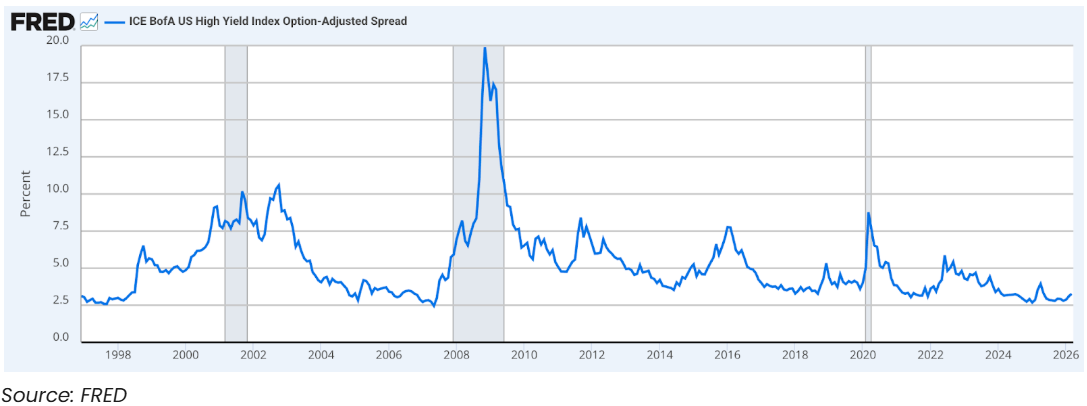
  • Zooming out, spreads are nowhere near “crisis” or “recession” level, but it is the first persistent weakness that markets have seen since the tariff fears in early 2025.  

FRED ICE BofA US High Yield Index Option-Adjusted Spread - Chart 2

  • Meanwhile, digital assets, generically, outperformed other markets again last week. Positioning in crypto looks clean (from a leverage standpoint), likely because anyone who wanted to sell has already sold during the 5-month slide in prices, and shorts continue to be forced to cover as there are few real sellers left. Further, while Bitcoin has failed to act in a rational way over the past 6 months, bearer assets like Bitcoin have historically done well during times of capital flight, and it might be regaining that narrative in the Middle East.

Putting it all together, I’d say equities and credit are behaving correctly, and may see dip buyers as long as the Iran situation doesn’t worsen. Digital assets and gold are behaving as expected. Treasuries seem to be the only instruments behaving wacky.

The SEC / CFTC Show Their Cards

Last week, the SEC and CFTC reportedly jointly released long-awaited guidance that finally begins to formalize how digital assets are classified under U.S. law. The framework introduces a clear taxonomy:

  • Digital commodities
  • Digital securities
  • Stablecoins
  • Collectibles
  • Tools

… with only the category of “digital securities” falling under traditional securities regulation. More importantly, the SEC reportedly named several major tokens, including BTC, ETH, SOL, ADA, AVAX, XRP, and LINK, as digital commodities, signaling that they fall outside of securities laws and into the CFTC’s domain. The guidance also establishes a path for tokens that may have originally been sold as securities to eventually trade as non-securities once network functionality is achieved or issuer obligations are fulfilled. After years of regulation-by-enforcement, this is the first real attempt at a coherent, rules-based framework.

From a market perspective, this is a big deal, not because it “changes” crypto, but because it removes a massive overhang. As Coinbase noted, regulatory uncertainty has effectively acted as a valuation discount on the entire asset class, with ~66% of institutions citing it as a primary barrier to investing.
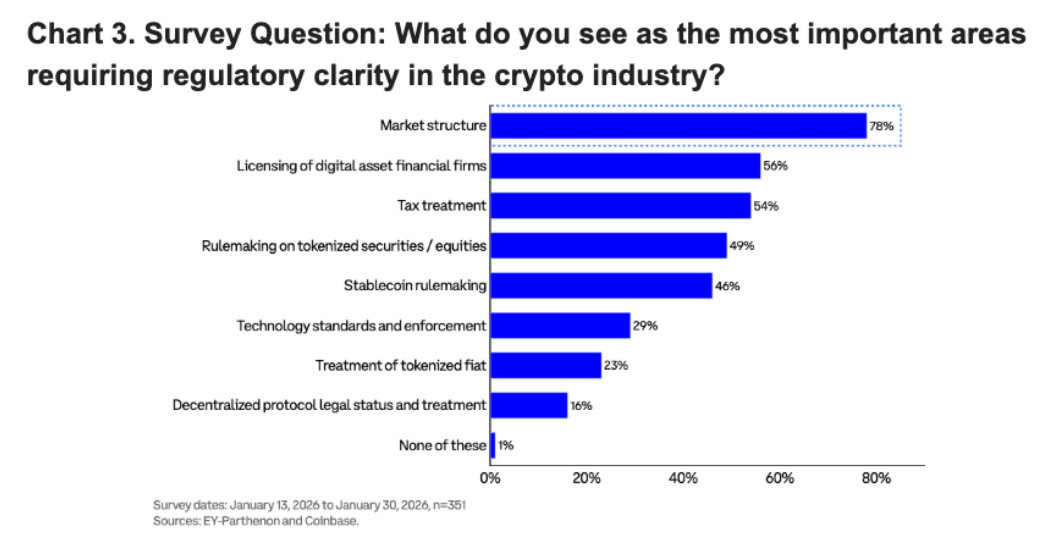
Chart 3 Survey Question


By explicitly classifying large-cap tokens as commodities and clarifying that core activities like staking, mining, and even airdrops are generally not securities transactions, the SEC has materially reduced perceived tail risk. Alex Thorn at Galaxy Digital highlighted an equally important nuance: this is an interpretive rule, not law, meaning it reflects how the current SEC intends to enforce policy, but can be changed and does not bind courts. That said, it also effectively updates the vague 2019 framework and marks a clear shift away from the Gensler-era approach, including a critical change that allows tokens to “graduate” from securities to non-securities over time (something previously denied in practice).

None of this is particularly surprising if you’ve been paying attention for the last five years. In fact, Arca laid out a nearly identical taxonomy framework back in 2020, separating digital assets based on function, use case, and economic reality rather than forcing everything through a securities lens. The idea that some tokens behave like commodities, some like currencies, and others like securities isn’t new…it has just taken regulators half a decade (and a lot of lawsuits) to catch up. What’s changed is not the assets themselves, but the willingness of regulators to acknowledge what the market has already known.

The bigger takeaway here is coordination. The SEC and CFTC are clearly trying to present a united front, something that historically would have been hard to imagine given their “frenemy” relationship over jurisdiction. This framework is effectively a signal that the two agencies believe they can co-regulate digital assets under their existing authorities, at least in the near term. But the reality is that both are still constrained without legislation. These interpretations can be reversed, and the exemptions are narrow by design. Which is why the real goal here is to buy time and build momentum for the CLARITY Act, which would codify this framework into durable law and give both agencies more flexibility to operate together. In the meantime, this could help unlock incremental institutional capital, increase dispersion across assets, and shift the market from “what won’t get sued” to “what actually works.” And that’s a pretty meaningful step forward.

As always, I’d also like to remind investors that there is nothing illegal about being a security. Investors buy and sell securities all the time. The hangup around whether something is deemed a security or not only affects:

a) the issuer’s ability to sell said security (and this new guidance will help in that regard)
b) an exchange/broker’s ability to trade said security (and these walls were already coming down, but this will speed up the wall destruction)

So, bottom line: Expect more and more digital assets to be issued and traded with confidence.

 

And That’s Our Two Satoshis!
Thanks for reading everyone! Questions or comments, just let us know.

 
The Arca Portfolio Management Team
Jeff Dorman, CFA - Chief Investment Officer
Katie Talati - Director of Research
Sasha Fleyshman - Portfolio Manager
David Nage - Portfolio Manager
Wes Hansen - Director of Trading and Operations
Alex Woodard - Associate, Research
Christopher Macpherson - Research Analyst
Andrew Masotti - Associate, Trading and Operations
Joey Reinberg, Associate, Trading and Operations
 
 
To learn more or talk to us about investing in digital assets and cryptocurrency
call us now at (424) 289-8068.

Subscribe For the Latest Blockchain News & Analysis


Disclaimer: The views expressed here are those of the author, and is not investment advice. This commentary is provided as general information only and is in no way intended as investment advice, investment research, legal advice, tax advice, a research report, or a recommendation. Any decision to invest or take any other action with respect to any investments discussed in this commentary may involve risks not discussed, and therefore, such decisions should not be based solely on the information contained in this communication. Please consult your own financial/legal/tax professional.


Statements in this communication may include forward-looking information and/or may be based on various assumptions. The Arca Funds, its affiliates, and/or clients may hold a position in any investment discussed as part of this communication, where any such investment is based on Arca’s proprietary research analytics. Actual future results or occurrences may differ significantly from those anticipated and there is no guarantee that any particular outcome will come to pass. The statements made in this commentary are subject to change at any time. Arca disclaims any obligation to update or revise any statements or views expressed in this commentary. Past performance is not a guarantee of future results and there can be no assurance that any future results will be realized. Some or all of the information provided  may be based on statements of opinion. In addition, certain information  may be based on third-party sources, which information is believed to be accurate, but has not been independently verified.  This commentary is not intended to be an offer to sell or a solicitation of any offer to buy any securities, or a solicitation to provide investment advisory services.