




The Changing of the Guard at the Fed
On August 22, 2025, the Trump Administration announced that the U.S. took a 10% stake in Intel (INTC). This position was purchased at $20.47/share, worth $8.9 billion, and it was followed by a $5 billion investment by Nvidia just 27 days later.
Last week, INTC hit its all-time high ($99.62), and this position is now up ~400% for a gain of $36 billion. The direct investment from the U.S. is unprecedented, but more importantly, it proves further that the well-known Wall Street saying “Don’t fight the Fed” has really become “Don’t fight the White House.”
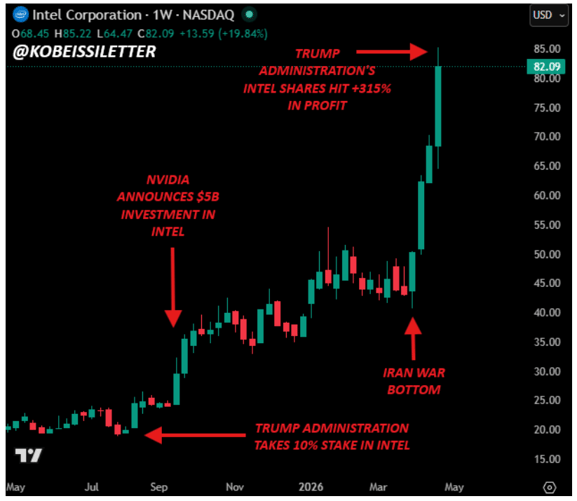 Source: Twitter/X
Speaking of the Fed, the FOMC held rates steady last week, as expected, but the more interesting discussion came from Powell’s final testimony, the 4 dissents on the pause in rate cuts, and the now-likely confirmation of Kevin Warsh as the next Fed chairman. For most of modern history, the Fed operated with a level of independence that showed up not just in policy, but in tone. It was more fragmented, less choreographed, and often with individual voices carrying distinct views. Back when I was a trader at Merrill Lynch and Citadel 15+ years ago, the desk would go silent on FOMC days as we literally had no idea what the announcement and subsequent testimony would reveal. It was a total mystery. Under Jerome Powell, that changed. The Powell Fed became unusually unified and transparent, leaning heavily on forward guidance and consistent messaging to shape expectations and reduce volatility. Even when policy was restrictive, markets at least had a script, as there was a clear attempt to tell you what the Fed was thinking and where it was going. This was the most transparent and most boring Federal Reserve in recent history.
That may now be reversing with Kevin Warsh. His approach looks less like consensus-building and more like a reset back to a looser, less scripted communication style. He wants fewer assurances, more debate, less guidance, and more room for interpretation. In other words, less “we’re all saying the same thing” and more “figure it out yourself.” If Powell narrowed the range of outcomes through transparency, Warsh could deliberately widen it. That shift matters, not because rates immediately change, but because the market may have to adjust to a Fed that’s less predictable, less unified, and ultimately more “every man for themselves” again.
Markets are already living in a stream-of-consciousness Trump/Truth Social world, which has increased volatility every time the President opens his mouth. Now we’re headed back to a world where the Federal Reserve will likely increase volatility rather than purposefully suppress it.
And that’s a good thing for digital assets, as this asset class used to be the most volatile but has become duller, more recently. When digital assets become more volatile, traders return, making the risk/reward of owning digital assets more palatable. Moreover, the CLARITY Act looks increasingly likely to pass, which will likely continue to give the CFTC more power than the SEC as it pertains to governing most digital assets, and will likely usher in more institutional investors into the digital assets investment arena. This all could bode well for digital assets.
But Will Retail Investors Actually Come Back?
Last week, Robinhood (HOOD) released its Q1 revenue, which rose 15% YoY, but its crypto revenue fell 47%. That’s a pretty ominous sign for Coinbase (COIN), which releases earnings later this month. It appears much of this retail activity has moved from crypto trading to prediction markets. The appeal is pretty straightforward: prediction markets feel like trading, but with cleaner narratives and faster feedback loops. Instead of grinding through tokenomics or macro, users can express a view on a single outcome with clear resolution. Platforms like Polymarket and Kalshi have seen surges in volume, and their UX increasingly resembles that of simplified derivatives trading. At the same time, crypto has lost some of its short-term speculative edge as less volatility, fewer “new narratives,” and more regulatory and liquidity overhangs are making it a tougher playground for casual traders.
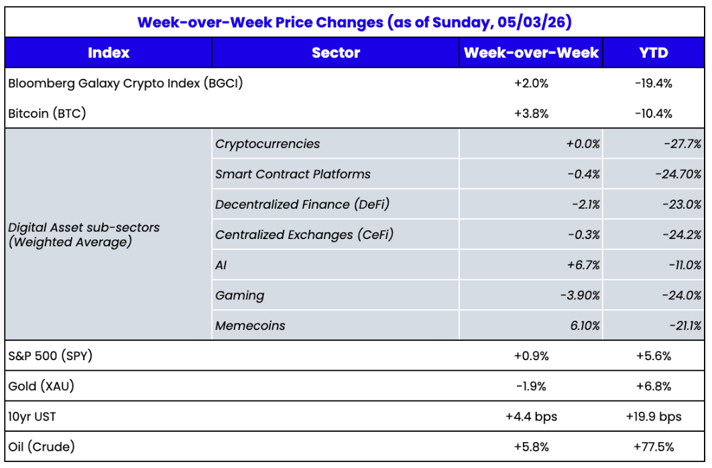
That said, last week, most of the biggest movers were retail-focused digital assets. Bittensor (TAO) rose 15% after a positive article appeared on WallStreetBets. ApeCoin (APE) rose 14% after a management shakeup. Even Dogecoin (DOGE) jumped 12% for reasons that can’t be explained, while WIF and PENGU rose 5-6% each. Even Strategy (MSTR) is moving again, up 50% since the start of April.
While that’s a small sample over a short time period, it does show how much juice there is in some of the most beaten-up digital assets if the retail investor base returns. Coinbase once consistently ranked #1 on the Top Finance app list (in 2020 and 2021). Today, they are 45th (Kalshi is 11th, Polymarket is 23rd, and Robinhood is 22nd). This is a good table to monitor as it pertains to retail interest in digital assets.