
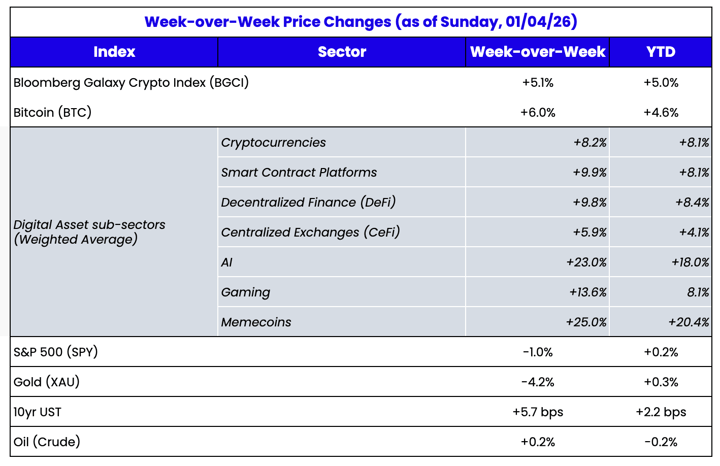
Source: TradingView, CNBC, Bloomberg, Messari
Before getting into 2026, it’s worth closing the book on 2025: a year that, depending on how you look at it, was either deeply frustrating or quietly constructive. From a price perspective, 2025 was undeniably disappointing. From a fundamentals and market-structure perspective, however, most of what we expected actually happened. Regulatory pressure eased meaningfully, bipartisan legislation finally began moving through Congress, token issuance expanded beyond crypto-native protocols, Wall Street accelerated its tokenization efforts, and real assets not just quasi-equity tokens) began moving on-chain. If there was one clear miss, it was price. And if there was one thematic miss, it was probably the speed and depth of the AI-crypto intersection, which progressed more slowly than we expected despite long-term inevitability. Taken together, we’ll give ourselves a B+ on predictions and an F on short-term returns. This is a familiar outcome in an industry that continues to reward patience far more than narrative timing.
Looking ahead, many of the forces that mattered in 2025 will matter even more in 2026, but with sharper consequences.
Prediction #1: This industry will start to see better long-term stakeholder alignment based on the success of HYPE.
The first and most important prediction is that long-term stakeholder alignment will become non-negotiable. The original promise of tokens was always to align founders, employees, users, and investors in the same economic system. In practice, much of the industry forgot that. What changed in 2025 was proof. Hyperliquid showed that linking token value to platform performance, particularly through its 99% revenue buyback model, can scale effectively. Binance and Bitfinex did this years ago with BNB and LEO. Others did not. At the same time, we saw the downside of misalignment play out publicly: disputes between protocol DAOs and operating companies, acquisitions that ignored token holders, and governance structures that funneled value everywhere except to the token itself. In 2026, issuing a token with no clear financial or utility-based value driver will become increasingly untenable. This isn't just about increasing the value of tokens- it's about preventing structural decay. Alignment won’t be a differentiator; it will be table stakes.
Prediction #2: In the coming year, anticipate the emergence of hybrid valuation frameworks that integrate on-chain analytics with traditional financial metrics. Tokens will be assessed more similarly to equities or credit instruments.
Second, we expect the emergence of hybrid valuation frameworks that finally move token analysis beyond vibes and charts. Every asset class starts this way. Equities traded for centuries before Graham and Dodd introduced valuation discipline. Bonds existed long before Frank Fabozzi helped to make duration, convexity, and credit analysis become standard. Tokens are no different. The challenge, of course, is that there is no “one-size-fits-all” token. Some tokens look like equity, some like commodities, some like software licenses, and others like nothing at all. But in 2026, we expect more consistent frameworks that integrate traditional financial analysis (cash flows, buybacks, issuance schedules) with on-chain analytics (usage, staking behavior, velocity, utility). Not everything will be valued with a DCF, and Bitcoin will never fit cleanly into these models, but for revenue-generating platforms like Hyperliquid, Pump.fun, Aerodrome, Binance, and others, pretending that valuation doesn’t matter will increasingly be a losing strategy.
Prediction #3: Companies need to modify their communication strategies with potential investors to attract new capital that targets specific sectors and nuances within crypto, rather than solely focusing on Bitcoin or crypto as a hedge.
Third, communication strategies across the industry will need to mature. The idea of “crypto as a macro trade” has outlived its usefulness. Fund managers, exchanges, and service providers will have to stop speaking to the lowest common denominator and start differentiating by sector, structure, and token design. Generic crypto funds will give way to more targeted strategies (DeFi, RWAs, Layer-1s, cash-flow-positive protocols, and beyond). Likewise, the industry’s largest gatekeepers need to rethink how they educate investors. When research teams spend more time writing macro commentary than explaining token mechanics, value accrual, and sector dynamics, something is broken. If investors can’t tell the difference between a stablecoin, a governance token, a meme coin, and a cash-flow-producing protocol, that’s not a market problem- it’s an education problem.
Prediction #4: Digital assets will absorb parts of traditional finance rather than replace them.
Fourth, digital assets will absorb traditional finance rather than replace it. The long-term outcome was never TradFi versus crypto; it was always convergence. The mistake of the past two years was taking native crypto assets and forcing them onto slow, antiquated TradFi rails through ETFs, DATs and legacy settlement systems. That was one step forward and two steps back. The real opportunity is moving high-quality traditional assets like equities, bonds, and real estate onto better technological rails via blockchain. Stablecoins were the first proof point: $300+ billion of dollar-denominated debt now lives on-chain. Stocks, credit, and real assets will follow, which is a $600 trillion+ opportunity. When investors can trade crypto and traditional assets from the same wallet, with the same settlement logic, blockchain’s value proposition finally becomes obvious.
Prediction #5: CeFi will be the consumer-facing UI, and all the backend will happen within DeFi.
Finally, DeFi will continue taking market share from centralized finance, not because of ideology, but because of efficiency. Five years ago, DeFi represented roughly 1% of activity. Today, it’s closer to 25% across spot, derivatives, and lending and is continuing to grow. Liquidity concentrates where barriers are lowest, execution is cheapest, and access is permissionless. Over time, centralized exchanges will increasingly function as familiar user interfaces layered on top of decentralized liquidity, not as proprietary and fragmented liquidity silos. Investors may still log into Coinbase or Binance, but the liquidity they access will increasingly live elsewhere.
Taken together, these trends point to a simpler conclusion for 2026: less narrative, more structure. Crypto doesn’t need louder stories. It needs better alignment, clearer valuation, smarter education, and infrastructure that actually improves asset movement. The industry made real progress in 2025- just not in price. Whether 2026 rewards that progress remains to be seen, but the direction is becoming harder to ignore.