




Two weeks ago, we wrote about how strangely rational crypto markets had become. Despite deteriorating macroeconomic conditions, rising interest rates, higher energy prices, and widening credit spreads, digital assets had largely ignored the warning signs. We argued that crypto prices probably deserved to be lower, not because anything was fundamentally wrong with the industry, but because risk assets generally struggle when financial conditions tighten.
Be careful what you wish for, I guess.
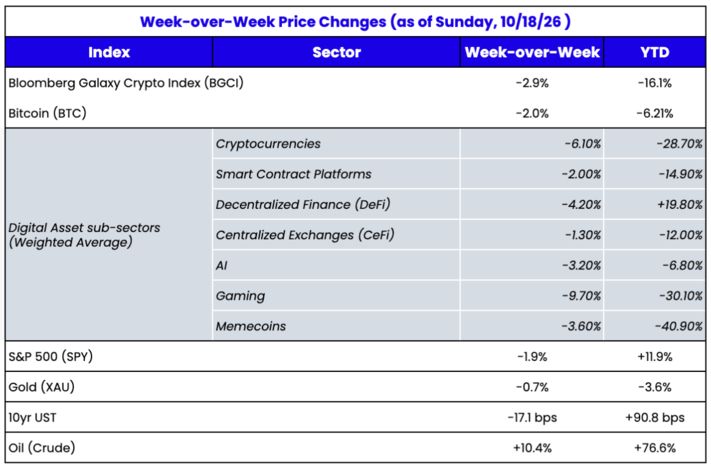
Over the past two weeks, crypto markets have sold off considerably, with many smaller-cap tokens declining 10–30%. Interestingly, however, Bitcoin has held up remarkably well, finishing this past week roughly flat, even as the Nasdaq declined another 4.5%, oil rose, and credit spreads blew back out to recent wides. Meanwhile, the 10-year U.S. Treasury rallied (yields fell), a “flight to quality” rally we hadn’t seen during a stock sell-off in quite some time.
The selling has been concentrated in smaller tokens, particularly those whose valuations are tied to future earnings, cash flows, and growth expectations, and that had been among the largest YTD winners. Most of the gains in crypto have come at the expense of others in a massive “fundamental rotation” trade, so it’s not entirely surprising to see some profit-taking even among the highest-quality tokens. In other words, crypto is once again behaving exactly like traditional financial markets. And perhaps that’s a good thing.
Crypto Is No Longer One Asset Class
For years, crypto investors treated virtually every digital asset as a leveraged bet on Bitcoin. When BTC went up, everything went up more. When BTC declined, everything collapsed. Fundamentals were largely irrelevant. And this led to one of the dumbest and most misleading terms in crypto history, “altcoins.”
But that’s increasingly changing.
Bitcoin is behaving more like a standalone macro asset, while many smaller digital assets trade more like growth equities. Higher interest rates and declining risk appetite disproportionately hurt assets whose valuations depend on future growth, and crypto is no exception.
This distinction matters because a decline in token prices does not necessarily mean a deterioration in the underlying businesses. In fact, in many cases, crypto fundamentals are improving even as crypto prices are declining.
Earnings Season Could Tell a Very Different Story
Third-quarter earnings season is underway, and despite the recent market weakness, corporate earnings are expected to be very strong. The U.S. economy continues to demonstrate surprising resilience, with robust economic growth supporting corporate revenues and profitability. In fact, consensus estimates suggest that S&P 500 earnings grew nearly 30% year over year in the third quarter.
This creates an interesting dynamic. Equity markets are selling off amid concerns about inflation, interest rates, and the sustainability of future growth (especially in AI sectors), even as reported earnings may be quite healthy. We suspect something similar is happening in crypto.
Coinbase (COIN), which reports earnings on October 29, will be particularly interesting to watch. While its stock price has struggled, the underlying business has continued to expand beyond simple cryptocurrency trading. In the second quarter, Coinbase reported record crypto trading market share of 10.3%, while its stablecoin, derivatives, payments, and prediction-market businesses continued to grow. Importantly, 88% of net revenue now comes from sources other than Bitcoin spot trading.
Of course, Coinbase is not immune to declining crypto trading volumes, and strong operating metrics don’t automatically translate into strong earnings. But the broader point remains: the crypto industry is becoming increasingly diversified, with multiple sources of revenue that don’t necessarily depend on rising token prices. Removing some of the reflexivity is a good thing for token and stock pickers.
The same is true across decentralized finance, stablecoin issuers, exchanges, and tokenization platforms. These are increasingly real businesses generating real revenue, with economic activity that can continue to grow regardless of short-term market sentiment.
Price and Value Are Not the Same Thing
We’ve argued for years that the next phase of digital asset investing would look very different from the last. Rather than buying everything and hoping Bitcoin goes up, investors would increasingly need to evaluate digital assets based on their underlying businesses, revenues, cash flows, and tokenholder value accrual.
That transition is happening right before our eyes.
And as earnings season unfolds, we suspect investors may discover that the crypto economy is doing considerably better than crypto prices would suggest.
And That’s Our Two Satoshis!