




Adoption Is Booming, But Token Accrual Is Not
Two weeks ago, I wrote about how certain cash-flow producing tokens with buybacks were acting “defensive” during the selloff. In a market that still trades mostly on narratives and reflexivity, it’s important to point out when actual cash flows take center stage.
Last week, I continued to write about where real blockchain adoption is happening:
But I also made a less comfortable point. Much of Wall Street’s adoption isn’t flowing through existing crypto infrastructure. TradFi firms are building their own rails, issuing their own stablecoins, and keeping the economics for themselves.
This past week gave us three relevant case studies illustrating this point. All of these announcements were bullish for infrastructure, RWA tokenization, and blockchain infrastructure. And all of these announcements further validated the RWA tokenization thesis and the growth of DeFi. But the uncomfortable throughline was that once again, Wall Street is adopting blockchain, but it’s not necessarily going to mean anything for the existing tokens.
1. Uniswap x BlackRock
BlackRock integrated its tokenized U.S. Treasury money market fund, BUIDL, with UniswapX.
BUIDL isn’t new. It launched nearly two years ago on Ethereum. It peaked at $2.9 billion in AUM in May 2025 and currently sits around $1.8 billion across 82 unique holding addresses. The underlying assets are short-dated U.S. Treasuries and repo. The minimum investment remains $5 million. All participants must be KYC’d and whitelisted through Securitize. The assets never leave the regulated perimeter.
What changed this week is distribution.
Instead of transacting solely through Securitize, BUIDL can now trade via UniswapX’s RFQ-style system. In practice, that still means whitelisted institutional “fillers” competing to execute orders. This is not BUIDL sitting in an AMM pool; rather, it is regulated capital accessing liquidity rails built by Uniswap Labs.
BlackRock also reportedly acquired an undisclosed amount of UNI tokens as part of the integration, though there were no details disclosed. UNI jumped roughly 40% on the announcement and then fully retraced, trading below pre-announcement levels within days.
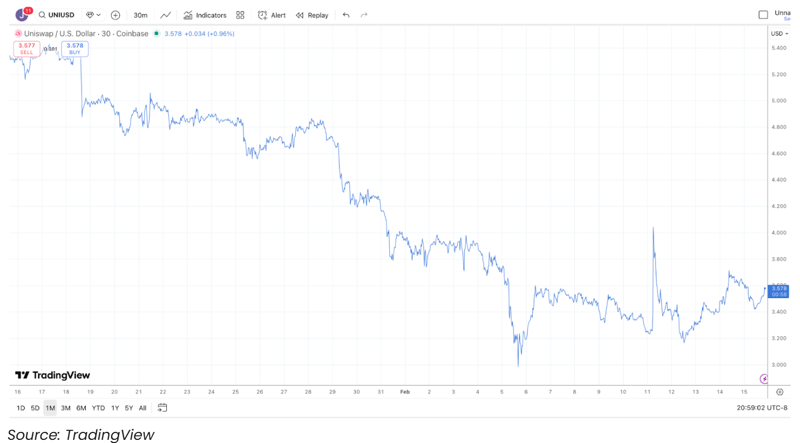
This is a meaningful validation of DeFi infrastructure. The world’s largest asset manager is comfortable using on-chain rails. But nothing about this changes UNI token’s value accrual mechanics, or usage on Ethereum or Unichain, or any other blockchain. There is no structural linkage between BUIDL AUM and UNI cash flow. No automatic revenue share. No buyback tied to this integration.
The headline validated the rails. The token still trades on reflexivity.
2. Morpho x Apollo Global Management
Apollo partnered with Morpho to bring institutional credit strategies on-chain and committed to purchasing MORPHO tokens.
Again, the signal is strong. Apollo is one of the largest alternative asset managers in the world with approximately $1 trillion in AUM, and institutional credit migrating on-chain is the RWA thesis in motion.
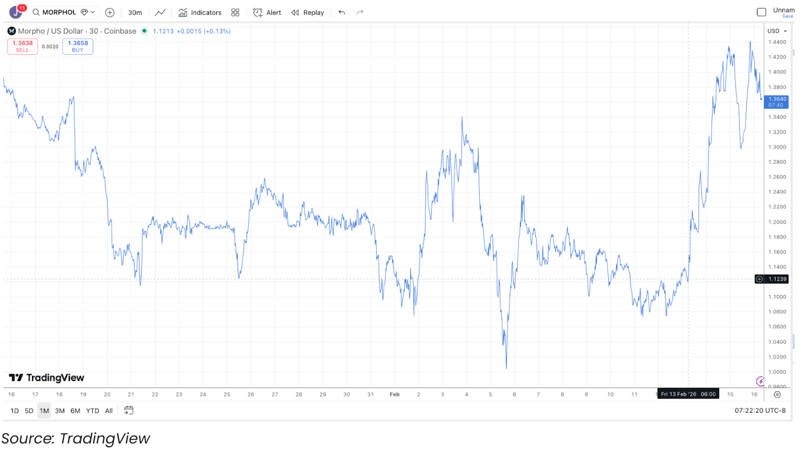
Morpho rallied and is currently near weekly highs, though I’d imagine this, too, will reset given how vague the token buying language is. Under the Agreement, Apollo or its affiliates may acquire MORPHO tokens through a combination of open-market purchases, OTC transactions, and other contractual arrangements, subject to an overall ownership cap of 90 million MORPHO tokens over a 48-month period, as well as transfer and trading restrictions.
This playbook isn’t new for Apollo.
Years ago, Apollo “partnered” with Figure’s Provenance blockchain and acquired some of its token, HASH. The press release was similarly flashy, making it seem like Apollo was purchasing HASH, yet there was no evidence of meaningful HASH token purchases tied to usage, nor was there sustained evidence that Apollo was meaningfully using the Provenance chain in a way that accrued to token holders. In fact, years later, I believe Apollo did not end up launching anything with Figure on Provenance.
Partnership headlines are easy. Token accrual is harder.
Morpho is a lending protocol with a governance token. The protocol’s growth does not automatically translate into token cash flow in the way equity would. A strategic purchase by a partner is a catalyst, not a structural value driver.
Institutional capital touching DeFi infrastructure is bullish for the ecosystem. It is not, by default, bullish for the token unless economics are explicitly designed that way. We continue to see adoption happening at the application and infrastructure layer while token design remains governance-heavy and economically thin.
3. LayerZero Labs Launches “Zero”
LayerZero unveiled plans for its own layer-one chain, “Zero,” with reported launch partners including ARK Invest, Citadel, and the DTCC.
Zero is positioned as a high-throughput, TradFi-oriented chain. It separates block producers (who do the expensive computation and ZK proving) from validators (who verify proofs). It introduces “Atomicity Zones” that execute asynchronously while inheriting shared security from a lightweight settlement layer.
Technically, it’s an interesting design. Separating production from verification is a valid scaling approach. But it’s also a different philosophical tradeoff than Ethereum’s model, which constrains throughput to preserve broad participation in verification. Zero’s model is likely to lead to fewer, more sophisticated block producers. Validation may be widely distributed; production will be specialized. That asymmetry matters.
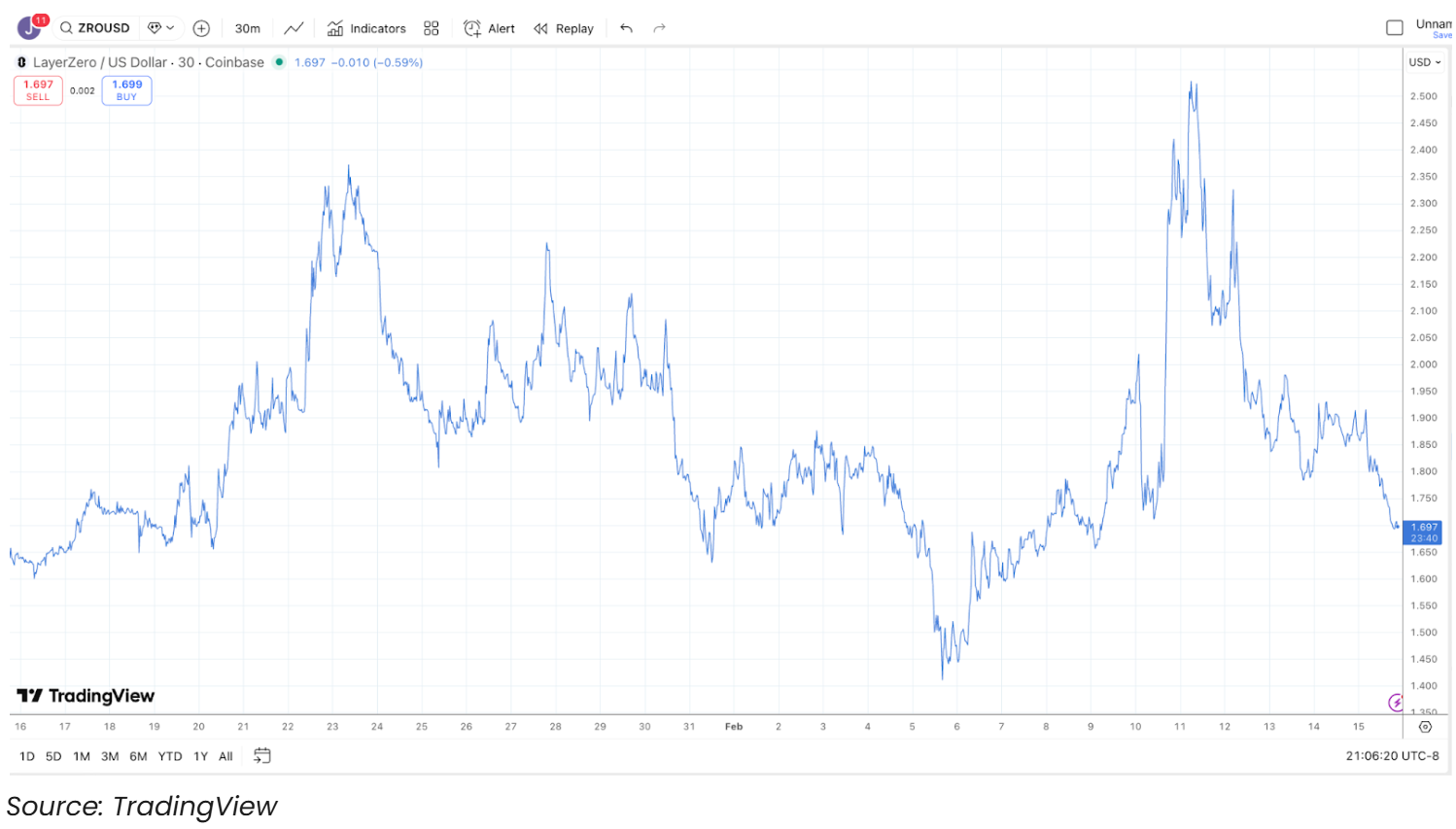
Naturally, the ZRO token pumped on the announcement, and then retraced. Again, infrastructure innovation does not automatically translate into durable token value capture.
All three of these developments are bullish for blockchain advancement:
Stablecoins, DeFi, and RWA tokenization continue to grow, and there seems to be little debate about this. The rails are maturing, and institutional comfort is increasing.
But the economic perimeter remains tight.
TradFi is experimenting with blockchain while preserving regulatory control, access control, and economic control. Many integrations are occurring inside whitelisted systems, RFQ modules, and governance processes that do not automatically distribute value to token holders.
This is why, during a selloff, the tokens that held up best were those with real cash flow generative properties, and buybacks, not just those that are drawing up new partnerships. When narrative fades, structure matters. That said, it’s still marginally positive to see all of these announcements, partnerships, and advancements. But until the economics are explicit and enforceable at the token layer, headlines and partnerships will only continue to produce pumps and retraces.
Coinbase (COIN): Strong Balance Sheet, Structural Headwinds
Coinbase reported 4Q2025 results that were, once again, a mixed bag.
Full-year 2025 revenue came in at $7.2 billion, with $1.8 billion in 4Q revenue, down 5% QoQ. Operating expenses were $1.5 billion for the quarter, up 9% sequentially. Technology & development plus SG&A totaled $1.3 billion. Net loss was $667 million, though adjusted net income was $178 million and adjusted EBITDA was $566 million. Most of the loss was due to markdowns on their crypto holdings.
The balance sheet remains strong, with $11.3 billion in cash and cash equivalents. Coinbase has also been active on capital returns, repurchasing 8.2 million shares since November 2025, reducing share count by 8% QoQ, and authorizing an additional $2 billion in January for further share and long-term debt repurchases.
Despite the headline net loss and ongoing expense growth, the stock rallied sharply on Friday following earnings. The move appeared driven less by fundamentals and more by positioning, as short interest had built meaningfully into the earnings release, and the combination of strong liquidity, buyback authorization, and absence of a catastrophic miss triggered visible short covering.
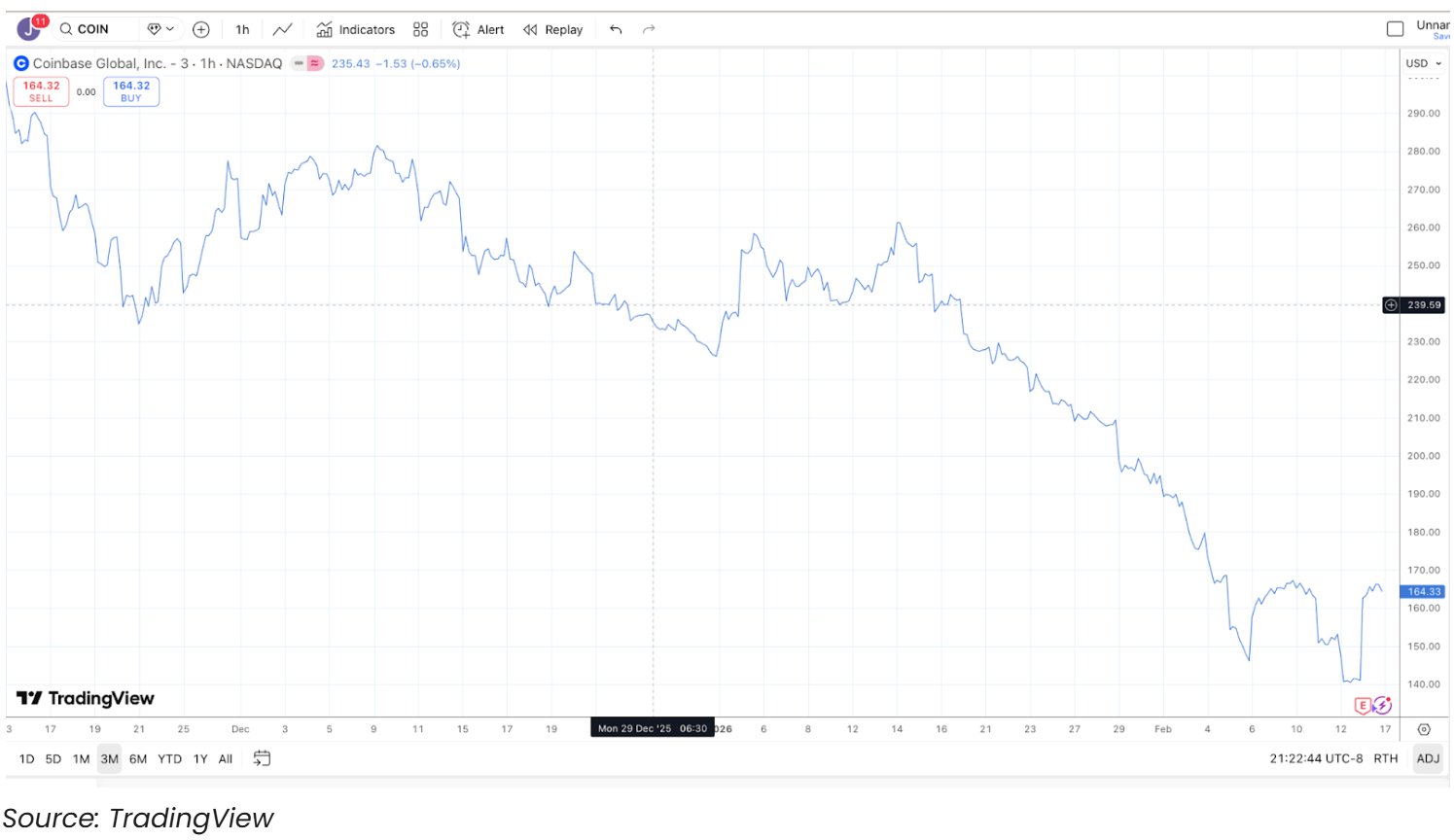
Subscription and services revenue continues to matter enormously, particularly stablecoin-related income. Stablecoin revenue accounts for roughly 50% of subscription and services revenue, and Coinbase receives approximately $1 billion annually from Circle related to USDC distribution economics.
That number is the elephant in the room and might be one of the biggest reasons why digital asset prices and Coinbase stock have been down only over the last few months.
Coinbase continues to play a central role in Washington regarding the CLARITY Act. The company has been vocal in shaping how digital asset market structure legislation evolves. Critics, including Treasury Secretary Scott Bessent, have publicly called out Coinbase for effectively blocking progress around the bill. The underlying issue is straightforward - if the CLARITY Act passes in a form that restricts the ability to pass through interest income from stablecoins like USDC to end users, Coinbase’s ~$1 billion annual revenue share from Circle becomes vulnerable.
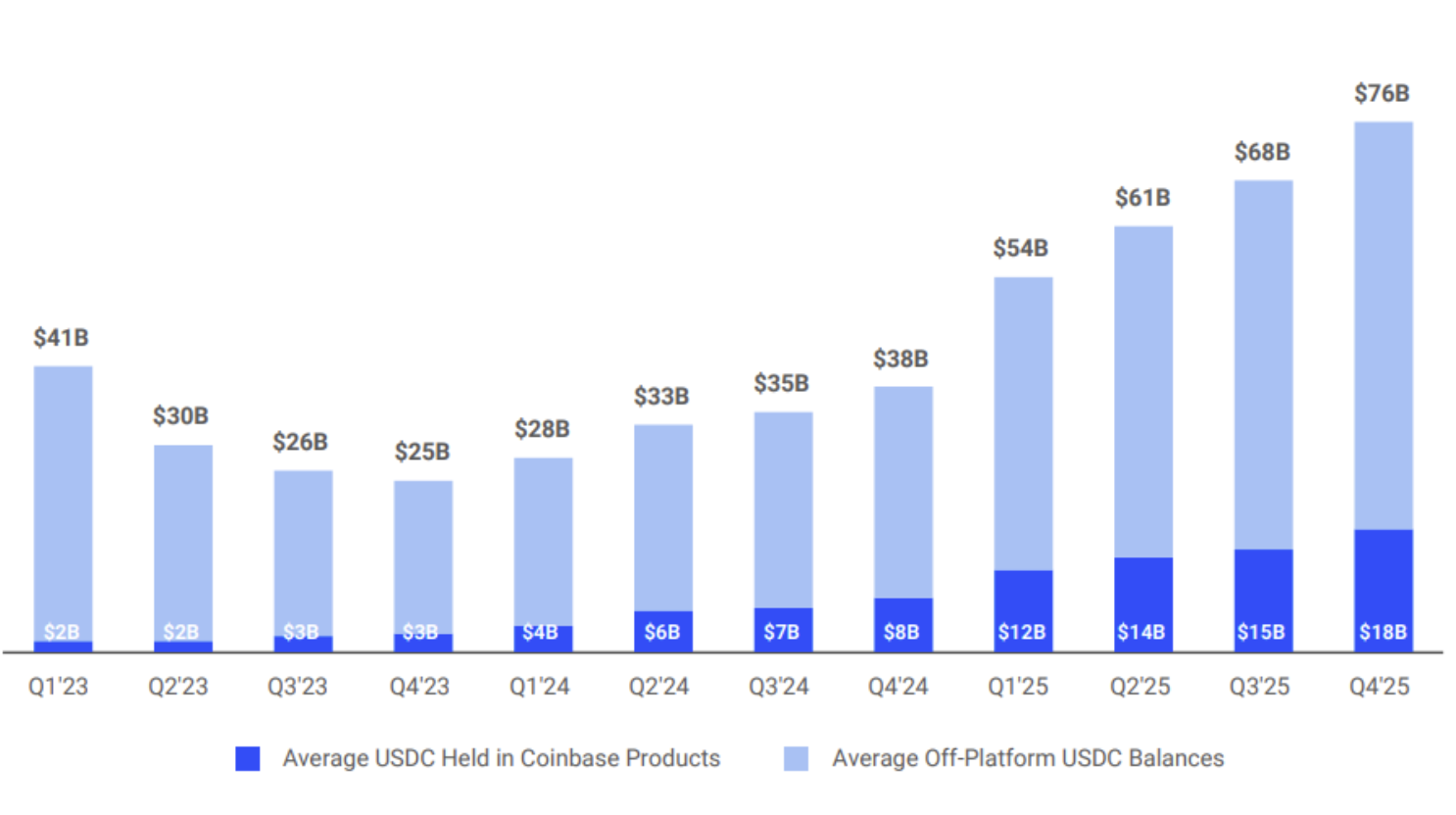
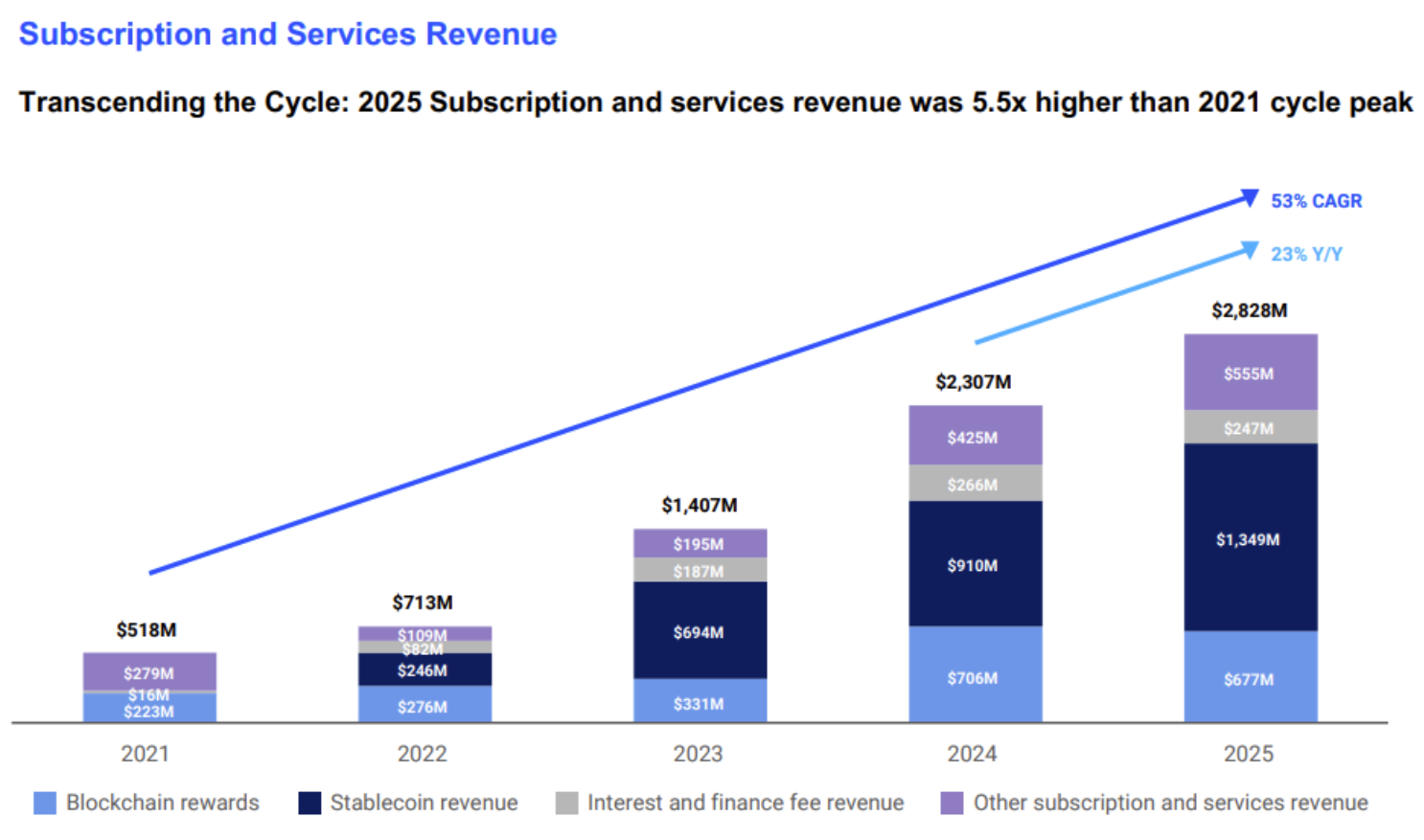
If Coinbase can no longer share USDC yield with users, the competitive advantage of holding USDC on-platform diminishes. And if the distribution economics between Coinbase and Circle are restructured under new regulatory clarity, that high-margin revenue stream could shrink materially.
Coinbase understands this. That’s why stablecoin economics sit at the center of the policy debate.
Coinbase remains a well-capitalized, cyclical exchange business with significant operating leverage when retail returns. They have also done a great job of entering into new areas of the market to help diversify their revenue mix. But expense growth, competitive pressure, and policy uncertainty, particularly around stablecoin economics, will likely continue to weigh on the stock, and quite possibly the entire digital assets market.